USAID DEC
PU-AMI DRC – North Kivu and Katanga Provinces – Quarterly Report N°3 – Fiscal year 2015
Sign inUSAID DEC
PU-AMI DRC – North Kivu and Katanga Provinces – Quarterly Report N°3 – Fiscal year 2015
The agricultural development initiative in North Kivu and Katanga Provinces of the Democratic Republic of Congo began in 2015 with funding from USAID's Food Security Program.
2015 · 9 pages
Sign in to readA free account is required to download.
Abstract
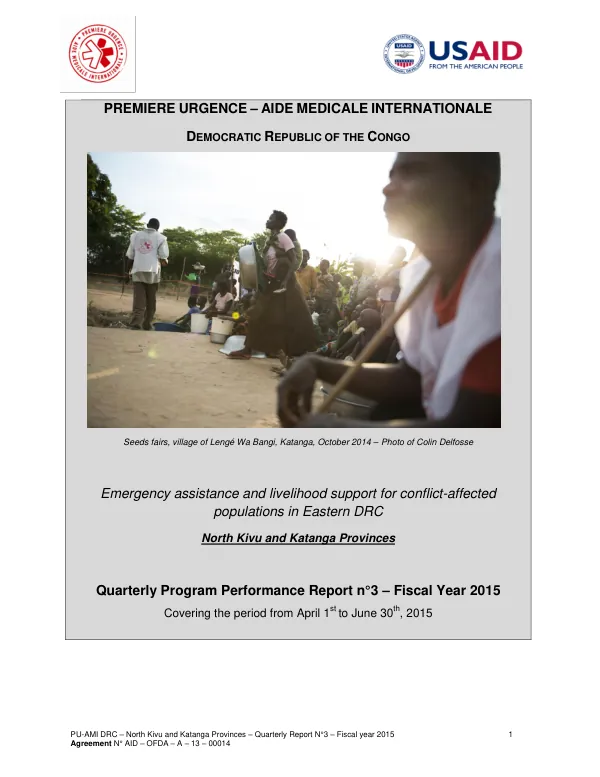
The program aimed to provide emergency relief to vulnerable populations, including internally displaced persons (IDPs), returnees, and host families, affected by continuous and recent armed conflicts. The geographic areas of focus included Katanga Province's Axis Mpiana-Kishale, Axis Mpiana-Monga, Axis Mpiana-Musovoy, Axis Kiambi-Musovoy, and Axis Kiambi-Kalamata, as well as North Kivu Province's Health Zones of Mweso, Katwe, and Pinga. The program's goal was to enable vulnerable populations to satisfy their urgent essential needs and help them restore their livelihoods. The program's objectives included contributing to the restoration of food security to vulnerable displaced, returnee, and host households through support to agricultural production. The program's activities focused on improving agricultural production and food security, enhancing livelihoods of the most vulnerable displaced, returnee, and host households through Cash For Work (CFW) activities, and providing emergency assistance and livelihood support for conflict-affected populations. The program's progress was monitored through various indicators, including the number of beneficiaries, IDP beneficiaries, and people benefiting from seed systems and agricultural inputs activities. The program also tracked the number of people employed through CFW activities, the average total USD amount per person earned through CFW activities, and the total USD amount channeled into the program area through sub-sector activities. In Katanga Province, 47.9 kilometers of market infrastructure were rehabilitated. The program's activities included preparatory measures for program implementation, such as recruitment and training of local staff, identification of crisis-affected areas, and program presentation to local authorities. The program also conducted a baseline survey to assess the food consumption score and household dietary diversity score of the target population. The survey revealed that 78% of households were extremely vulnerable, 19% were vulnerable, and 3% were acceptable according to the food consumption score, while 21% of households were extremely vulnerable, 48% were vulnerable, and 31% were acceptable according to the dietary diversity score. The program also supported agricultural inputs, including supply of tools, identification and selection of seed suppliers, fairs agreement and logistics planning, organization of fairs and distributions, and distributions of tools and fairs of seeds. The program also provided technical supervision of cultivation, including trainings of agricultural technics, evaluation of gardening seed sowing, and evaluation of crop seed sowing. The results of the data acquisition of surface and intercropping showed that 38% of beneficiaries already prepared land and planted cassava cuttings before the tools distribution, while 40.5% started agriculture this year, and 44% increased the surface planted compared to last year.