USAID DEC
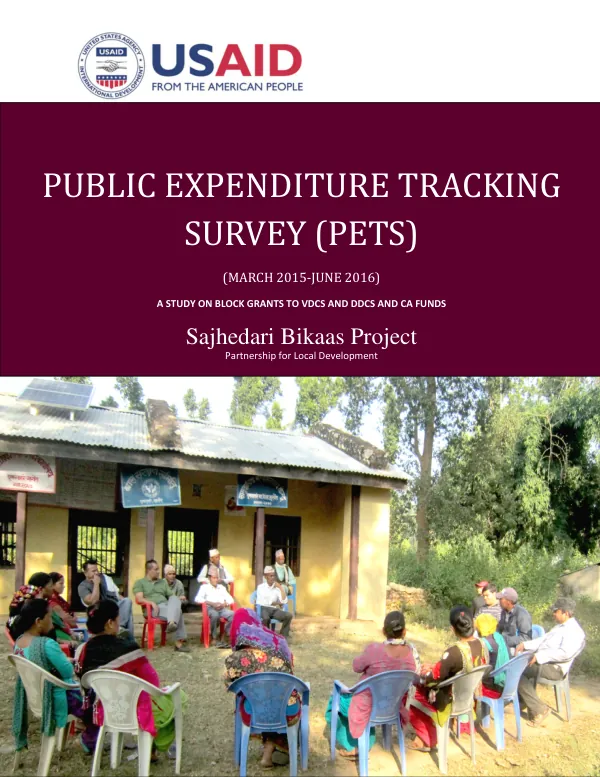
Public Expenditure Tracking Survey (PETS) (March 2015-June 2016): A Study on Block Grants to VDCs and DDCs and CA Funds in Sajhedari Bikaas Project Districts in Nepal’s Far West and Mid-West Regions
Sign inUSAID
Public Expenditure Tracking Survey (PETS) (March 2015-June 2016): A Study on Block Grants to VDCs and DDCs and CA Funds in Sajhedari Bikaas Project Districts in Nepal’s Far West and Mid-West Regions
The Public Expenditure Tracking Survey (PETS) was conducted in Nepal's Far West and Mid-West regions from March 2015 to June 2016.
2016 · 54 pages
Sign in to readA free account is required to download.
Abstract
The study focused on block grants to Village Development Committees (VDCs) and District Development Committees (DDCs) and Community Assistance (CA) funds in the Sajhedari Bikaas project districts. The research aimed to assess the flow of funds from the central to local level, track expenditures, and analyze the effectiveness of the block grants and CA funds. The study employed a mixed-methods approach, combining both quantitative and qualitative data collection and analysis methods. The research team conducted surveys, interviews, and focus group discussions with various stakeholders, including government officials, VDC members, and project beneficiaries. The study also collected data on project implementation, governance, and accountability. The PETS study revealed that the flow of funds from the central to local level was often delayed, with significant variations in the timing of fund transfers across districts. The study found that VDC block grants were allocated and released in a timely manner, but the actual expenditure was often lower than the allocated amount. In contrast, CA funds were often delayed in release and expenditure. The study also analyzed the effectiveness of the block grants and CA funds in improving the lives of project beneficiaries. The results showed that the block grants and CA funds had a positive impact on the lives of project beneficiaries, particularly in terms of improved access to basic services such as healthcare, education, and infrastructure. The study identified several challenges and issues related to the implementation of the block grants and CA funds. These included inadequate capacity building of VDCs and DDCs, lack of transparency and accountability in the use of funds, and inadequate monitoring and evaluation of project implementation. The PETS study made several recommendations to improve the effectiveness of the block grants and CA funds. These included strengthening the capacity building of VDCs and DDCs, improving transparency and accountability in the use of funds, and enhancing monitoring and evaluation of project implementation. The study also highlighted the importance of social inclusion in the local budget allocation and expenditure. The results showed that the block grants and CA funds had a positive impact on the lives of disadvantaged groups, including women and children. The PETS study was conducted by the Centre for International Studies and Cooperation (CECI) and Policy Research and Development (PRAD) for the Sajhedari Bikaas Project, with funding support from the United States Agency for International Development (USAID). The study was conducted in six sample districts in Nepal's Far West and Mid-West regions. The study's findings and recommendations have important implications for the design and implementation of public expenditure tracking systems in Nepal. The study highlights the need for strengthening the capacity building of VDCs and DDCs, improving transparency and accountability in the use of funds, and enhancing monitoring and evaluation of project implementation. The study also emphasizes the importance of social inclusion in the local budget allocation and expenditure. The study's results showed that the block grants and CA funds had a positive impact on the lives of project beneficiaries, particularly in terms of improved access to basic services such as healthcare, education, and infrastructure. The study also identified several challenges and issues related to the implementation of the block grants and CA funds, including inadequate capacity building of VDCs and DDCs, lack of transparency and accountability in the use of funds, and inadequate monitoring and evaluation of project implementation. The study's recommendations included strengthening the capacity building of VDCs and DDCs, improving transparency and accountability in the use of funds, and enhancing monitoring and evaluation of project implementation. The study also emphasized the importance of social inclusion in the local budget allocation and expenditure.