USAID DEC
Public Policy Training Course
Public policy is a crucial aspect of governance that involves the formulation and implementation of decisions by governments to address various issues and problems.
2016 · 23 pages
Sign in to readA free account is required to download.
Abstract
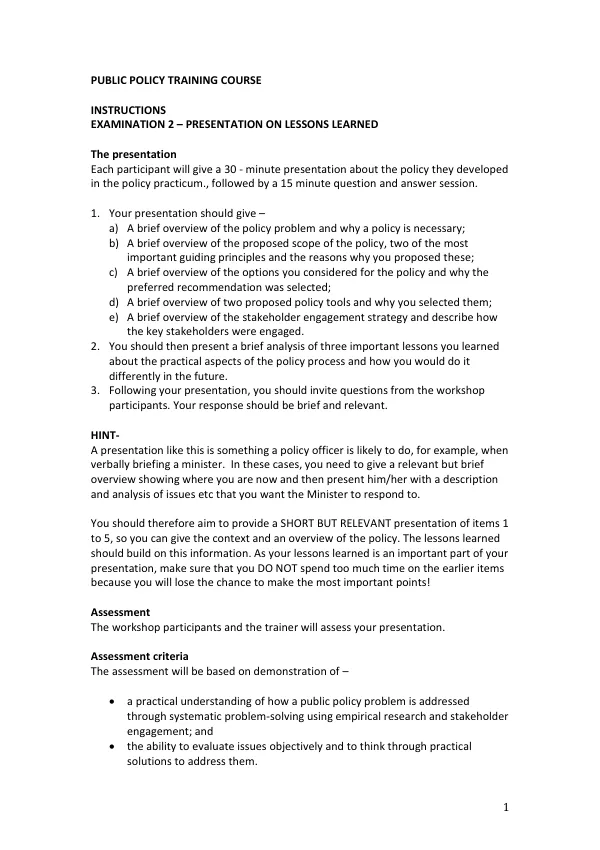
The primary goal of public policy is to improve the lives of citizens by addressing social, economic, and environmental challenges. Public policy is often developed through a systematic problem-solving process that involves empirical research, stakeholder engagement, and analysis of various options. The process typically begins with the identification of a policy problem, followed by the development of a policy proposal that outlines the scope, guiding principles, and recommended actions. Stakeholders, including individuals, organizations, and communities, play a crucial role in the policy development process, as their input and feedback help shape the policy proposal. The policy development process involves the consideration of various options and the selection of the most appropriate course of action. This may involve the use of policy tools, such as legislation, regulations, and programs, to achieve the desired outcomes. The effectiveness of public policy is often evaluated through regular review and assessment, which helps identify areas for improvement and informs future policy decisions. Public policy is not limited to the formulation of new laws, but also involves the review and revision of existing policies to ensure they remain relevant and effective. The policy development process is often iterative, with policymakers continually assessing and refining their approaches to address complex and evolving issues. In the context of public policy, stakeholders are individuals or organizations that have an interest in or are affected by the policy problem. Examples of stakeholders include businesses, non-governmental organizations (NGOs), farmers, and community groups. Effective stakeholder engagement is critical to the policy development process, as it helps ensure that the policy proposal is informed by diverse perspectives and addresses the needs and concerns of various stakeholders. Public policy is not a matter for individual ministries or ministers to decide, but rather a collaborative effort that involves multiple stakeholders and agencies. The policy development process is often guided by a set of principles and values that prioritize the well-being of citizens and the common good. The assessment of public policy is often based on its ability to address the policy problem, engage stakeholders, and achieve desired outcomes. The evaluation of public policy is an ongoing process that involves regular review and assessment to ensure that policies remain effective and relevant. In the context of public policy training, the assessment of knowledge and skills is critical to ensuring that participants have a solid understanding of the policy development process and the tools and techniques required to develop effective policies. The assessment of public policy knowledge and skills is often based on a set of criteria that evaluate the participant's ability to analyze policy problems, engage stakeholders, and develop effective policy proposals. The public policy pre-training assessment is designed to evaluate the knowledge and skills of participants before they commence the public policy training program. The assessment is based on a set of questions that evaluate the participant's understanding of public policy concepts, including the definition of public policy, the role of stakeholders, and the policy development process. The assessment results are used to adapt the training program to meet the needs of participants and to evaluate the success of the program once it is completed. The assessment is not penalized, and participants are encouraged to answer questions to the best of their ability. The assessment questions cover a range of topics, including the definition of public policy, the role of stakeholders, and the policy development process. The questions are designed to evaluate the participant's understanding of public policy concepts and their ability to apply this knowledge in practice. The assessment results are used to inform the training program and to evaluate the success of the program once it is completed. The assessment is an important tool for ensuring that participants have a solid understanding of public policy concepts and the skills required to develop effective policies. In conclusion, public policy is a critical aspect of governance that involves the formulation and implementation of decisions by governments to address various issues and problems. The policy development process is often iterative, with policymakers continually assessing and refining their approaches to address complex and evolving issues. Effective stakeholder engagement is critical to the policy development process, and the assessment of public policy is often based on its ability to address the policy problem, engage stakeholders, and achieve desired outcomes.