UNITED STATES DEPARTMENT OF STATE
Quadrennial Diplomacy and Development Review
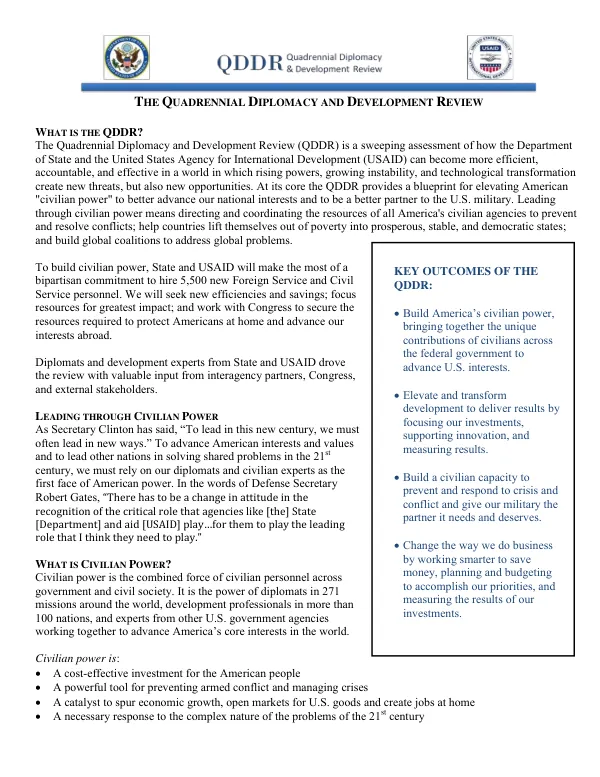
The Quadrennial Diplomacy and Development Review (QDDR) is a comprehensive assessment of the Department of State and the United States Agency for International Development (USAID) aimed at enhancing their efficiency, accountability, and effectiveness in a rapidly changing global environment.
2 pages
Sign in to readA free account is required to download.
Abstract
The review seeks to elevate American "civilian power" to better advance national interests and serve as a better partner to the U.S. military. Leading through civilian power involves directing and coordinating the resources of all U.S. civilian agencies to prevent and resolve conflicts, help countries lift themselves out of poverty, and build global coalitions to address global problems. To achieve this, State and USAID will make the most of a bipartisan commitment to hire 5,500 new Foreign Service and Civil Service personnel, seek new efficiencies and savings, and focus resources for greatest impact. The QDDR process was driven by diplomats and development experts from State and USAID, with valuable input from interagency partners, Congress, and external stakeholders. The review emphasizes the importance of relying on diplomats and civilian experts as the first face of American power in the 21st century. Civilian power is the combined force of civilian personnel across government and civil society, encompassing diplomats in 271 missions worldwide, development professionals in more than 100 nations, and experts from other U.S. government agencies working together to advance America's core interests. Civilian power is a cost-effective investment for the American people, a powerful tool for preventing armed conflict and managing crises, a catalyst for economic growth, and a necessary response to the complex nature of 21st-century problems. The QDDR calls for State and USAID to change the ways they do business in four broad areas. First, they will adapt to the diplomatic landscape of the 21st century by leading the implementation of global civilian operations overseas, reorganizing structurally to meet new challenges, engaging beyond the capital, and leveraging technological tools of 21st-century statecraft. Second, they will elevate and modernize development to deliver results by focusing investments where they have a comparative advantage, practicing high-impact development, and continuing to make USAID the world's premier development institution. Third, they will strengthen civilian capability to prevent and respond to crisis and conflict by recognizing that civilians are the first line of defense abroad, building conflict prevention and response capabilities, and integrating an effective capability to reform security and justice sectors in fragile states. Fourth, they will work smarter to deliver results for the American people by ensuring they have the expertise to meet the challenges of today and tomorrow, managing contracting and procurement effectively, and planning and budgeting for impact. The QDDR process is an ongoing commitment that began when Secretary Clinton took office and will continue through the launch of the next Review. The State Department and USAID have already begun to implement many of the reforms described in the Report, with some already complete and others to follow. The Deputy Secretary of State for Management and Resources and the USAID Administrator will oversee the implementation of the QDDR.
Related documents