USAID DEC
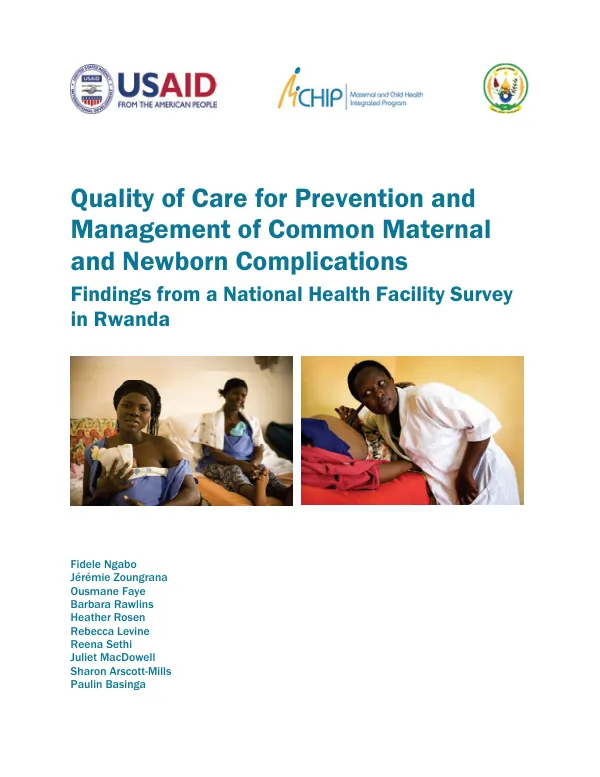
Quality of Care for Prevention and Management of Common Maternal and Newborn Complications in Rwanda
Sign inICF
Quality of Care for Prevention and Management of Common Maternal and Newborn Complications in Rwanda
The Maternal and Child Health Integrated Program (MCHIP) is the USAID Bureau for Global Health flagship maternal, neonatal and child health (MNCH) program.
2012 · 58 pages
Sign in to readA free account is required to download.
Abstract
MCHIP supports programming in maternal, newborn and child health, immunization, family planning, malaria, nutrition and HIV/AIDS, and strongly encourages opportunities for integration. Cross-cutting technical areas include water, sanitation, hygiene, urban health and health systems strengthening. The report was made possible by the generous support of the American people through the United States Agency for International Development (USAID), under the terms of the Leader with Associates Cooperative Agreement GHS-A-00-08-00002-000. The contents are the responsibility of the Maternal and Child Health Integrated Program (MCHIP) and do not necessarily reflect the views of USAID or the United States Government. A national health facility survey was conducted in Rwanda to assess the quality of care for prevention and management of common maternal and newborn complications. The survey aimed to evaluate the presence of national policies and guidelines, skilled personnel, essential medicines and supplies, and health worker knowledge of management of obstetric and newborn complications. The survey found that most health facilities in Rwanda have national policies and guidelines in place for maternal and newborn care. However, the availability of skilled personnel, essential medicines and supplies, and health worker knowledge of management of obstetric and newborn complications varied across facilities. For example, a significant proportion of health workers reported that they did not have the necessary knowledge to manage postpartum hemorrhage, birth asphyxia, and other complications. Routine antenatal and delivery care practices were also assessed in the survey. The results showed that focused antenatal care was provided in most facilities, but routine labor and delivery care practices varied. For instance, only about half of the facilities had a system in place for monitoring labor progress, and fewer than one-third of facilities had a system for monitoring fetal heart rate. The survey also evaluated the provision of emergency obstetric care signal functions, prevention and management of postpartum hemorrhage, and management of birth asphyxia. The results showed that the provision of emergency obstetric care signal functions was limited, and health workers reported that they did not have the necessary knowledge and skills to manage postpartum hemorrhage and birth asphyxia. The survey's findings have important implications for improving the quality of care for prevention and management of common maternal and newborn complications in Rwanda. The results suggest that there is a need for increased investment in health worker training, improved availability of essential medicines and supplies, and enhanced supervision and management of health facilities.