ABT ASSOCIATES
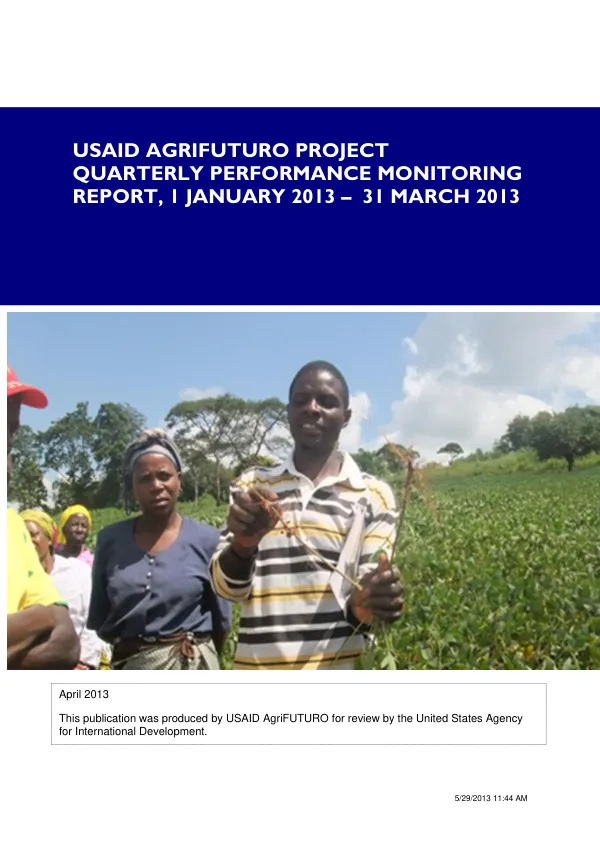
Quarterly Performance Monitoring Report, 1 January 2013 – 31 March 2013
The AgriFUTURO Project in Mozambique aimed to increase the competitiveness of the country's private agribusiness sector through the development of competitive agricultural value chains.
2013 · 40 pages
Sign in to readA free account is required to download.
Abstract
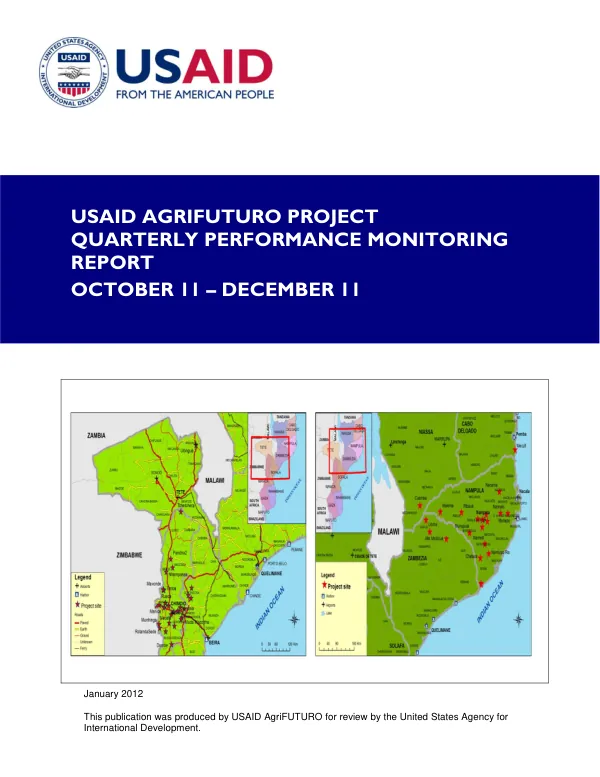
The project's objective was to improve the enabling environment for agribusiness, expand and strengthen agribusiness development services, build linkages to financing services for agribusiness development, and increase and strengthen public-private partnerships. The project focused on two geographic corridors: the Nacala Corridor and the Beira Corridor. The Nacala Corridor included 14 districts in Nampula Province and 8 districts in Zambezia Province, while the Beira Corridor included 6 districts in Manica Province and 1 district in Sofala Province. Between January and March 2013, the project achieved significant milestones. In the Beira Corridor, AgriFUTURO helped mobilize private investment of US$168,414, which was used to purchase agriculture inputs, equipment, and guarantee funds to the Banco de Oportunidade de Moçambique (BOM) Bank. The soybeans value chain accounted for US$162,925.47, which was 97% of the total investment in the corridor. In the Nacala Corridor, AgriFUTURO helped mobilize investment of US$2,790,000 through IKURU, which purchased cleaning and packaging equipment from Norway. This investment was a significant achievement for the project, demonstrating the potential for private sector investment in the agribusiness sector. The project also made progress in other areas, including the development of business plans, mobilization of finance, and assistance to potential investors. The project's value chain highlights for the second quarter of 2013 showed significant progress in the soybeans, groundnuts, sesame, and pulses value chains. The project's performance indicators for the first quarter of 2013 showed that private investment mobilized was 97% of the target in the Beira Corridor and 100% of the target in the Nacala Corridor. The project also made progress in other areas, including the development of business plans, mobilization of finance, and assistance to potential investors. The project's major implementation issues and lessons learned highlighted the importance of effective communication and coordination among stakeholders, as well as the need for more effective monitoring and evaluation systems. The project's administrative update provided information on the project's budget, personnel, and other administrative matters. The project's geographic focus was on the Nacala Corridor and the Beira Corridor, with a total of 22 districts in Nampula Province, Zambezia Province, Manica Province, and Sofala Province. The project's funding was provided by the United States Agency for International Development (USAID) and totaled US$24,291,291.820 with an extension of 11 months.