USAID DEC
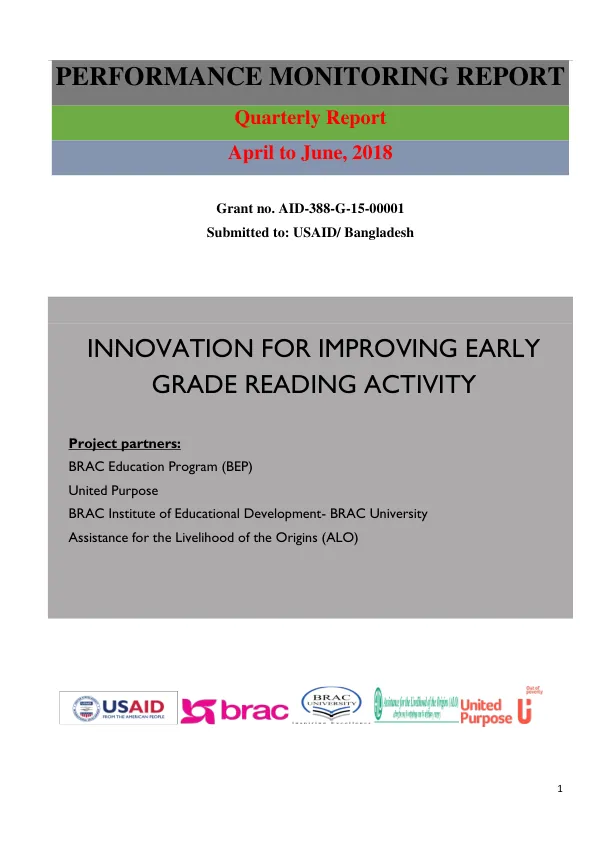
Performance Monitoring Report: Innovation for Improving Early Grade Reading Activity
Sign inUSAID
Performance Monitoring Report: Innovation for Improving Early Grade Reading Activity
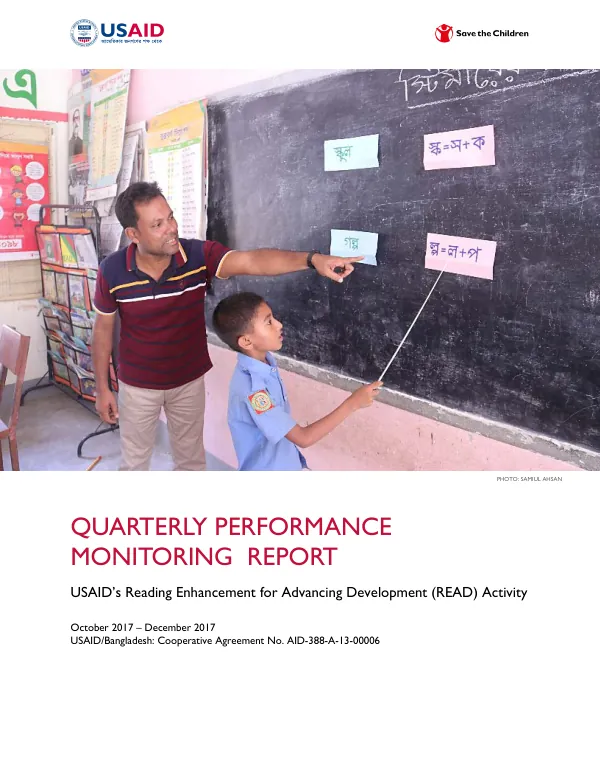
Innovation for Improving Early Grade Reading Activity (IIEGRA) is a project designed to enhance Bengali reading skills for students in grade I-III in Government Primary Schools of Bangladesh.
2018 · 20 pages
Sign in to readA free account is required to download.
Abstract
The project aims to improve the mother tongue early grade reading skills of Bangladeshi students living in low-performing areas. Initially, the project started its journey for three years from June 2015 to May 2018 with United States Agency for International Development (USAID)'s financial and technical support. It started activities in 245 Government Primary Schools of seven Upazilas in Cox's Bazar and Khagrachari district. The project has been modified to expand activities in 17 districts, and the project duration has been extended up to December 2018. As an expansion of the project, 1000 BRAC Primary Schools (BPS) and the same number of Community Development Centers (CDC) have been opened on January 2017. The goal of BPS is to ensure quality primary education for less privileged children of urban areas, while 1000 CDCs aim to develop life skill knowledge of different age groups of people. 200 Government Primary Schools have been newly included with this expansion of IIEGRA for enhancing reading skills of early grade students in 2018. The total coverage of Government Primary Schools is 445, including 245 GPS in Khagrachari and Cox's Bazar and 200 from 13 districts of urban areas. The project has a result framework that outlines its objectives and intermediate results. The objective of the project is to create access and improve early grade (I-III) reading skills of students living in selected areas through building the capacity of teachers and School Management Committees (SMCs). The project has three intermediate results: Improved reading instruction, Increased community engagement for early grade reading, and Provided quality primary education to the children of selected urban areas. The project is implemented by BRAC, with the support of three other partners: BRAC Institute of Educational Development – BRAC University (BIED-BRACU), United Purpose (UP), and Assistance for the Livelihood of the Origins (ALO). USAID provides financial and technical support to the project. The project has achieved several key milestones, including providing basic training to 400 teachers of selected 200 Government Primary Schools to improve Bangla reading skills. The project has also conducted ToT, teachers' training, and refresher training, and has developed supplementary reading materials and Teachers' Guides. The project has a strong partnership management system, with BRAC as the leading organization managing most of the project activities. The organization is accountable to USAID on issues of budget and cost of the project. USAID's Education Team Leader Kate Melony visited IIEGRA-supported BRAC Primary School in Badda, Dhaka on 12th March 2018. The project has also formed a Reading Advisory Committee (RAC) to provide guidance and monitoring support to the program regularly to improve and maintain the quality of the project. The project has achieved several key results, including enhancing teacher's capacity for reading instruction, increasing community engagement for early grade reading, and providing quality primary education to the children of selected urban areas. The project has also increased access for out-of-school, dropped-out, or never-enrolled children and improved life skill-based learning focusing on values education, climate change, and contemporary issues.