USAID DEC
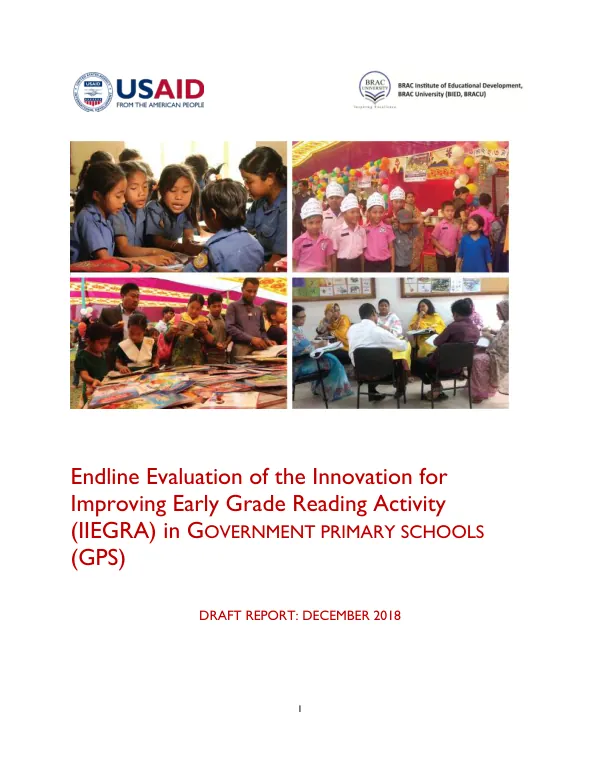
Endline Evaluation of the Innovation for Improving Early Grade Reading Activity (IIEGRA) in Government Primary Schools (GPS)
Sign inUSAID DEC
Endline Evaluation of the Innovation for Improving Early Grade Reading Activity (IIEGRA) in Government Primary Schools (GPS)
The Innovation for Improving Early Grade Reading Activity (IIEGRA) was implemented in Government Primary Schools (GPS) in Bangladesh.
2018 · 53 pages
Sign in to readA free account is required to download.
Abstract
The initiative aimed to improve early grade reading skills among students. The program was launched in 2015 and was funded by the World Bank. The research methodology involved a baseline study, followed by an endline evaluation in 2018. The baseline study was conducted in 2015 to assess the reading skills of students in grades I, II, and III. The study used the Early Grade Reading Assessment (EGRA) tool to evaluate students' reading skills. The EGRA tool assessed various reading skills, including emerging literacy skills, similar beginning sounds, rhyming words, sound matching with pictures, listening comprehension, decoding, letter knowledge, pseudo words, antonyms, and reading comprehension. The endline evaluation was conducted in 2018 to assess the impact of the IIEGRA program on students' reading skills. The evaluation used the same EGRA tool as the baseline study. The results showed significant improvements in students' reading skills, particularly in fluency, accuracy, and reading comprehension. The evaluation also found that students who completed grades I, II, and III showed higher levels of reading proficiency compared to those who did not complete these grades. The evaluation results also showed that students from urban areas performed better in reading skills compared to those from rural areas. Additionally, students from schools with higher levels of resources and infrastructure performed better in reading skills compared to those from schools with lower levels of resources and infrastructure. The evaluation also found that students who borrowed books from their schools performed better in reading skills compared to those who did not borrow books. The IIEGRA program was implemented in 1,200 GPS in Bangladesh, covering over 100,000 students. The program was designed to improve reading skills among students in grades I, II, and III. The program consisted of various components, including teacher training, instructional materials, and community engagement. The program was implemented over a period of three years, from 2015 to 2018. The evaluation results showed that the IIEGRA program was effective in improving reading skills among students in grades I, II, and III. The program's impact was significant, particularly in fluency, accuracy, and reading comprehension. The evaluation results also showed that the program's impact was sustained over time, with students showing higher levels of reading proficiency at the endline evaluation compared to the baseline study.