USAID DEC
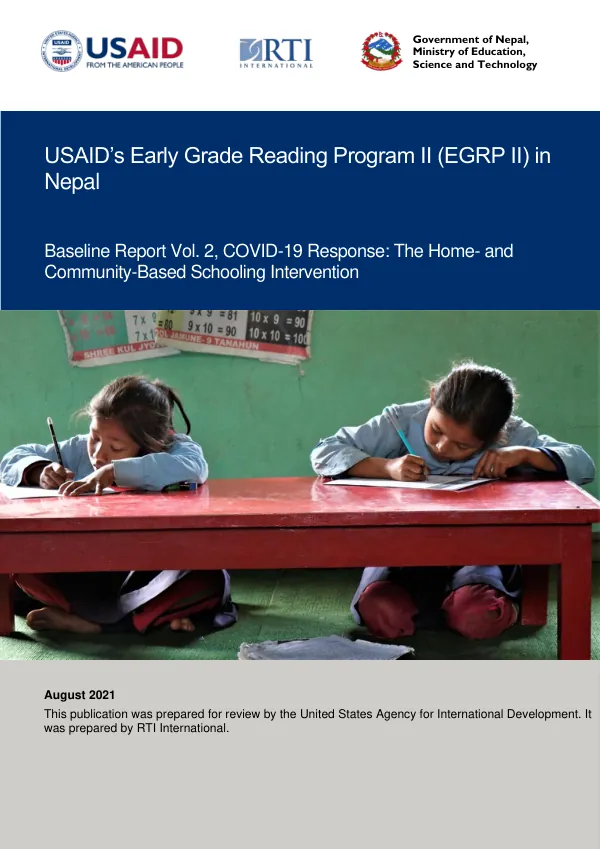
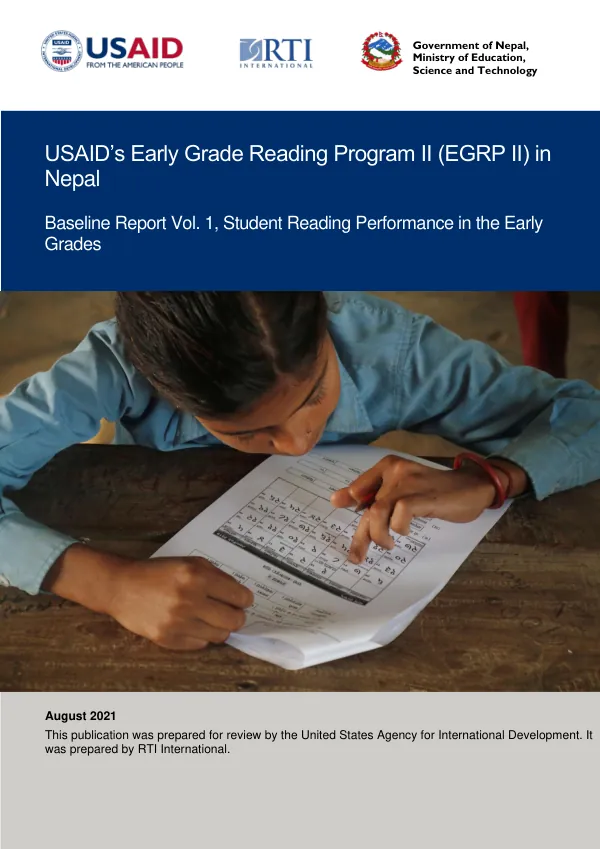
USAID’s Early Grade Reading Program II (EGRP II) in Nepal: Baseline Report Vol. 1, Student Reading Performance in the Early Grades
Sign inRTI INTERNATIONAL
USAID’s Early Grade Reading Program II (EGRP II) in Nepal: Baseline Report Vol. 1, Student Reading Performance in the Early Grades
The Early Grade Reading Program II (EGRP II) in Nepal is a USAID-funded initiative aimed at improving reading performance in early grades.
2021 · 65 pages
Sign in to readA free account is required to download.
Abstract
The program began in 2020, with a focus on enhancing reading skills among students in grades 2 and 3. The baseline report, released in August 2021, provides an overview of the program's objectives, methodology, and initial findings. The study design involved a sample of 1,500 students in grades 2 and 3, selected from 30 schools across Nepal. The sample size was determined to achieve a desired level of precision, as shown in Figure 1. The study instruments included the Early Grade Reading Assessment (EGRA) and the Computer-Based Early Grade Reading Assessment (CB-EGRA), which were administered to students in both grades. The EGRA assessment tool consisted of several subtasks, including letter/matra identification, word and sentence identification, vocabulary, dictation, listening comprehension, and reading comprehension. The CB-EGRA assessment tool was used to collect data on reading performance, with average item scores reported for each subtask. For example, Table 2 describes the grade 2 CB-EGRA assessment tool, while Table 3 describes the grade 3 CB-EGRA assessment tool. The baseline report presents findings on reading achievement in grades 2 and 3. In grade 2, the average item scores for the letter/matra identification subtask were 4.3, while the average item scores for the word and sentence identification subtask were 5.1. The average item scores for the vocabulary subtask were 4.5, and the average item scores for the dictation subtask were 3.8. The average item scores for the listening comprehension subtask (25 words) were 4.2, and the average item scores for the reading comprehension subtask (60 words) were 3.9. The report also presents findings on reading achievement by subtask and sex, as well as by subtask and language. For example, Table 11 presents the average percentage scores of grade 2 students, by subtask and sex, while Table 12 presents the average percentage scores of grade 2 students, by language. The baseline report also explores the relationship between EGRA and CB-EGRA data, using a model to predict overall reading achievement and reading comprehension. The model was used to extrapolate reading achievement, with equivalent scoring reported for emergent and fluent benchmarks. For example, Table 22 presents equivalent CB-EGRA scores for emergent and fluent benchmarks (in cwpm), while Table 23 presents the percentage of learners who met the reading benchmark (45 words and 80% comprehension), by grade. Overall, the baseline report provides a comprehensive overview of the EGRP II program's objectives, methodology, and initial findings. The report highlights the importance of improving reading skills among students in early grades and provides a foundation for future program evaluations and assessments.
Related documents