FAMILY HEALTH INTERNATIONAL
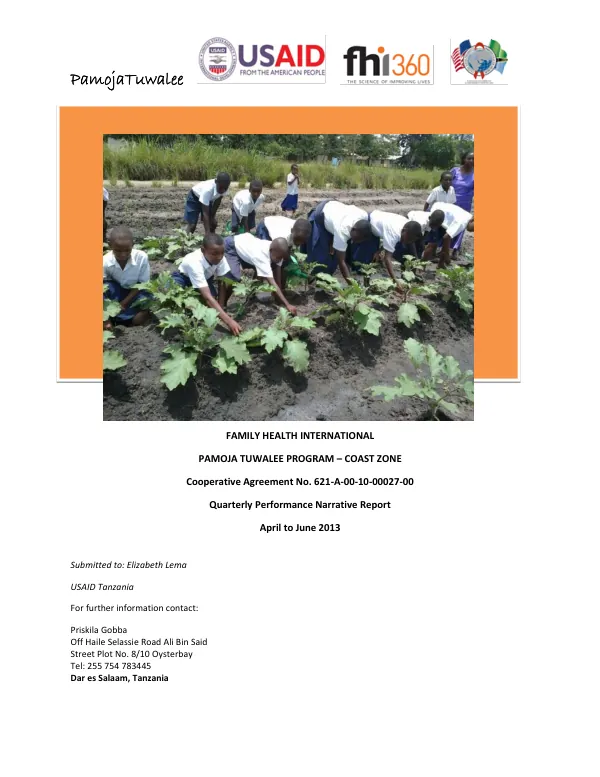
Quarterly Performance Narrative Report: Pamoja Tuwalee Program – Coast Zone
The Pamoja Tuwalee program is a five-year initiative implemented by four partners in five zones of Tanzania, including the Coast zone, which is covered by FHI 360.
2013 · 52 pages
Sign in to readA free account is required to download.
Abstract
The program aims to improve the quality of life and well-being of Most Vulnerable Children (MVC) and their households by empowering households and communities to provide comprehensive and sustainable care, support, and protection. The program is funded by the President's Emergency Plan for AIDS Relief (PEPFAR) through the United States Agency for International Development (USAID). The goal of the program is to cover all 26 districts in the Coast zone, but due to the involvement of PASADA in Dar es Salaam, the program currently covers 25 districts, including two in Dar es Salaam, six in Morogoro, seven in Coast, and ten in Zanzibar. The Coast zone has a population of approximately 8,985,270, with Dar es Salaam having the highest number of people, followed by Morogoro and Zanzibar islands. The program has made significant progress in mobilizing government stakeholders, community members, and the private sector to support MVC and their caretakers. During the reporting period, a total of TZS 25,199,600 (US $ 15,750) were mobilized from non-program sources, bringing the cumulative total to TZS 33,906,100 (US $ 21,192). The program has also made notable improvements in income generation in MVC households, with about 614 MVC supported by their caregivers with school and basic material support. Additionally, the program has established 22 new Savings and Internal Lending Communities (SILC) groups, composed of 532 community members, which generated total savings of TZS 28,738,900 (US $ 17,962) and contributed TZS 2,232,250 (US $ 1,395) towards the establishment of MVC funds. The program has also provided core services to 39,136 MVC, representing 63% of the annual target, and has supported 100 out of 121 new Gender-Based Violence (GBV) and Violence Against Children (VAC) cases through initial counseling, referral to healthcare, and legal aid. Furthermore, the program has established 373 children clubs, benefiting 11,812 children, and has provided psychosocial support to MVC. The program continues to succeed in its objectives, with notable improvements in income generation, core services provided to MVC, and support for GBV and VAC cases. The program's efforts to empower households and communities to provide comprehensive and sustainable care, support, and protection to MVC are yielding positive results, and the program is expected to continue making significant progress in the coming quarters.
Related documents