FAMILY HEALTH INTERNATIONAL
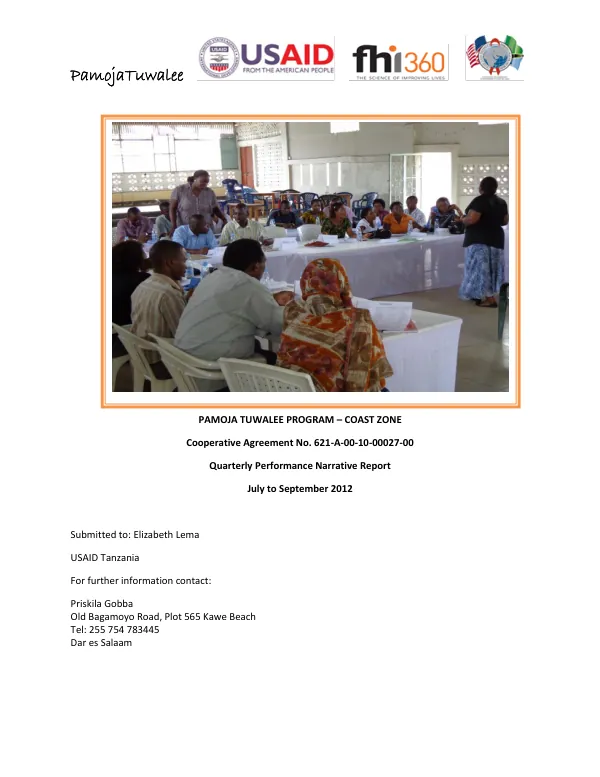
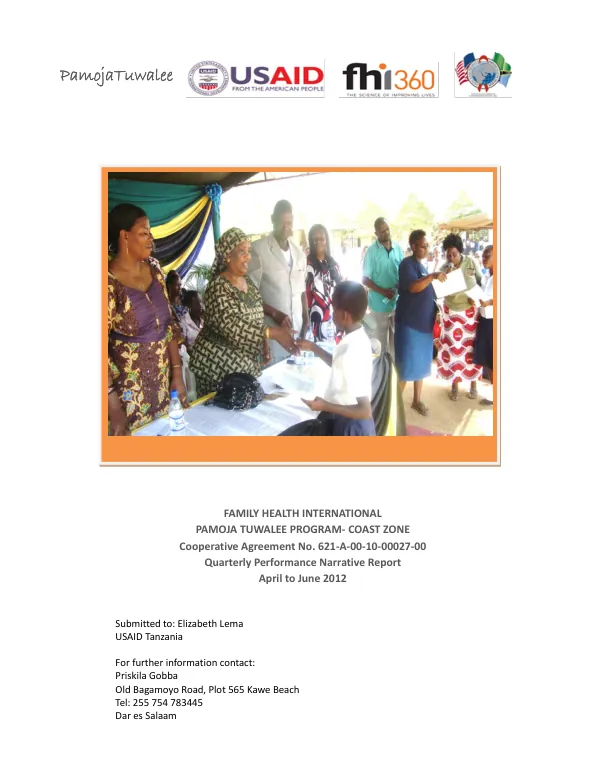
Quarterly Performance Narrative Report: Pamoja Tuwalee Program - Coast Zone
The Pamoja Tuwalee program is a five-year initiative implemented by FHI360 in the Coast zone of Tanzania, covering the regions of Dar es Salaam, Morogoro, and Coast in the mainland, as well as Unguja and Pemba in Zanzibar.
2012 · 72 pages
Sign in to readA free account is required to download.
Abstract
The program is funded by the President's Emergency Plan for AIDS Relief (PEPFAR) through the United States Agency for International Development (USAID). The program's broad goal is to improve the quality of life and well-being of Most Vulnerable Children (MVC) and their households by empowering households and communities to provide comprehensive and sustainable care, support, and protection. In the third quarter of FY2 (2011/2012), the program continued to enhance the capacity of Local Government Authorities (LGAs) to care, support, and protect MVC in the Coast zone. This involved close follow-up to ensure that promises made for MVC support were embedded in the approved Medium Term Expenditure Framework (MTEF) of the Ministry of Prime Minister's Office, Regional Administration, and Local Government Authorities (PMORALG). As a result, all 10 LGAs that committed direct support to MVC confirmed most of the proposed allocations, including TZS 27,172,000 in Ulanga and Kilombero and TZS 30,000,000 to support MVC with education support. At the community level, 89 Self-Help Income Generating Activity (SILC) groups contributed a total of TZS 9,357,905 for MVC support. Additionally, commitments were made by individuals and institutions to support MVC, including free or subsidized training for seven MVC with vocational training in Dar es Salaam and 600kg of maize stored for MVC in need of food in Matema village in Kilombero. The program also conducted a major workshop to orient MVCC members on their roles and responsibilities using a national MVCC handbook developed with the Department of Social Welfare. A total of 70 MVC District facilitators participated in the workshop, consisting of 33 males and 37 females. The program's efforts to enhance the capacity of LGAs and communities to care for MVC are expected to lead to improved outcomes for MVC and their households in the Coast zone. The program's activities are focused on increasing the capacity of communities and local government to meet the needs of MVC and their households. This includes mobilizing support for MVC, strengthening local government authorities to implement the National Child Protection Action Plan (NCPA)/Zanzibar Child Protection Action Plan (ZCPA), and providing technical assistance to LGAs to manage the MVC Data Management System (DMS) and use data for planning and decision-making. The program also aims to increase the capacity of households to protect, care for, and meet the basic needs of MVC in a sustained way, including providing training and other support to increase savings and improve livelihoods for MVC households. The program's geographic focus is on the Coast zone of Tanzania, which includes the regions of Dar es Salaam, Morogoro, and Coast in the mainland, as well as Unguja and Pemba in Zanzibar. The program's timeframes are from June 2010 to May 2015, with the current quarter being the third quarter of FY2 (2011/2012). The program's recommendations include continued support for the capacity-building efforts of LGAs and communities, as well as the provision of technical assistance to LGAs to manage the MVC DMS and use data for planning and decision-making.
Related documents