USAID DEC
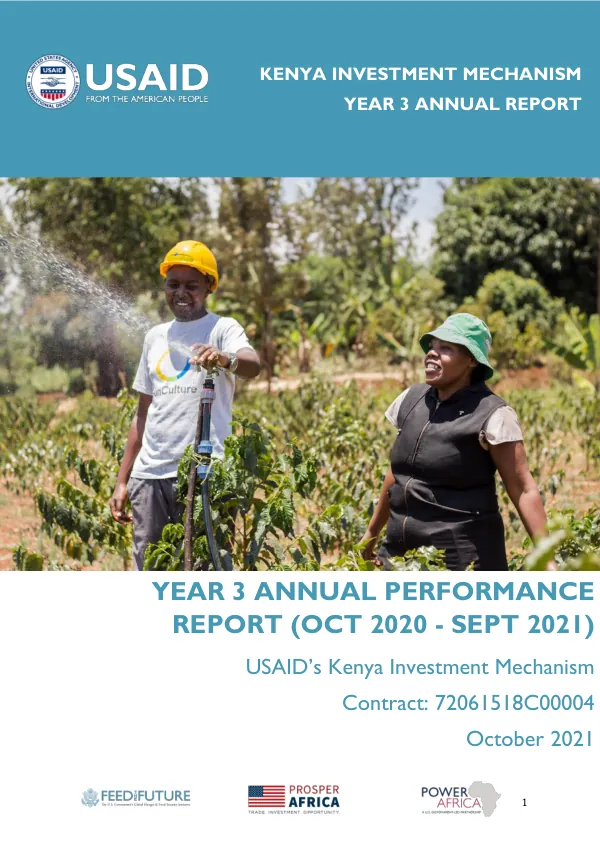
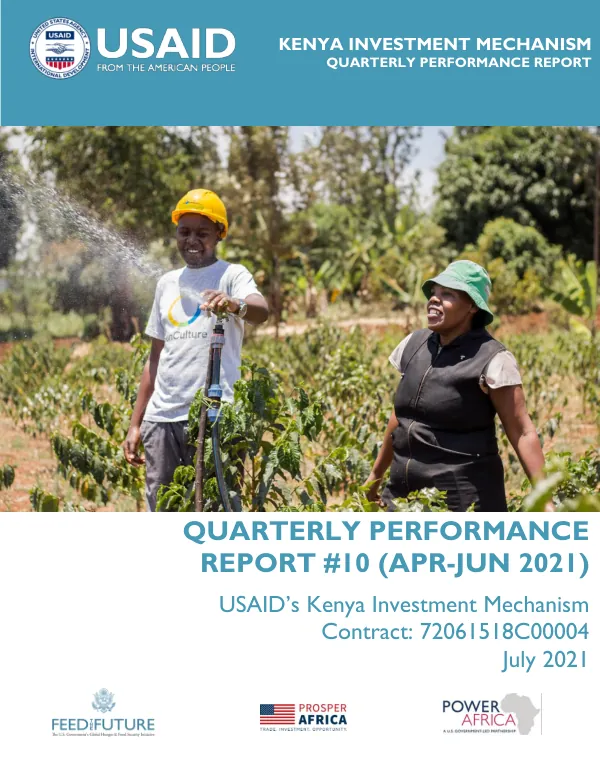
Quarterly Performance Report #10 (APR-JUN 2021) for USAID's Kenya Investment Mechanism
Sign inPALLADIUM INTERNATIONAL, LLC
Quarterly Performance Report #10 (APR-JUN 2021) for USAID's Kenya Investment Mechanism
USAID's Kenya Investment Mechanism (KIM) has achieved significant milestones across all project objectives and performance indicators.
2021 · 47 pages
Sign in to readA free account is required to download.
Abstract
As of the end of Quarter 3, KIM has either achieved or surpassed 15 of its 17 annual targets, representing an 88% achievement rate. The project has exceeded its annual capital mobilization target of $82 million, with actual capital mobilized this year totaling $106.6 million, a 130% achievement. KIM's network of business advisory service providers (BASPs) and financial institutions (FIs) mobilized $28.5 million in investments for enterprises in KIM's target value chains during this quarter. BASPs mobilized $1.7 million, while FIs disbursed $26.8 million. Although total capital mobilized this quarter is slightly less than the previous quarter, lending by FIs increased by 150.1% compared to the last quarter, despite the impact of the COVID-19 pandemic on the economy. The recent onboarding of three leading commercial banks—Equity Bank, KCB Bank, and Family Bank—significantly contributed to the increased flow of capital to enterprises in the targeted sectors. The three commercial banks have a wide reach and will contribute to enterprises' capacity to participate in regional and international trade of agricultural commodities. In the context of collaboration, learning, and adapting (CLA), KIM conducted a review of its partner FIs' lending to the agriculture sector. Based on the data shared by 15 FIs, the proportion of agriculture lending in relation to total lending increased from 3.6% in 2019 to 7.1% as of December 2020. Central Bank of Kenya data on overall lending to the agriculture sector shows a marginal increase of 7.8% between 2019 and 2020, indicating that the FIs in the KIM program performed better compared to the general market. The overall drop in total lending was largely due to uncertainties in the economy and financial market brought about by the COVID-19 pandemic. Despite these economic challenges, lending to the agriculture sector remained stable and recorded growth, attributed to the effectiveness of KIM's interventions to stimulate lending to the targeted sectors. On the policy front, the Central Bank of Kenya (CBK) approved the Credit Information Sharing (CIS) Code of Conduct this quarter. The CIS Code of Conduct, developed through a partnership between Credit Information Sharing Association of Kenya (CIS Kenya) and KIM, aims to improve the flow of credit to small and medium enterprises (SMEs) while enhancing diversity and widening participation in the financial system. The Code of Conduct seeks to strengthen the credit information sharing mechanism in Kenya to ensure the fair treatment and protection of borrowers, which is proving to be a powerful force for financial inclusion of underserved businesses. KIM's policy initiative and stakeholder engagement gave a boost to the aquaculture sector this quarter. In collaboration with key stakeholders, KIM facilitated the development of a comprehensive aquaculture sector strategy, which aims to increase the sector's contribution to Kenya's GDP. The strategy focuses on improving the sector's productivity, competitiveness, and sustainability, and is expected to create jobs and stimulate economic growth in the sector. The strategy also aims to address the sector's key challenges, including limited access to finance, inadequate infrastructure, and lack of technical expertise. KIM will continue to work with stakeholders to implement the strategy and provide support to the sector. The aquaculture sector is a critical component of Kenya's economy, and KIM's efforts are expected to have a positive impact on the sector's growth and development. KIM's achievements in the aquaculture sector are a testament to the project's ability to collaborate with stakeholders and drive positive change in the economy. The project's focus on stimulating lending to the agriculture sector and improving access to finance for SMEs has also had a positive impact on the sector's growth and development. Overall, KIM's performance in Quarter 3 has been impressive, and the project is on track to achieve its annual targets.