IOM
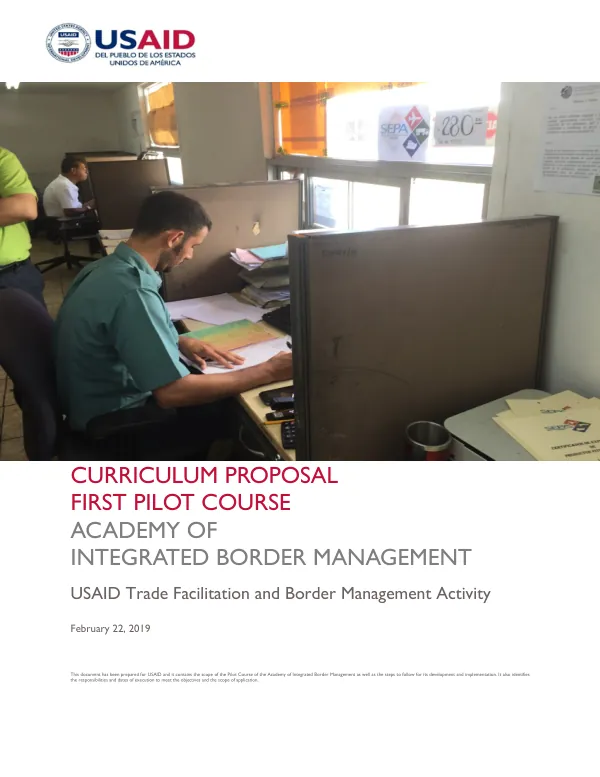
Second Pilot Course Report: Academy of Integrated Border Management
The Central America Regional Trade Facilitation and Border Management Project, financed by the United States Agency for International Development (USAID) and executed by Nathan Associates Inc., seeks to strengthen the trade capacity and competitiveness of countries in Central America.
2019 · 62 pages
Sign in to readA free account is required to download.
Abstract
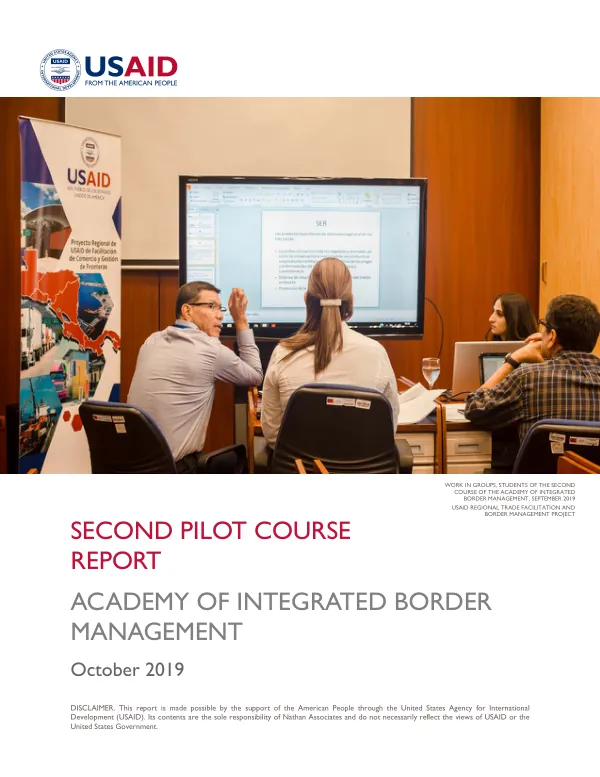
The project supports the implementation of key elements within the framework of the World Trade Organization (WTO) Trade Facilitation Agreement, the Deep Integration Process towards Free Transit of Goods and Natural Persons between the Republics of El Salvador, Guatemala, and Honduras, and the Central American Strategy for Trade Facilitation and Competitiveness. The project works at national and regional levels with key government institutions such as Ministries and Agencies of Customs, Taxes, Migration, Agriculture, and Economy of El Salvador, Guatemala, and Honduras, and with the Secretariat for Central American Economic Integration (SIECA). During the meeting of the Ministers and Vice-Ministers of the Northern Triangle held in Panama City on October 18, 2018, the USAID Manager and Project Manager presented the plan for Strategic Support to the Governments of the Northern Triangle for Economic Integration in the Customs Union. Central American countries face multiple obstacles and challenges to achieving trade facilitation. While these countries have identified many potential remedies, the Integrated Border Management Model is at the heart of these solutions. The Integrated Border Management Model stems from the Central American Strategy for Trade Facilitation and Competitiveness, approved by the governments of El Salvador, Guatemala, Honduras, and their other partners in the Council of Ministers of Economic Integration (COMIECO), through resolution No. 1-2015. The objective of the Integrated Border Management Model is to strengthen the technical capabilities of officials responsible for implementing procedures at border points, in accordance with the decisions taken at the highest level of regional and national institutions involved in trade. The governments agreed on building technical capacity through the Integrated Border Management Academy, in order to instruct officials in the Integrated Border Management Model. USAID's Trade Facilitation and Border Management Project is responsible for supporting SIECA in carrying out the pilot courses of the Academy. The second pilot course of the Integrated Border Management Academy was conducted from September 2 to 27, with a hybrid option combining traditional classroom instruction with e-learning. A group of 23 public officials representing the border control institutions of Costa Rica, El Salvador, Guatemala, and Honduras completed the course. The technical educational sessions covered topics relevant to border controls, with a double objective: to strengthen the institutions involved in border management through the creation of technical capacities in Integrated Border Management, and to increase the effects of the Integrated Border Management model by creating/strengthening interpersonal skills at the managerial level. The participants in the Academy's second pilot course achieved the following results: they identified overlaps and commonalities in terms of roles, objectives, functions, and implementation methods as well as barriers and opportunities for operational improvement of each border control institution. They exchanged the macro-level processes of release and border clearance goods, as well as best practices at the national level that each country maintains in effect. They deepened contributions to economic development through international trade and the needs of the private sector, as well as the state of its institutional capacity. The institutions that collaborated to support the academy's second pilot course included the Secretariat for Economic Integration (SIECA), INL (Office of Counter Narcotics and Law Enforcement), CBP (US Customs and Border Protection), APHIS USDA (Animal and Plant Health Inspection Service of the US Department of Agriculture), IMF (International Monetary Fund), IOM (International Organization for Migration), AMEXCID (Mexico's Agency for International Development Cooperation), SADER Mexico (Mexico's Secretary of Agriculture and Rural Development of Mexico), AGCID Chile (Chile's International Development Cooperation Agency), Aduanas Chile (Chilean Customs), and SAG Chile (Chile's Agriculture and Livestock Service). Business leaders and other private sector representatives also participated, serving as instructors sharing their experiences and contributions to trade and economic growth. The results of the second pilot course will allow for the improvement of the course to benefit future students of the academy, improving their knowledge and technical application of the Integrated Border Management model. The report contains a detailed description of the results, activities, participants, summary of the surveys, evaluations, synopsis of the practical cases, and technical recommendations.
Related documents