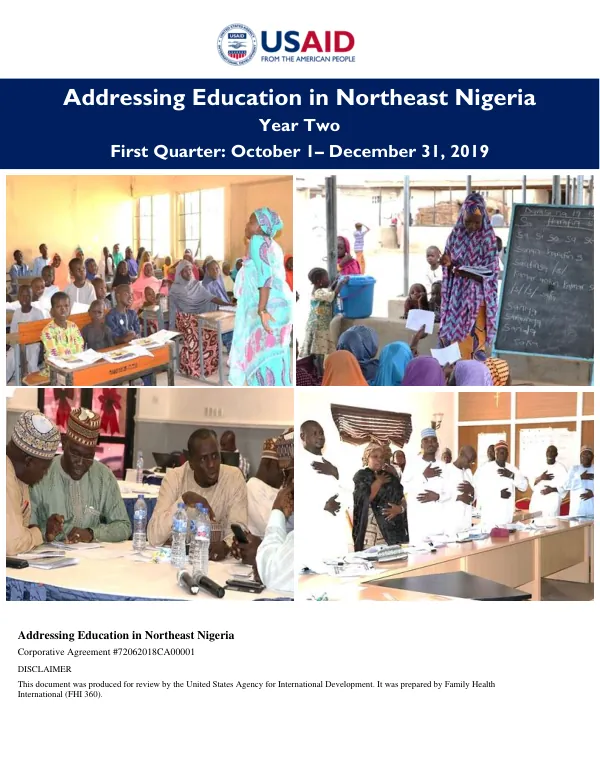
FAMILY HEALTH INTERNATIONAL
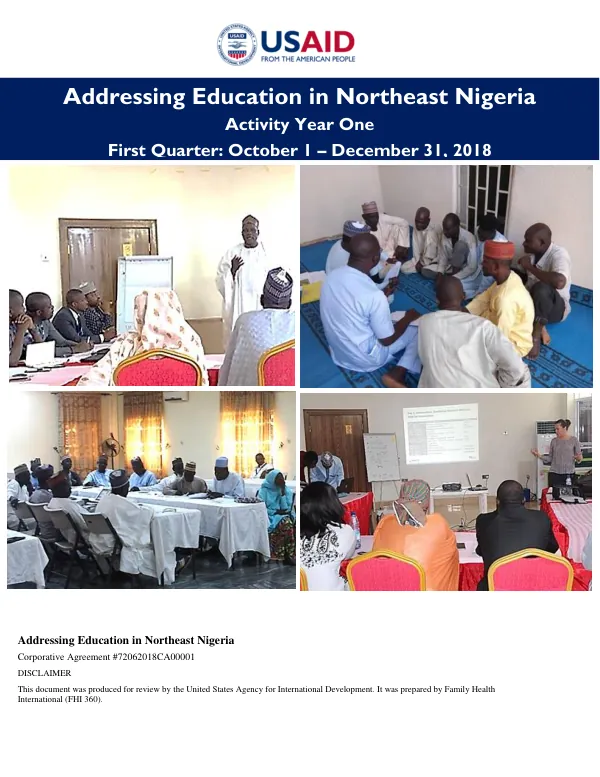
Addressing Education in Northeast Nigeria Activity Year One Quarter One Report
Addressing Education in Northeast Nigeria is a project implemented by Family Health International (FHI 360) under the Cooperative Agreement #72062018CA00001.
2019 · 40 pages
Sign in to readA free account is required to download.
Abstract
The project aims to respond to the immediate educational needs of 302,500 children and youth in Borno and Yobe states through safe non-formal and formal education. The project seeks to improve the capacity of education authorities to plan, manage, and oversee education services that are responsive to the evolving needs of the context. The project will work to provide safe and certified education opportunities by revitalizing or establishing non-formal learning centers and supporting formal schools. A minimum package of learning materials will be provided to improve upon existing curricula and emphasize age-appropriate foundational skills. NFLC instructors and formal school teachers will be trained in learner-centered pedagogy, positive discipline, social-emotional learning, and inclusion. AENN will increase community awareness and support of education opportunities in target locations through training partners in the community action cycle, creating or revitalizing community coalitions, conducting participatory community mapping, creating and implementing school action plans, and supporting education management, early warning systems, and monitoring. The project will ensure that children and adolescents in Northeast Nigeria will equitably access certified high-quality basic education opportunities, communities will benefit from increased skills and overall well-being, and the foundation will be laid for long-term peacebuilding in the region. During the first quarter of project implementation, the project made progress on several activities. The total number of new entrants in USG-supported primary schools or equivalent non-school-based settings was 0, but the annual target is 75,000. The number of learners in primary schools or equivalent non-school-based settings reached with USG education assistance was also 0, but the annual target is 75,000. The percentage of displaced learners enrolled in formal or non-formal schools supported by the program was 0, but the target is TBD. The project has established partnerships with various organizations, including Save the Children International, Viamo, State Ministries of Education, State Agencies for Mass Education, State Universal Basic Education Boards, Civil Society Organizations, Community Coalition, Education in Emergency Working Group, University of Maiduguri, Yobe State University, Kashim Shettima College of Education, and Umar Suleiman College of Education Gashua, Yobe State. The project will continue to work with these partners to achieve its objectives. The project has also made progress on several indicators, including the number of education administrators and officials who complete professional development activities with USG assistance, the number of education policies/frameworks supported/improved with USG support, and the number of new non-formal education opportunities established with USG assistance. However, some indicators, such as the percentage of school communities with a Comprehensive School-Based Safety & Security Plan and the number of classrooms supplied with a minimum package of instructional materials/supplies, are still TBD. Overall, the project has made significant progress in its first quarter of implementation, and it is expected to continue making progress in the coming quarters. The project will continue to work with its partners to achieve its objectives and ensure that children and adolescents in Northeast Nigeria have access to certified high-quality basic education opportunities.