USAID DEC
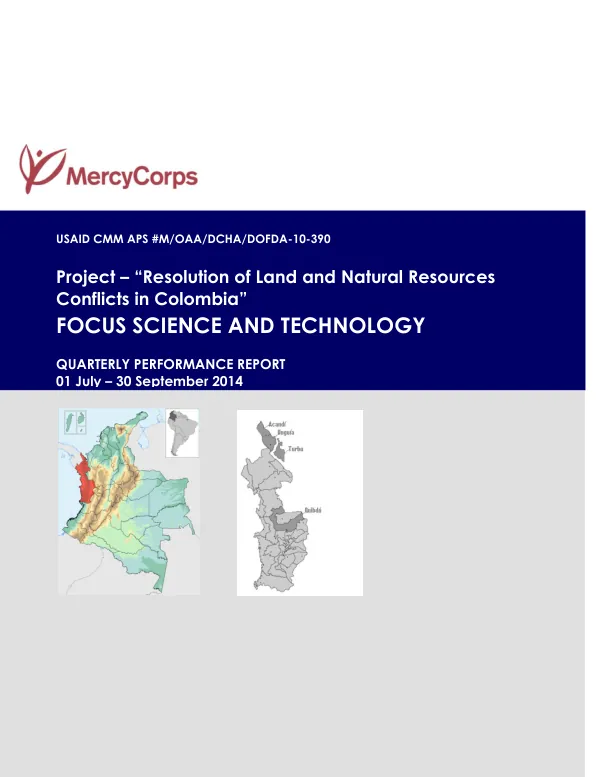
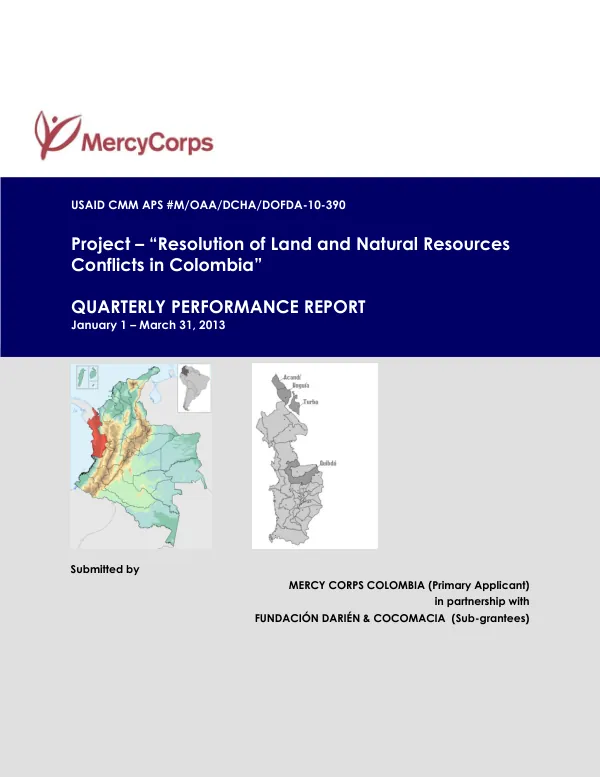
Quarterly Performance Report: Resolution of Land and Natural Resources Conflicts in Colombia
Sign inAECOM INTERNATIONAL
Quarterly Performance Report: Resolution of Land and Natural Resources Conflicts in Colombia
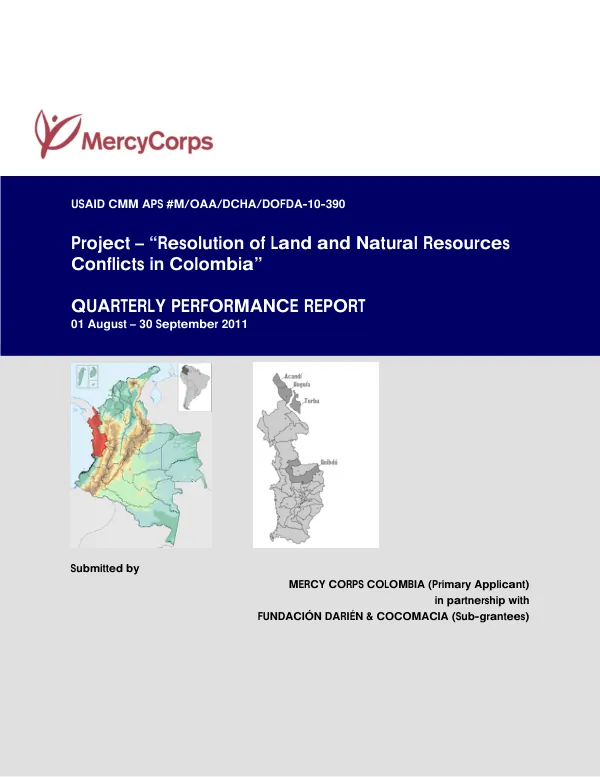
In Colombia, the "Resolution of Land and Natural Resources Conflicts in Colombia" project, implemented by Mercy Corps in partnership with Fundación Darién and COCOMACIA, aimed to strengthen the capacity of Afro-Colombian and indigenous communities to peacefully manage conflict within and between communities in the Darién region and Quibdó.
2011 · 11 pages
Sign in to readA free account is required to download.
Abstract
The project's objective was to promote good governance and reconciliation through Alternative Dispute Resolution (ADR) and People to People principles. During the quarter ending September 30, 2011, the project team and Mercy Corps' Monitoring and Evaluation Unit elaborated the Work Plan and Indicator Plan for the project in consultation with local partners and community representatives. Agreements were signed with local partners, and the project was introduced to communities. Meetings were held with government institutions responsible for collective territories and ethnic community issues, including INCODER, municipal functionaries, and the Environmental and Agrarian Attorney General Office of El Chocó. Prior to project start-up, two existing Mediation Centers (MC) were run by Mercy Corps and partners in the municipalities of Unguía and Acandí, Chocó. An agreement was signed for rent-free MC facilities to be run by Mercy Corps and partners with Unguía's Mayor's Office for a period of three years. During this period, the Unguía MC received 47 cases, and the Acandí MC received 87 cases. As part of this quarter's results, 31 agreements were reached for resolution of land and/or natural resource conflicts, resulting in 310% achievement of the quarterly goal. The project also focused on training community leaders on ADR and People to People principles to resolve conflicts in communities. During the month of September 2011, six training modules on ADR, ethnic and land rights, and social cartography were designed by the local partner Fundación Darién and Mercy Corps. These modules will be published in November 2011. The project also trained 110 Afro-Colombian, indigenous, and community members/women on Global Positioning System (GPS) use and interpretation, satellite image interpretation, and other land measurement skills to prevent and manage conflicts over land and natural resources. Women's participation in land conflict mediation activities was also promoted, resulting in increased land access and land tenure security. During the first quarter of the project, 31 cases were resolved through agreements between parties, with 22 of the resolved cases including the participation of more than 25 women in the mediation sessions. The mediation process provided opportunities for formal recognition of ancestral land rights under the Colombian constitution for women and their families who occupy land within collective territories.
Related documents