USAID DEC
Quarterly Performance Report, Landmine Activities for Victims of the Conflict in Colombia
Sign inMERCY CORPS INTERNATIONAL
Quarterly Performance Report, Landmine Activities for Victims of the Conflict in Colombia
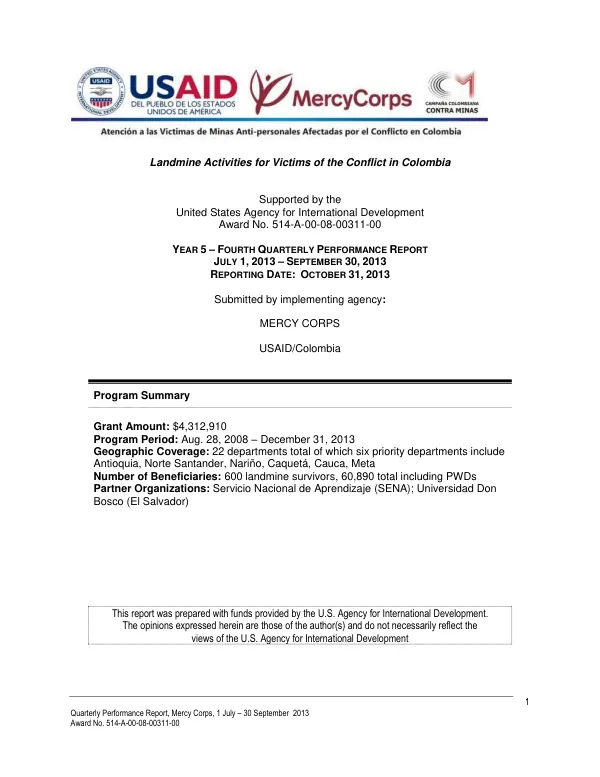
Landmine Activities for Victims of the Conflict in Colombia is a program implemented by Mercy Corps, supported by the United States Agency for International Development (USAID).
2013 · 10 pages
Sign in to readA free account is required to download.
Abstract
The program aims to provide high-quality services to improve the quality of life of people with disabilities affected by armed conflict in Colombia. The program has been in operation since August 28, 2008, and is set to conclude on December 31, 2013. The program has made significant progress in its fifth year, with over 193,000 people with disabilities benefiting from its services. More than 46,000 victims of armed conflict have improved their access to health and rehabilitation services, public policy, and socioeconomic inclusion. The program has also directly impacted health institutions in six departments and has contributed to the design and implementation of policies to guarantee rights for people with disabilities at national, departmental, and municipal levels. Between July and September 2013, 1,597 people with disabilities were treated in 14 communities. The program's services, provided by 35 prosthetists and orthotists, have improved the quality of life and mobility of people with different types of disabilities, including lower and upper limb amputation, spinal cord pathologies, neurological injuries, and sequels from polio. The program has also trained 18 students in prosthetics and orthotics, who are set to graduate as technologists in this field. The program's quarterly performance report highlights several key achievements, including the training of 1,332 people with disabilities, the provision of services to 4,890 people, and the strengthening of 130 institutions. The report also notes that the program has made significant progress in its mission indicators, including the number of vulnerable persons benefited, socio-economic reintegration, and health outcomes. The program's progress towards its objectives is also highlighted in the report. Objective 1, which aims to improve the quality and access to rehabilitation services for landmine survivors and other persons with disabilities, has made significant progress. The program has increased national capacity to provide quality prosthetic and orthotic services, according to international standards, through the training of 30 P&O technicians. The final evaluation of students in the program has also been completed, with 20 students presenting their module V exams and three students presenting their exams for module IV. Of the 23 students, 22 will graduate the program. The module V evaluation, which focused on spinal cord pathologies, presented significant challenges for students, but thanks to the efforts of Mercy Corps and its allies, 20 people with disabilities with spinal pathologies benefited from high-quality orthotic devices. Overall, the program has made significant progress in its fifth year, and its achievements are a testament to the dedication and hard work of its staff and partners. The program's impact will continue to be felt in the years to come, as it contributes to the improvement of the quality of life of people with disabilities in Colombia.