CATHOLIC RELIEF SERVICES ORGANIZATION
Quarterly Program Performance Report: Development Food Aid Program 2012-2017
The Development Food Aid Program (DFAP) in Niger is a 5-year initiative aimed at reducing food insecurity and malnutrition in rural households in the Maradi and Zinder regions.
2012 · 8 pages
Sign in to readA free account is required to download.
Abstract
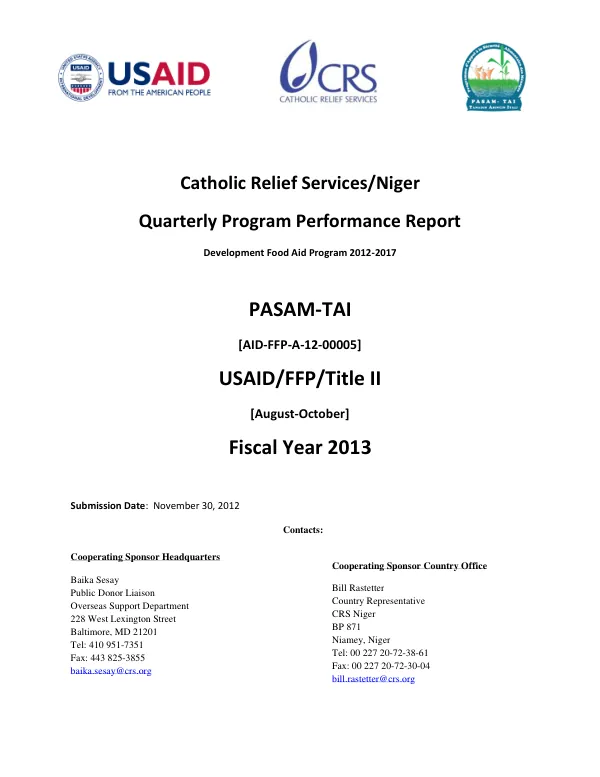
The program, named PASAM-TAI, is implemented by Catholic Relief Services (CRS) in partnership with the International Crop Research Institute for the Semi-Arid Tropics, Misola, and the Government of Niger's Extension Services. The program's strategic objectives include reducing chronic malnutrition among pregnant and lactating women and children, increasing food production and consumption for nutrition, and improving disaster risk management. During the reporting period, August-October 2012, PASAM-TAI successfully established office buildings in Maradi, Matameye, and Mayahi. The program also recruited 139 staff members, with 14% being women, and advertised program positions in national newspapers and job centers. The program's staff participated in capacity-building workshops, including a review of the Development Food Aid Program documents, a FANTA workshop to establish project indicators, and a workshop to establish the Monitoring and Evaluation system. The operating environment in Niger is characterized by a high risk of safety and security threats, including kidnappings, which have been reported in the past. The program is taking necessary precautions to ensure the safety of its staff and beneficiaries. The 2012/2012 growing season was well-established across the country, with good rainfall and good harvest prospects. However, delays in the start of the season in the Tillabéri and Dosso regions may reduce crop yields. PASAM-TAI has made significant progress in establishing its offices and recruiting staff. The program has also identified properties to be used as satellite offices in Mayahi and Matameye, which will improve communication with departmental officials and departmental services. The program has also identified properties to be used as guest houses for staff and visitors during monitoring visits or capacity-building sessions. The program has also made progress in recruiting staff, with 139 positions filled out of 151 planned. However, the program has faced challenges in recruiting women, with only 14% of the positions filled by women. The program plans to use networks of women involved in the required fields to recruit potential female candidates. The program has also established a Monitoring and Evaluation system and has identified indicators to measure its progress. The PASAM-TAI logo was chosen to represent the program's goal of achieving food security for households. The logo features a united household made up of a man, woman, and their child, surrounded by two ears of millet and sorghum, which are staple foods in the Maradi and Zinder regions. The logo also features a flow of water, which represents the source of life and food security. The colors used in the logo have specific meanings, including blue, which represents water and rationalism, green, which represents prosperity and security, and orange, which represents joy and ambition. The program's name, PASAM-TAI, means "Assistance Program for Household Food Security" in English and "Tanadin Abincin Iyali" in Hausa, which means "it is good." The program's name and logo are designed to be used as a communication tool for communication campaigns for behavior change.