USAID DEC
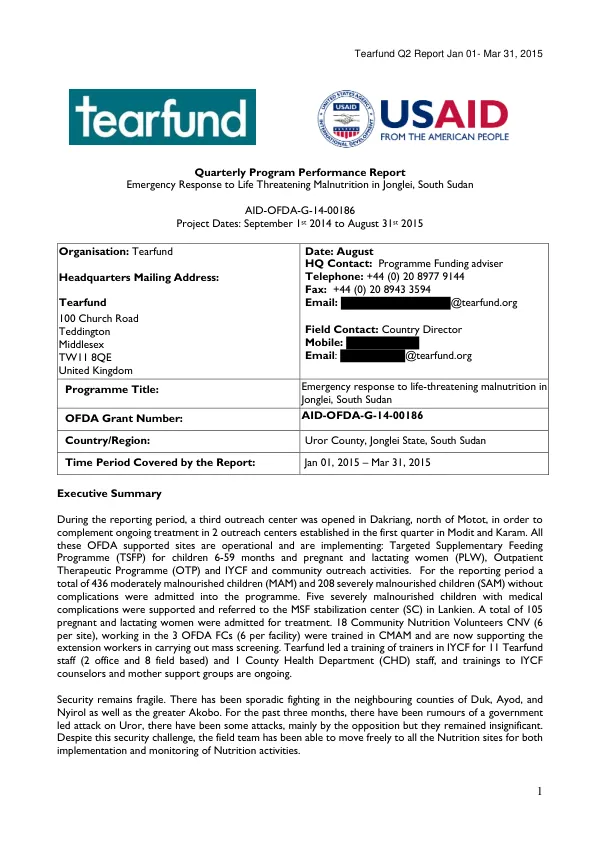
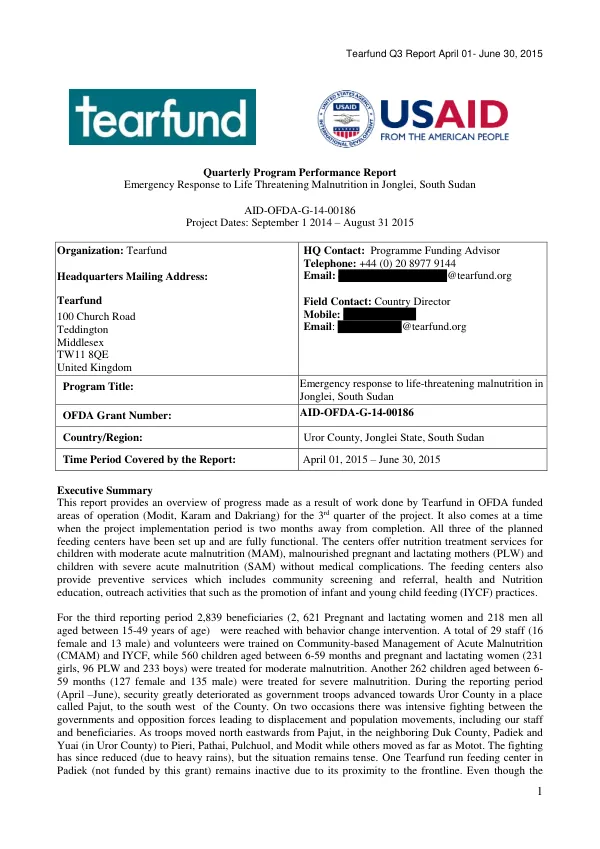
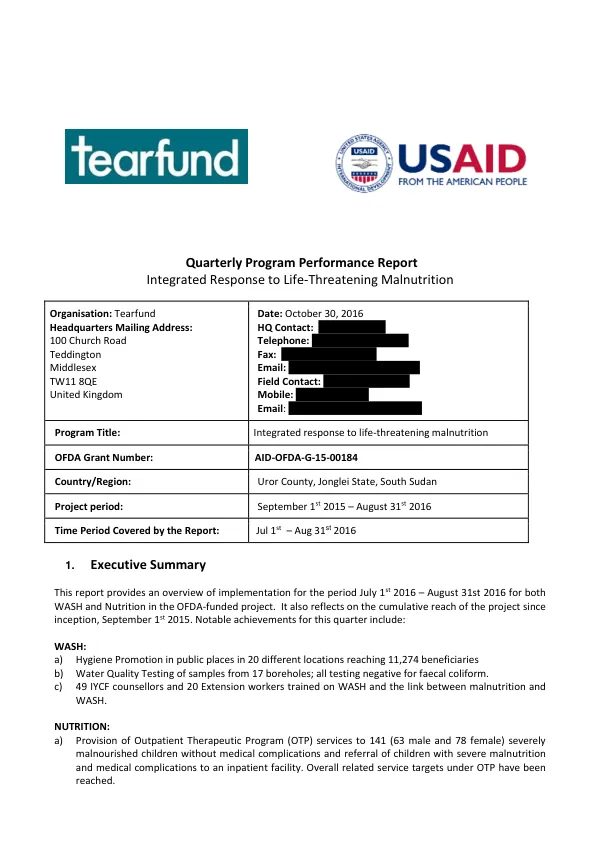
Quarterly Program Performance Report Integrated Response to Life-Threatening Malnutrition
Sign inTEARFUND INTERNATIONAL
Quarterly Program Performance Report Integrated Response to Life-Threatening Malnutrition
The Integrated Response to Life-Threatening Malnutrition program in Uro, Jonglei State, South Sudan, was implemented by Tearfund from September 1st, 2015, to August 31st, 2016.
2016 · 11 pages
Sign in to readA free account is required to download.
Abstract
The program aimed to increase access to safe water sources, knowledge of good hygiene practices, and sanitary facilities among internally displaced persons (IDPs) and host communities. The Water, Sanitation, and Hygiene (WASH) sector achieved notable milestones, including the rehabilitation of 20 boreholes, which were reported to be fully functional and producing sufficient water. Water quality testing of 17 boreholes revealed no faecal coliform contamination. Additionally, 49 IYCF counsellors and 20 extension workers were trained on WASH and the link between malnutrition and WASH. The Nutrition sector focused on increasing access to life-critical services for the treatment of severe and moderate acute malnutrition. A total of 6,786 children were screened for moderate acute malnutrition (MAM), with 80.9% classified as normal, 16.4% as moderately malnourished, and 2.7% as severely malnourished. Vitamin A supplementation was provided to 956 children, while deworming tablets were administered to 60 children due to a lack of supplies. The Targeted Supplementary Feeding Program (TSFP) served 320 malnourished mothers, and 141 severely malnourished children were admitted into the Outpatient Therapeutic Program (OTP). The program also provided training to 21 staff members on Community-based Management of Acute Malnutrition (CMAM). The cumulative reach of the program was 87,286 IDPs and host community members, with 13,093 IDPs and 63,282 host community members benefiting from WASH services. The program's indicators showed significant progress, with 53,816 IDPs benefiting from the water supply infrastructure program, 17 water quality tests with zero faecal coliform contamination, and 20 water points actively utilizing Water Safety Plans. In the Hygiene Promotion sector, 11,274 beneficiaries received direct hygiene promotion, and 24 active club members supported the continued hygiene awareness among children. The program's achievements were attributed to the integration of WASH and Nutrition messaging, which ensured comprehensive coverage of the community's needs. The program's success was also facilitated by the support of Water Management Committees, which maintained the hygiene of the water points targeted under the project. The program's impact was evident in the reduction of malnutrition levels, with a 27% increase in household income among program participants. The program's achievements were also reflected in the improvement in food security, with the greatest gains in areas where both agricultural and market access were combined. The program's success was also marked by the establishment of 20 Water Management Committees, which maintained the hygiene of the water points targeted under the project. The program's achievements were also facilitated by the training of 49 IYCF counsellors and 20 extension workers on WASH and the link between malnutrition and WASH.
Related documents