UNITED NATIONS
Quarterly Program Report of USAID/OFDA for Democratic Republic of Congo
The humanitarian response in North Kivu, including Walikale territory, is being optimized and increased through the provision of logistics facilities.
2014 · 13 pages
Sign in to readA free account is required to download.
Abstract
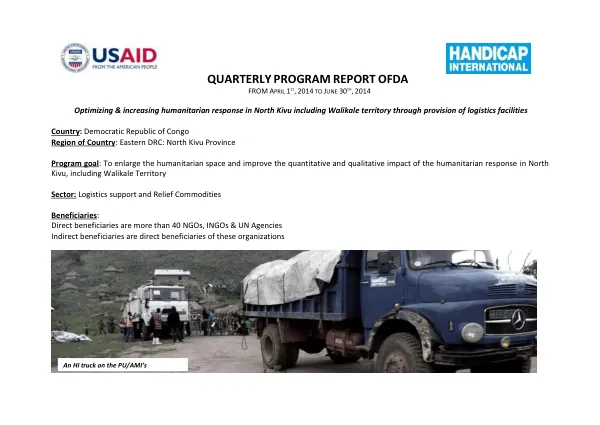
The project, funded by the US Office for Foreign Disaster Assistance (OFDA), aims to enlarge the humanitarian space and improve the quantitative and qualitative impact of the humanitarian response in the region. The project provides logistics support to humanitarian actors, enabling them to access remote areas and implement a broader, more proactive, and more flexible humanitarian response to the crisis prevailing in North Kivu and South Kivu. Instability, insecurity, and poor road conditions are the main challenges facing humanitarian actors in the region. Long-standing conflicts in North Kivu have internally displaced 1,123,446 people as of November 25, 2013. The project intervention is twofold, consisting of a platform in Walikale to provide services to humanitarian partners, including transport, storage, garage, accommodation, internet access, and office space, and a Logistic Rapid Response Unit (LRRU) based out of Goma, which is a mobile platform for organizing the transport of goods to partners' operational areas. The platform in Walikale provides a range of services, including transportation, storage, and accommodation, to humanitarian partners. The LRRU, based in Goma, is a mobile platform that enables the rapid response to humanitarian needs in the region. The project has established partnerships with 55 humanitarian organizations, including national and international NGOs, and UN agencies, which have planned for 360,291 direct beneficiaries for the reporting period. The cumulative total of indirect beneficiaries is estimated to be 1,225,324. The project has faced several challenges, including security incidents, such as the forced transportation of HI vehicles by FARDC soldiers, and access issues, such as the deterioration of the road from Walikale to Masisi. However, the project has continued to provide logistics support to humanitarian actors, despite these challenges. The project has also established a system for monitoring and evaluating its services, including transportation, storage, and accommodation, which has enabled it to identify areas for improvement and make adjustments as needed. The project has made significant progress in providing logistics support to humanitarian actors in North Kivu, including Walikale territory. The platform in Walikale has provided a range of services to humanitarian partners, and the LRRU has enabled the rapid response to humanitarian needs in the region. The project has established partnerships with 55 humanitarian organizations, which have planned for 360,291 direct beneficiaries for the reporting period. The cumulative total of indirect beneficiaries is estimated to be 1,225,324. The project's success is due in part to its ability to adapt to the changing security situation in the region. The project has continued to provide logistics support to humanitarian actors, despite the challenges posed by security incidents and access issues. The project has also established a system for monitoring and evaluating its services, which has enabled it to identify areas for improvement and make adjustments as needed. The project's ability to adapt to the changing security situation and its commitment to providing logistics support to humanitarian actors have enabled it to make a significant contribution to the humanitarian response in North Kivu, including Walikale territory. The project's geographic focus is on North Kivu, including Walikale territory, and its timeframes are quarterly, with the current reporting period covering April to June 2014. The project's recommendations for future action include continuing to provide logistics support to humanitarian actors in the region, adapting to the changing security situation, and improving the efficiency and effectiveness of its services.