GLOBAL COMMUNITIES
Quarterly Programmatic Report
The Yemen Emergency Food Assistance (YEFA) program is a food assistance project implemented by Global Communities in Yemen.
2019 · 7 pages
Sign in to readA free account is required to download.
Abstract
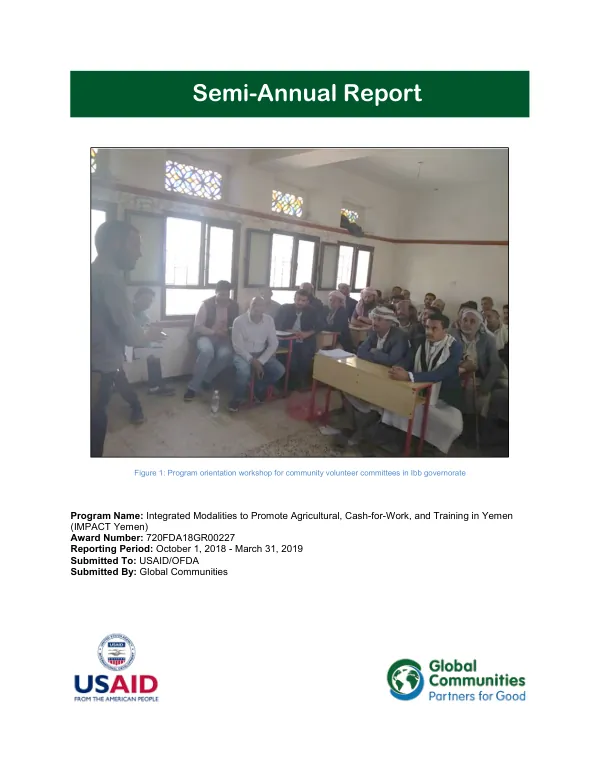
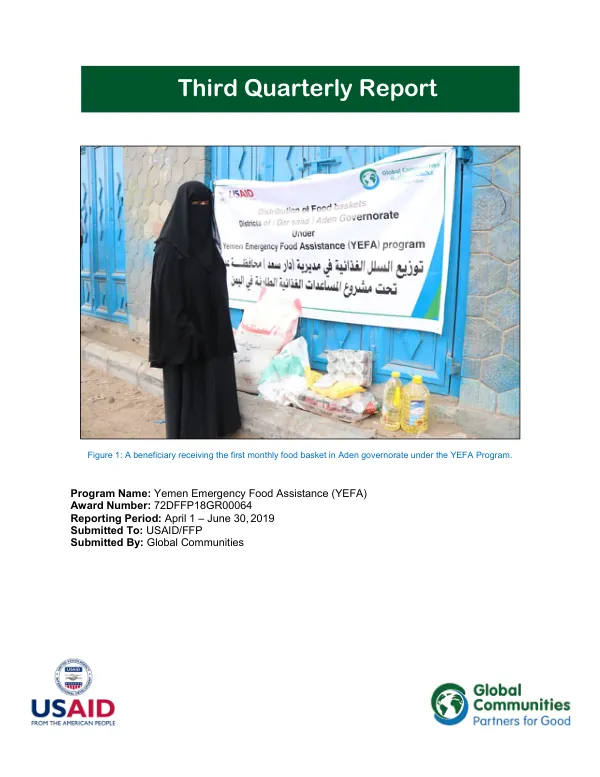
The program aims to provide food assistance to 3,990 of the most vulnerable households in Aden, Al Dhale, Ibb, and Dhamar governorates of Yemen. The program is funded by the United States Agency for International Development (USAID) through the Food for Peace (FFP) program. During the third quarter of 2019, Global Communities completed area selection, beneficiary selection, verification, and initiated distribution of food baskets to the beneficiaries. The team negotiated with authorities in the north to receive travel permits and access, and coordinated with the Food Security and Agriculture Cluster (FSAC), community volunteers, World Food Programme, and other international and national non-governmental organizations (I/NGOs) to avoid overlapping and ensure eligible households are included in food assistance programming. The program focuses on providing food baskets to 3,990 households within the most vulnerable host community and internally displaced person (IDP) households for a period of nine months. The food commodities are delivered to the beneficiaries through a commodity food voucher system, with a voucher value in line with the approved FSAC Minimum Survival Food Basket. The voucher is intended to provide 1,663 kcals of food, meeting 80% of a household's monthly food needs. Implementation of program activities included community mobilization and sensitization about the YEFA program, area selection meetings, and community volunteer committees formation. The team conducted broad-based community meetings in remaining sub-districts of Al Dhale, Dhamar, and Ibb governorates to introduce the program, beneficiaries' selection criteria, and the kind of assistance they will receive. Community Volunteer Committees (CVCs) were established in the new areas, with members elected through fair voting by the households that participated in the meetings. Registration of beneficiaries was completed in all districts during the reporting period, with verification of beneficiaries completed in Mudhaykirah and Al Manar districts. Data has been entered in the database developed using Podio and Device Magic platforms. Five hundred IDPs have been identified in coordination with FSAC to provide minimum food basket under rapid response activity. The first monthly food basket distribution was completed for 788 beneficiaries in Aden governorate and for 763 households in Al Dhale governorate. The quality assurance committee completed the quality check for monthly food items in Aden, Al Dhale, and Ibb governorates. The contents of the minimum food basket are in line with FSAC recommendations, including wheat flour, red beans, oil, sugar, and salt. Monitoring and evaluation activities included baseline assessment, feedback handling mechanisms, and data collection. The baseline survey was completed in Dhamar and Ibb governorates and in Aden and Al Dhale during the previous quarter. Global Communities' feedback handling mechanisms were fully operational during the reporting period, with various ways to register feedback, including a telephone hotline, WhatsApp number, on-site help desks, and suggestion boxes. The team received non-sensitive feedback from the community, including requests for more food assistance beneficiaries, inquiries about the selection criteria, and requests for changes to the food commodity package.
Related documents