DEPUTY MINISTRY OF TECHNICAL AND VOCATIONAL EDUCATION AND TRAINING
Quarterly Programmatic Report
The program aimed to improve household food security and livelihoods through the provision of agricultural inputs, including seeds, tools, and livestock.
2018 · 20 pages
Sign in to readA free account is required to download.
Abstract
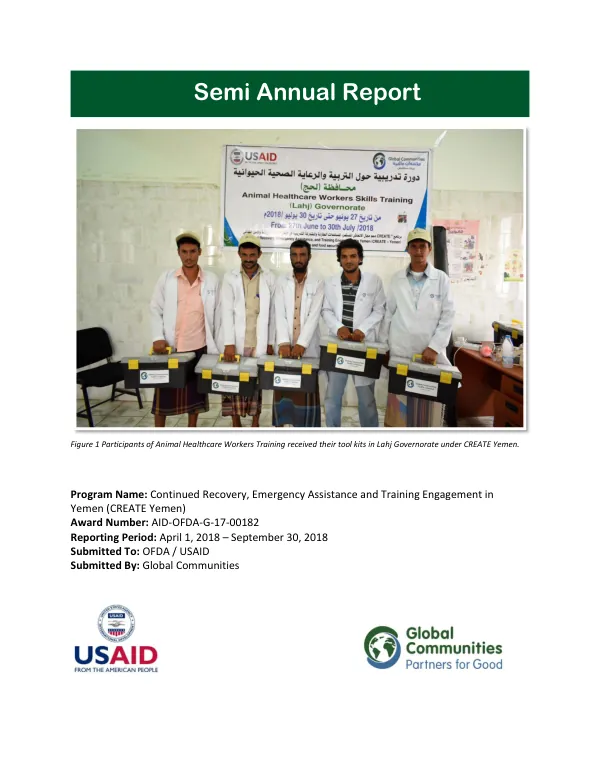
The program also provided income generation opportunities for vulnerable households through market-driven vocational training, support to asset building groups, and cash-for-work opportunities. A total of 147 youth were trained in eight different vocations, including mobile maintenance, electrical, and plumbing. Twenty-five Asset Building Groups (ABGs) were formed, with 13 ABGs completing their training by the end of the reporting period. In addition, the program aimed to improve community hygiene practices through the provision of hygiene kits and training of hygiene promoters. A total of 59 hygiene promoters were trained, who provided hygiene awareness sessions to 234 female beneficiaries. Twenty-two teachers were also trained, who provided hygiene awareness sessions to 3,216 students. Global Communities continued to implement the planned CREATE Yemen interventions through community consultations and involvement of Community Volunteer Committees (CVCs). The CVCs were established in new communities in the target districts, with the membership of local communities within the targeted areas. The CVCs were oriented on sectoral interventions and beneficiary selection process, with a strong emphasis on selection criteria. The program also experienced some challenges during the reporting period, including teacher's strikes, unrest, and protests, which resulted in unexpected delays. However, Global Communities managed to continue program implementation smoothly, with the support of headquarters team members and expats. The program received nominations of over 2,500 most vulnerable household beneficiaries, falling under the project-specific beneficiary criteria. The program's overall coordination was ensured through active participation in relevant coordination forums, including WASH, FSAC, Health, and Education Clusters. Global Communities maintained strong relationships with the Government, particularly with key Government line ministries, including MoPIC, and the Ministry of Agriculture (MoA). The program also ensured proper branding and visibility of USAID/OFDA and Global Communities. The program's achievements during the reporting period included the provision of agricultural inputs to 188 farmers, training of 44 Animal Healthcare Workers, and provision of one day Animal Healthcare Training to 198 livestock beneficiaries. The program also provided vocational training to 147 youth, formed 25 Asset Building Groups, and trained 59 hygiene promoters. The program's overall goal was to improve household food security and livelihoods, provide income generation opportunities, and improve community hygiene practices.
Related documents