FEWS NET
Yemen - Complex Emergency Fact Sheet #10, Fiscal Year (FY) 2018
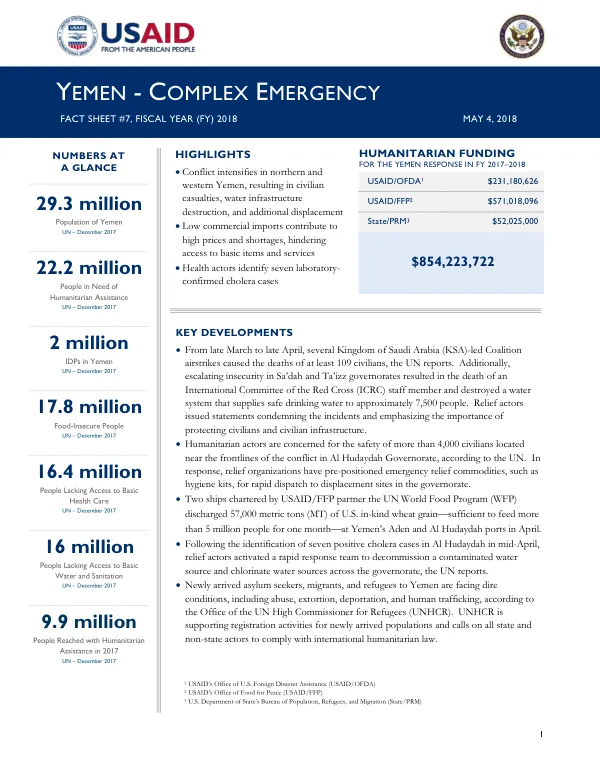
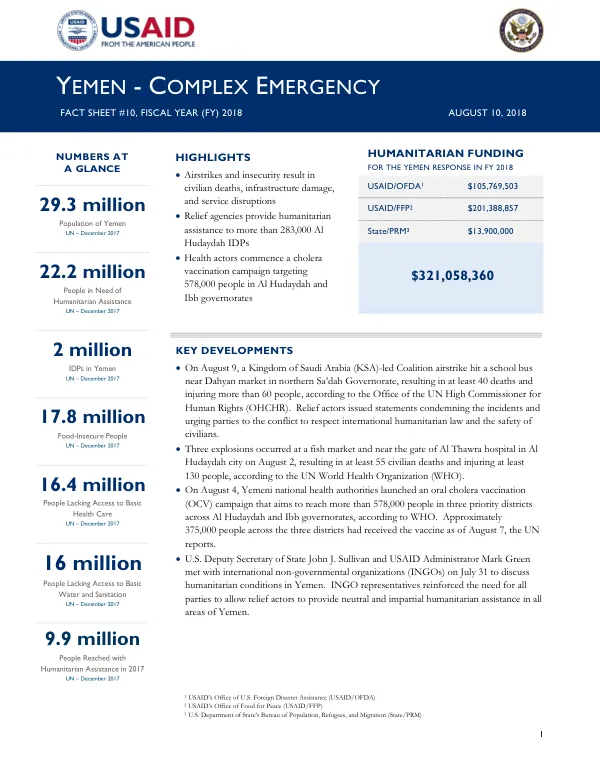
The Kingdom of Saudi Arabia (KSA)-led Coalition airstrike on August 9 hit a school bus near Dahyan market in northern Sa'dah Governorate, resulting in at least 40 deaths, including at least 20 children aged 15 years and younger, and injuring more than 60 people, according to the Office of the UN High Commissioner for Human Rights (OHCHR).
2018 · 7 pages
Sign in to readA free account is required to download.
Abstract
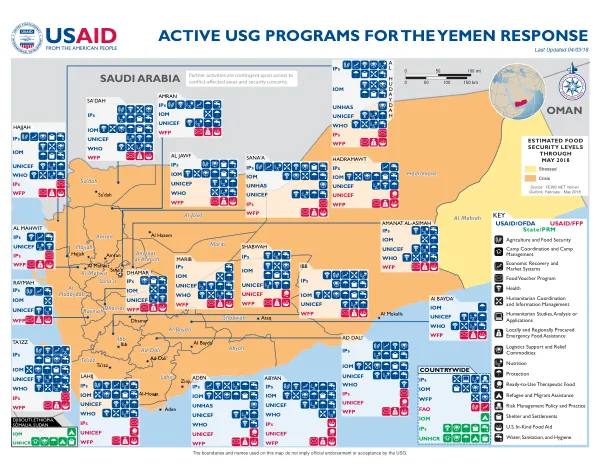
The attack occurred in an area with high access constraints, where more than 10,500 people were restricted from accessing safe drinking water due to a July 21 airstrike that disabled the area's water system. The UN human rights body has documented nearly 17,100 civilian casualties, including more than 6,500 deaths and nearly 10,500 injured persons, with KSA-led Coalition airstrikes resulting in nearly 10,500, or 60 percent, of the total casualties. Following the attack, UN Secretary-General Antonio Guterres, UN Resident and Humanitarian Coordinator (RC/HC) for Yemen Lise Grande, and UN Special Envoy for Yemen Martin Griffiths, as well as several international non-governmental organizations (INGOs), released statements condemning the incident and urging parties to the conflict to respect international humanitarian law and the safety of civilians. Between June 1 and July 29, the military offensive in Al Hudaydah displaced approximately 340,000 people, with the majority remaining within the governorate, according to the UN. Despite access constraints and ongoing conflict in southern Al Hudaydah, relief actors had provided emergency assistance to nearly 283,000 people displaced from and within the governorate as of July 29, the UN reports. More than 1.4 million people were residing in areas with high access constraints, representing an increase of 200,000 people since February, the UN reports. The Famine Early Warning System Network (FEWS NET) continued to warn in a July update that the worst-affected Yemeni households may begin to experience Catastrophe—IPC 5—conditions as coping capacities are exhausted, even if conflict conditions do not deteriorate further. FEWS NET also cautioned that any significant, prolonged operational disruptions to the Red Sea ports of Al Hudaydah and Al Saleef are likely to result in Famine—IPC 5—levels of acute food insecurity. Al Hudaydah and Al Saleef ports remained open as of August 10, according to the UN Verification and Inspection Mechanism for Yemen (UNVIM), allowing humanitarian actors to transport emergency relief commodities to crisis-affected locations. With support from USAID/FFP, the World Food Programme (WFP) reached 7.5 million people, more than 96 percent of the 7.8 million people targeted, with emergency cash, in-kind, and voucher food assistance across 20 governorates in June. This marks a more than 10 percent increase from the 6.8 million people receiving WFP emergency food assistance in May, and a nearly 32 percent increase compared to the 5.7 million assisted in June 2017.