DEPUTY MINISTRY OF TECHNICAL AND VOCATIONAL EDUCATION AND TRAINING
Semi Annual Report: IMPACT Yemen, April 1, 2019 – September 30, 2019
The Integrated Modalities to Promote Agriculture, Cash-for-Work, and Training in Yemen (IMPACT Yemen) project aims to address the humanitarian and early recovery needs of vulnerable and conflict-affected populations in Yemen.
2019 · 13 pages
Sign in to readA free account is required to download.
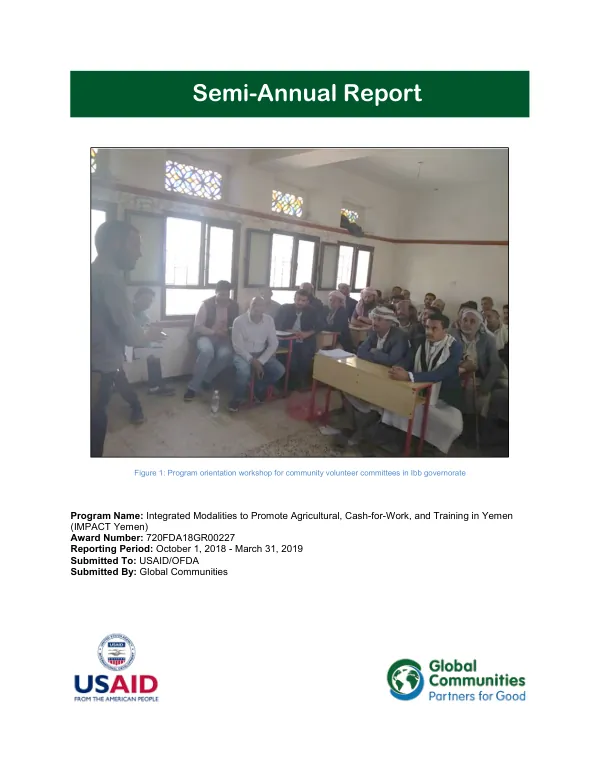
Abstract
The project is being implemented in seven governorates, including Sana'a, Dhamar, Ibb, Taiz, Aden, Lahj, and Al Dhale, and targets 78,054 vulnerable beneficiaries. The project is an 18-month initiative that focuses on improving food security, livelihoods, WASH, and economic opportunities. The project is being implemented in an integrated manner with the USAID/FFP-funded Yemen Emergency Food Assistance (YEFA) project in four districts. The program has three objectives: to improve household food security and livelihoods, to increase income for vulnerable households through market-driven vocational training and cash-for-work opportunities, and to improve access to safe water supplies and sanitation facilities while improving hygiene practices in targeted communities. During the reporting period, Global Communities continued to implement planned interventions through community consultations facilitated in close coordination with relevant government departments at the governorate and district levels. The organization established 12 Community Volunteer Committees (CVCs) in Sana'a, Dhamar, Ibb, and Taiz governorates, which were formed after a needs assessment identified the most vulnerable areas in targeted districts. The CVCs were established to ensure community participation and to provide the Global Communities team with initial lists of beneficiaries. Global Communities maintained strong relationships with the government, particularly with key government line ministries, including the Ministry of Planning and International Cooperation (MOPIC) in the south, the National Authority for Management and Coordination of Humanitarian Affairs & Disaster Response (NAMCHA) and the Central Statistics Organization (CSO) in the north, and the Ministry of Agriculture & Irrigation (MoAI). The organization also coordinated with local District Councils and informal community leaders to ensure humanitarian access and smooth implementation of project activities. The project team conducted field visits to recommended areas and organized Broad-Based Community Meetings (BBCM) and Focus Group Discussions (FGD) to confirm the initial assessment and selection of intervention areas. The team used a questionnaire designed according to sectoral requirements and criteria related to the presence of district council representatives, local leaders, and Sheikhs. The sectoral heads, field teams, and the technical team held meetings to identify the most suitable areas that fit all program interventions, enabling integration in almost each area and keeping in mind the level of vulnerability, humanitarian needs, response gaps, and overall humanitarian situations within the communities. Global Communities also established a total of 12 CVCs (95 members) in six districts in Sana'a, Dhamar, Ibb, and Taiz governorates. The CVCs were formed with the active participation of local communities within the targeted areas, and the community members elected the representatives. Global Communities effectively supported the participation of women and youth in the Community Volunteer Committees, with 30 women elected out of a total of 95 CVC members, raising the active participation of women to 36%. The organization aims for 40% of the CVCs membership to be female and includes the topic of gender sensitization in community orientation sessions. The CVCs have been fully active with a high level of contribution to the Global Communities team, providing the team with initial lists of beneficiaries and supporting the implementation of project activities. The organization has also maintained coordination with all relevant stakeholders on the ground, including the Ministry of Agriculture & Irrigation (MOAI), the Ministry of Technical Education and Vocational Training (MOTEVT), the Education, Health, and WASH Clusters, and the Food Security and Agriculture Cluster (FSAC).