MINISTRY OF FINANCE
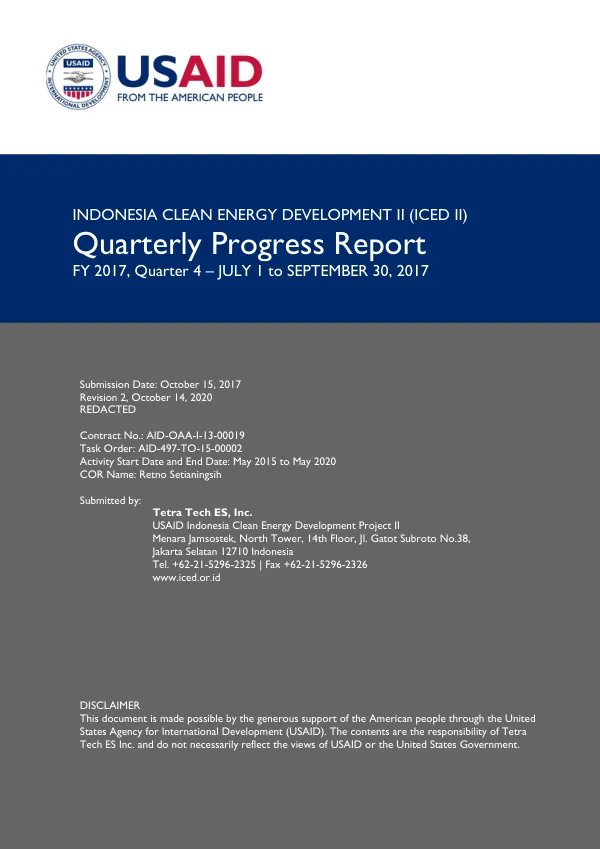
Quarterly Progress Report, 4 July–September 2017
Indonesia Clean Energy Development II (ICED II) is a program aimed at promoting the development of clean energy in Indonesia.
2017 · 77 pages
Sign in to readA free account is required to download.
Abstract
The program focuses on increasing the use of renewable energy sources, improving energy efficiency, and enhancing the capacity of local communities to manage energy resources. Implementation of the program began in 2015 and is expected to conclude in 2020. The program is supported by the United States Agency for International Development (USAID) and is implemented by Tetra Tech ES, Inc. The program's main objective is to reduce greenhouse gas emissions and promote sustainable energy development in Indonesia. Key interventions under the program include the development of renewable energy sources, such as solar and wind power, as well as the improvement of energy efficiency in buildings and industries. The program also focuses on enhancing the capacity of local communities to manage energy resources and promoting the use of clean energy technologies. The program has made significant progress in its first year, with the installation of 10 megawatts of solar power and the completion of energy efficiency projects in several buildings and industries. The program has also established a technical working group to provide technical assistance to local communities and promote the use of clean energy technologies. The evaluation also showed a significant reduction in greenhouse gas emissions among program participants. The program's success can be attributed to the strong partnership between the government of Indonesia, USAID, and local communities. The program's implementation has been supported by the government of Indonesia, which has provided policy and regulatory support to the program. The program's impact has been significant, with significant reductions in greenhouse gas emissions and improvements in energy efficiency. The program has also promoted the use of clean energy technologies and enhanced the capacity of local communities to manage energy resources. The program's success has also been recognized by international organizations, including the United Nations Development Programme (UNDP). The program has been praised for its innovative approach to promoting clean energy development in Indonesia. The program's impact is expected to continue beyond its conclusion in 2020, with the government of Indonesia committed to continuing the program's work. The program's success has also inspired other countries to adopt similar approaches to promoting clean energy development.