JOHNS HOPKINS UNIVERSITY
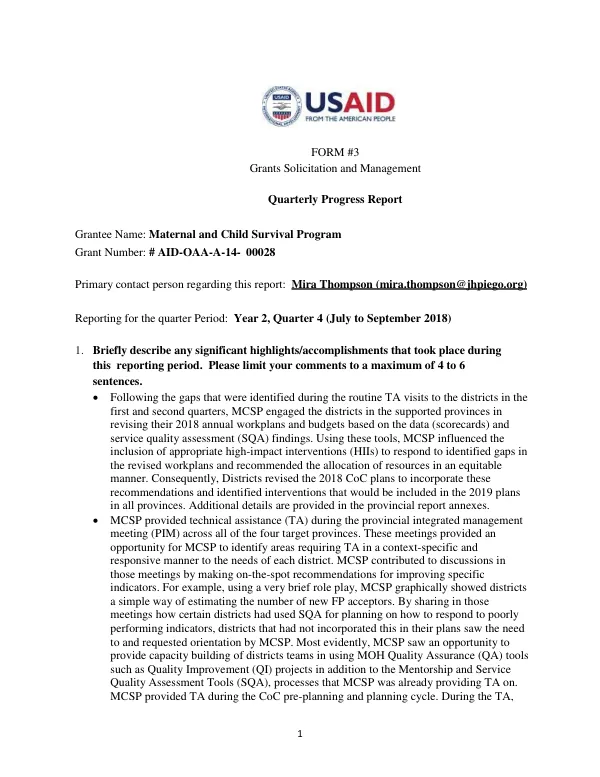
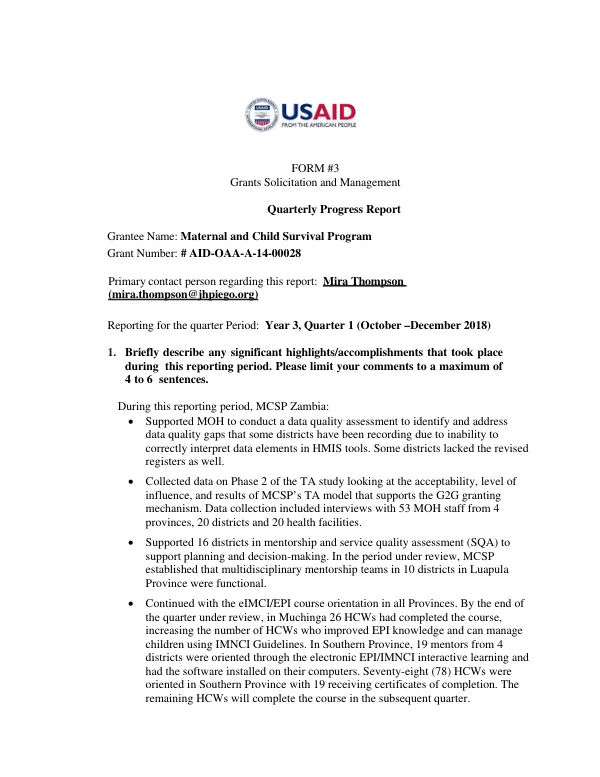
Quarterly Progress Report: Maternal and Child Survival Program
The Maternal and Child Survival Program in Zambia, funded by the United States Agency for International Development (USAID), has made significant progress in the first quarter of Year 3.
2019 · 139 pages
Sign in to readA free account is required to download.
Abstract
The program, which aims to provide demand-driven technical assistance for sustainable scale-up of Reproductive, Maternal, Newborn, Child, and Adolescent Health and Nutrition (RMNCAH&N) interventions across four focus provinces, has achieved notable milestones. During this reporting period, the program supported the Ministry of Health (MOH) in conducting a data quality assessment to identify and address data quality gaps in the Health Management Information System (HMIS) tools. The assessment revealed that some districts lacked the revised registers, which hindered their ability to correctly interpret data elements. The program also collected data on Phase 2 of the Technical Assistance (TA) study, which examined the acceptability, level of influence, and results of the program's TA model that supports the G2G granting mechanism. The program provided technical assistance to 16 districts in mentorship and service quality assessment (SQA) to support planning and decision-making. In Luapula Province, multidisciplinary mentorship teams in 10 districts were established, and the program continued to provide eIMCI/EPI course orientation in all provinces. In Muchinga Province, 26 healthcare workers completed the course, increasing the number of healthcare workers who improved EPI knowledge and can manage children using IMNCI Guidelines. The program also faced unforeseen obstacles, including the late disbursement of 2018 G2G CoC grants to the districts, which affected the program's plans to provide TA during implementation of the 2018 district plans. However, the program has been following up with the CoC coordinators to reschedule these activities and provide TA during implementation of GRZ-funded activities. To ensure compliance with USAID family planning and commodity regulations, the program has taken several measures. All MCSP staff at the national and provincial levels have taken the 2018 version of the US Abortion and FP Compliance and Protecting Life in Global Health Assistance courses on Global Health eLearning Center. The program has also emphasized the need for compliance with FP rules and regulations to MOH at all levels and provided TA to MOH personnel to take the appropriate online courses. The program has continued to provide technical assistance to MOH to review maternal perinatal deaths and determine how to promptly respond to them. In Southern Province, the program supported Kalomo District following 3 maternal deaths that occurred in the district in the 3rd quarter of 2018. Based on the program's guidance and recommendations, Kalomo District has re-oriented 52 healthcare workers in new maternal referral guidelines, conducted one round of obstetric emergency drills at the district hospital, and installed or repaired resuscitative equipment in two ambulances. The program has also supported MOH in conducting Data Quality Assessments (DQA) in Southern and Luapula Provinces in collaboration with SBH. In Luapula Province, Chipili District reported that ANC < 14 weeks was at 95% in Quarter 3 2018, but the actual data reviewed showed 65% coverage instead of 95%. The program guided the district team to ensure close supervision of healthcare staff in registers updating and used as primary source of data when reporting. The program has continued to implement the LNG IUS study in collaboration with SM360+ in Luapula, Eastern, and Muchinga Provinces. In Eastern Province, the program and SM360+ teams offered TA to Mafuta RHC as the HF is a study site. The program oriented Safe Motherhood Action Groups in FP messages to create demand for LARC in the community, to reduce unwanted pregnancies that result in obstetric emergencies. The program has also provided technical assistance for Essential Newborn Care. The program followed up on Technical Assistance visits during implementation of 2018 CoC grants. MCSP conducted TA visits to 6 health facilities in Muchinga and 11 facilities in Eastern province to ascertain levels of compliance to recommendations made during the previous visits. All the visited facilities acted on most of the recommendations, which included infection prevention, creation of resuscitation spaces, and KMC. Overall, the program has made significant progress in the first quarter of Year 3, achieving notable milestones in providing demand-driven technical assistance for sustainable scale-up of RMNCAH&N interventions across four focus provinces.