CARANA CORPORATION, INC.
Quarterly Progress Report: USAID Post-Harvest Handling and Storage Project
The USAID Post-Harvest Handling and Storage (PHHS) project was initiated in Rwanda in September 2009.
2010 · 27 pages
Sign in to readA free account is required to download.
Abstract
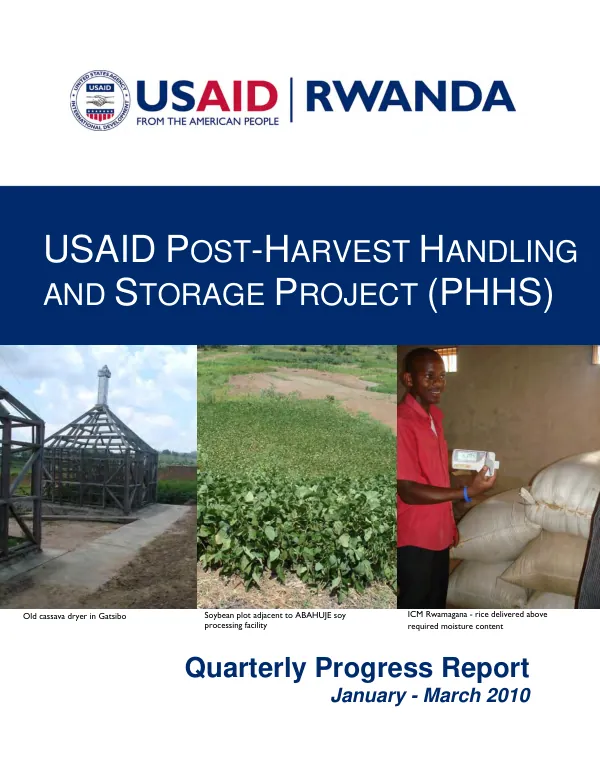
The project's primary objective is to enhance food security in Rwanda by establishing connections between producers of staple crops and markets. The project will collaborate with private sector agribusiness firms and processors to reduce post-harvest losses through investments in post-harvest infrastructure and process improvements, including crop conditioning, storage, and processing. The project's goal is to increase the quality of crops for storage, enabling smallholder farmers to sell their surpluses in domestic and regional markets. By investing in storage facilities, the project aims to free smallholder farmers from the need to sell crops at harvest time when prices are at their lowest. The PHHS project is working in partnership with private sector firms and Rwanda's Ministry of Agriculture. In the first quarter of 2010, the PHHS project made significant progress. The Investment Finance team was brought on board and began gathering information on finance available in Rwanda and the region for staple crop post-harvest activities. The project's Market Linkages Specialist and Chief of Party traveled to cooperatives producing staple crops in different regions of Rwanda, meeting with representatives to identify major post-harvest constraints and discuss potential project interventions. The PHHS team also met with support organizations working with the cooperatives to determine how best to incorporate project assistance into their existing activities. The regions visited included Nyagatare and Gatsibo in the Eastern Province, where large volumes of maize, rice, beans, and cassava are produced. A semi-completed grain storage and drying facility, built with UNDP funds, was visited, and discussions began with the Rwanda Development Organization (RDO) to assist them in making the facility operational and setting up a management structure. Another potential opportunity for project assistance was identified in Gatsibo District, where a group called the Cassava Initiative Platform wishes to take over and rehabilitate an abandoned cassava processing unit. In south-central Rwanda, the rice union Union des Cooperatives Rizicoles de Butare (UCORIBU) was found to be well organized, with a good relationship with the buyer (ICM) and a list of needs in terms of renovation or extension of post-harvest infrastructure to reduce losses and improve the quality of paddy delivered to the mill. The team also met and discussed potential collaboration with support organizations such as CAF ISONGA, RDO/RDI, and the Union des Cooperatives Agricoles de Gikongoro (UNICOOPAGI). The Investment Finance team held meetings with a wide range of local finance institutions, including Reseau Interdiocesain de Microfinance (RIM) and Banque Commerciale du Rwanda (BCR), to gather information on finance available in Rwanda for staple crop post-harvest activities. The PHHS project's activities in the first quarter of 2010 focused on gathering information, meeting with stakeholders, and identifying potential opportunities for project assistance. The project's progress in the first quarter laid the foundation for future activities aimed at reducing post-harvest losses and improving food security in Rwanda.