USAID DEC
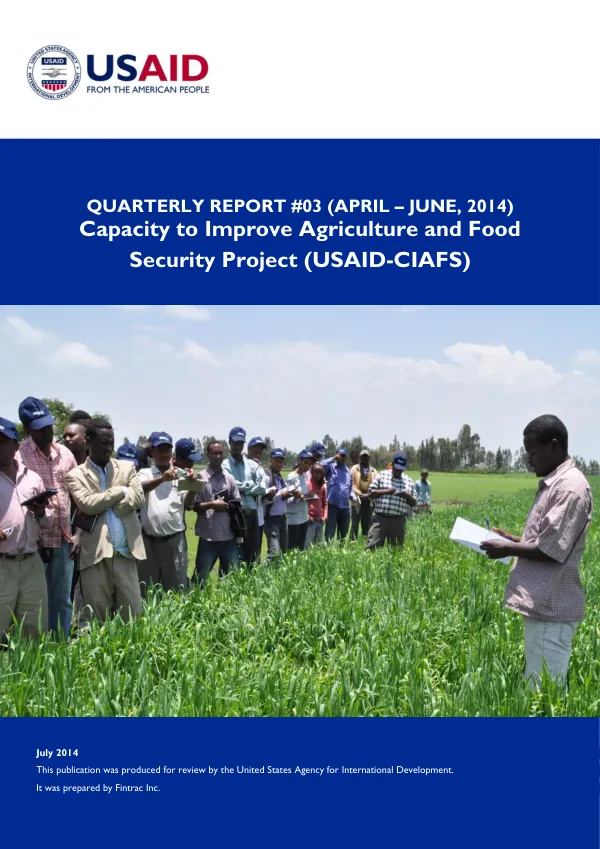
Quarterly Report #04 (October – December 2014): Capacity to Improve Agriculture and Food Security (USAID-CIAFS)
Sign inBAHIR DAR UNIVERSITY
Quarterly Report #04 (October – December 2014): Capacity to Improve Agriculture and Food Security (USAID-CIAFS)
The Capacity to Improve Agriculture and Food Security (USAID-CIAFS) project is an important component of USAID-Ethiopia's multi-year strategy under the Feed the Future (FTF) initiative.
2015 · 11 pages
Sign in to readA free account is required to download.
Abstract
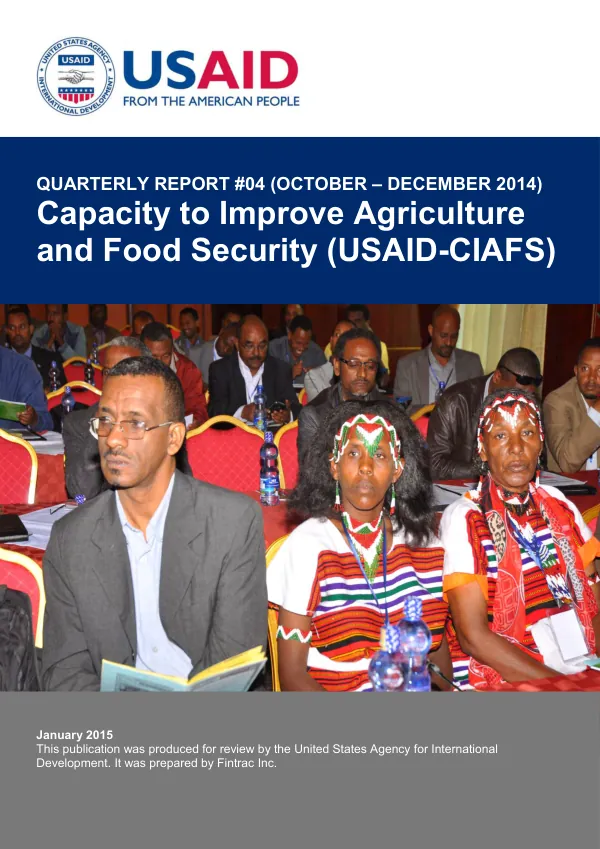
Objectives of FTF include increasing agricultural productivity, preserving natural resources, improving agricultural marketing, increasing the purchasing power of vulnerable households, and maximizing food security. USAID-CIAFS supports the Ministry of Agriculture (MoA) and regional Bureaus of Agriculture (BoAs) to build their human capital and institutional capacity for decision-making and resource use to achieve the Growth and Transformation Plan (GTP)/Agricultural Transformation Plan (ATP) objectives. Private sector agribusiness, associations, and entrepreneurs are also stakeholders supported by the project. USAID-CIAFS also provides monitoring and evaluation (M&E) related support, including data quality assessments (DQAs) to FTF partners and the USAID Mission to measure project performance across the primary regions of Tigray, Amhara, Oromiya, and Southern Nations, Nationalities, and Peoples’ Region (SNNPR). Key achievements in this quarter include convening the fourth bi-annual planning and M&E national workshop for 83 senior officials drawn from all of the regional BoAs in the country, the Federal MoA, and allied offices. The workshop was organized in collaboration with the Agricultural Transformational Agency (ATA) and focused on the role of planning and M&E. Collaborations with Mekelle and Bahir Dar Universities resulted in the development of tertiary-level curriculums on Global Climate Change (GCC) and the conduct of research on the linkages between climate change and food security. The research produced more than 20 papers that were presented to regional workshops to raise awareness of climate change. A two-day national conference was organized to deliberate on climate change impacts and adaptation options to sustain smallholder agriculture in Ethiopia. The conference concluded by establishing a Climate Adaptation Forum to map strategic direction and advise government institutions, donor interventions, etc. USAID-CIAFS was chosen to serve as secretariat to the Forum. A modular curriculum on leadership for district level leaders was designed to enhance their capacity in planning and implementation. A rapid DQA of AGP-AMDe, AGP-LMD, ESAI, and USAID-ENGINE projects in Amhara and Tigray regions was conducted to verify the accuracy and relevance of data reported in the FTF Monitoring System (FTFMS). Collaborations with the Network of African Science Academies (NASAC) and the Ethiopian Academy of Sciences resulted in the production of a policy brief booklet for policy makers on biotechnology. Three volumes of best practices in smallholder agriculture and climate adaptation were published, derived from study visits and research. Compiled and finalized proceedings on biotechnology international conference were also produced. A briefing session for all FTF implementing partners on FY2014 FTFMS reporting was organized, and FTFMS user training was provided to two M&E managers from CARE and Aged and Children Pastoralists Association (ACPA). A report on post-study visit of best practices in agricultural extension in Thailand was prepared and submitted to USAID, the MoA, and BoAs. The fourth bi-annual planning and M&E national workshop focused on three major themes: sharing best experiences in planning and M&E, fostering horizontal and vertical linkage among regions and between regions and the federal MoA-PPD, and reviewing the status of the FAO sector-wide M&E system initiative. The workshop was attended by 83 senior representatives, 11 percent of whom were women, drawn from all ten of the regional BoAs in the country, the Federal MoA, and allied offices. The workshop reviewed implementation performance of the GTP-I and drew lessons for GTP-II. USAID-CIAFS supports the development of tertiary-level curriculums on Global Climate Change (GCC) in collaboration with Mekelle and Bahir Dar Universities. The curriculums were critiqued at regional workshops before being presented to the senates and boards for approval. Research on the linkages between climate change and food security was conducted, resulting in the production of more than 20 papers that were presented to regional workshops to raise awareness of climate change. A two-day national conference was organized to deliberate on climate change impacts and adaptation options to sustain smallholder agriculture in Ethiopia. The conference concluded by establishing a Climate Adaptation Forum to map strategic direction and advise government institutions, donor interventions, etc.