USAID DEC
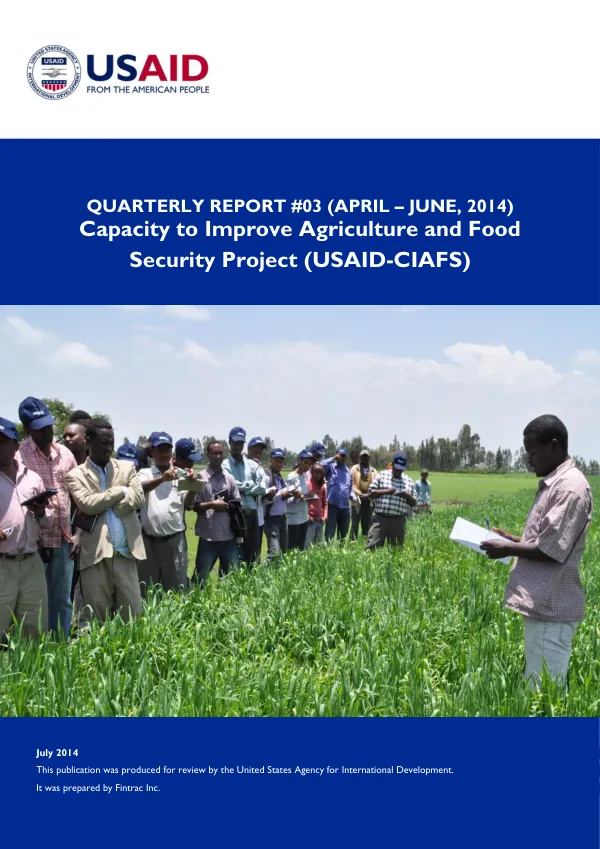
Quarterly Report #03 (April – June, 2014) Capacity to Improve Agriculture and Food Security Project (USAID-CIAFS)
Sign inFINTRAC
Quarterly Report #03 (April – June, 2014) Capacity to Improve Agriculture and Food Security Project (USAID-CIAFS)
The Capacity to Improve Agriculture and Food Security (USAID-CIAFS) project is an important component of USAID-Ethiopia's new multi-year strategy under the Feed the Future (FTF) initiative.
2014 · 16 pages
Sign in to readA free account is required to download.
Abstract
The objectives of FTF include increasing agricultural productivity, preserving natural resources, improving agricultural marketing, increasing the purchasing power of vulnerable households, and maximizing food security. Pursuant to this objective, USAID-CIAFS supports the Ministry of Agriculture (MoA) and regional Bureaus of Agriculture (BoAs) to build their human capital and institutional capacity for decision-making and resource use to achieve the GTP/ATP objectives by enhancing the competitiveness of private sector agribusiness associations and entrepreneurs. Key achievements in this quarter include the organization of two rounds of "Women's Entrepreneurship" trainings for 71 women entrepreneurs drawn from Addis Ababa, Oromiya, SNNPR, Tigray, and Amhara. The trainings focused on topics such as exploring and exploiting business opportunities, business management and communication, the enabling environment, and conducting successful Public-Private Dialogues (PPDs). A total of 111 mid-level leaders from the MoA, Amhara, and Tigray regional BoAs participated in the leadership training organized in two rounds. Participants included process coordinators, agricultural experts, case team coordinators, directors, researchers, extension experts, HR experts, and reform officers from various professional backgrounds. A best practices study tour to Thailand was designed for a high-level delegation of 13 leaders from the Ministry of Agriculture (MoA) to support Ethiopia's effort to transform the agricultural sector. The tour is designed to expose MoA participants to improved extension practices that can be scaled or replicated in Ethiopia. Final preparations were made to convene an international conference on "Harnessing the Potential of Biotechnology for Food Security and Agricultural Transformation in Ethiopia," which will take place August 21-22 in Addis Ababa. The conference will bring together international experts and national policymakers to explore the potential role of biotechnology to improve agricultural production and food security in Ethiopia. Nine short videos (10-12 minutes) were produced that leverage lessons learned in the USAID-CIAFS best practices study tour to promote a range of topics, such as the cultivation of improved varieties of wheat and teff, soil conservation and management, and milk/dairy production. The videos will be provided to the Ministry of Agriculture to improve dissemination of best practices to farmers and to strengthen advocacy to service providers and policymakers. A field assessment was conducted that produced 10 cases of successful scale-up of new practices such as water harvesting, integrated watershed management, and agriculture practices. Quantitative and qualitative data were collected from trained agents of change and participants in study tours using population survey techniques and started data sets in collaboration with the HO office M&E team. A draft of the preliminary findings was completed. The Women Entrepreneurship Development Program was organized for women agribusiness operators, which were provided in two rounds in April and May 2014. The Capacity Building of Women Entrepreneurs program was developed to address capacity gaps among women engaged in small and medium businesses in Ethiopia and of Women Entrepreneurs Associations, the main institutions that support them. The program is strengthening the ability of women entrepreneurs under program Objective One – strategic capacity building activities for key agents of change. The first round of the training was provided to 41 women entrepreneurs drawn from Addis Ababa, the Oromiya, and SNNPR region's agribusiness sector. The second round of the training was provided to 30 women entrepreneurs drawn from Addis Ababa, the Oromiya, and SNNPR region's agribusiness sector. The Capacity to Improve Agriculture and Food Security (USAID-CIAFS) project is working to enhance the competitiveness of private sector agribusiness associations and entrepreneurs in Ethiopia. The project is supporting the Ministry of Agriculture (MoA) and regional Bureaus of Agriculture (BoAs) to build their human capital and institutional capacity for decision-making and resource use to achieve the GTP/ATP objectives. The project is also providing monitoring and evaluation (M&E) related support, including data quality assessments (DQAs) to FTF partners and the USAID Mission to measure project performance across the primary regions of Tigray, Amhara, Oromiya, and Southern Nations, Nationalities and Peoples (SNNPR).
Related documents