USAID DEC
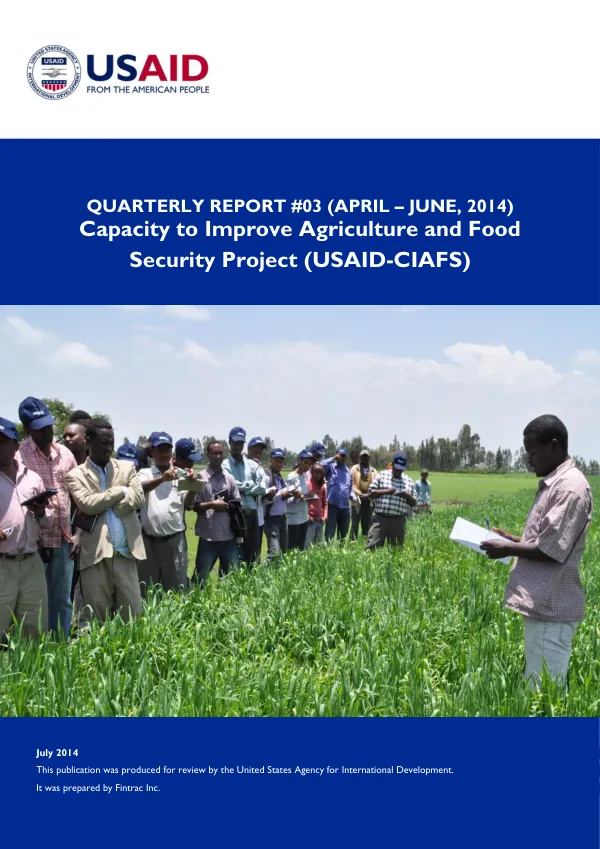
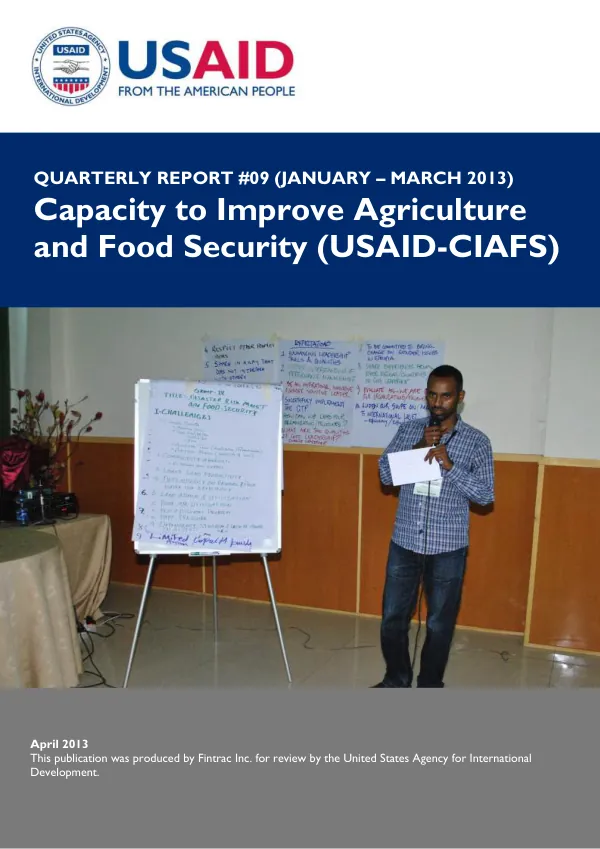
Quarterly Report #09 (January – March 2013) Capacity to Improve Agriculture and Food Security (USAID-CIAFS)
Sign inFINTRAC
Quarterly Report #09 (January – March 2013) Capacity to Improve Agriculture and Food Security (USAID-CIAFS)
The Capacity to Improve Agriculture and Food Security (USAID-CIAFS) project supports Ethiopia's efforts to transform its agricultural sector and improve food security for the Ethiopian people.
2013 · 18 pages
Sign in to readA free account is required to download.
Abstract
The project provides targeted training and raises awareness of best practices in agricultural development to empower leaders to catalyze change, drive growth, and reduce poverty. Since its inception in 2011, the project has carried out needs assessments and designed and implemented tailor-made training programs on leadership, entrepreneurship, and competitiveness to the public and private sectors and civil society leaders and professionals. The impact assessments conducted for both public- and private-sector trainings indicated the project's capacity building activities were achieving results. Trainees attributed increased incomes, streamlined administrative procedures and communications, and the development of innovative solutions to address bottlenecks directly to the project's interventions. During the quarter, USAID-CIAFS provided monitoring and evaluation support for Feed the Future (FTF) partners to track agricultural indicators critical to Ethiopian food security. The project implemented the following major activities: leadership training to 66 agents of change from the federal Ministry of Agriculture (MOA) and Tigray Bureau of Agriculture, food and nutrition security leadership training to 54 CBO/NGO leaders, activation of a network of CIAFS-trained agents of change, analysis of the seed certification process, dissemination of contract farming study, and organization of the fifth quarterly FTF partner coordination meeting. USAID-CIAFS builds the institutional capacity of government, trade associations, civil society, and other stakeholders to improve Ethiopia's agricultural production and productivity. The project serves as a foundational platform to support other USAID/Ethiopia Feed the Future programs to achieve the ambitious targets of this US government initiative. Objectives of FTF include increasing agriculture productivity, preserving natural resources, improving agricultural marketing, increasing the purchasing power of vulnerable households, and maximizing food security. The project implements activities focused in four main technical components: strategic capacity building, analytical studies, technology and best practice dissemination, and M&E support. Its geographic coverage includes the Amhara, Oromia, SNNP, and Tigray regions. Year three work plan activities include leadership training for the Ministry of Agriculture at federal and regional levels, competitiveness training for agribusinesses, leadership and entrepreneurship training targeted to women business owners, and identification and dissemination of Ethiopian and international best practices for climate change adaptation and agricultural transformation. The project's strategic capacity building activities aim to improve human and institutional capacity for sustainable agricultural productivity. This is achieved through leadership training for senior authorities from the MOA and Tigray Bureau of Agriculture. The goal of the training is to cultivate thoughtful, engaged leaders who will advocate for policy reform to improve the enabling environment and lead transformation in the agriculture sector. The project also enhances technology and best practice dissemination, management, and implementation capacity through study tours, contributes to improved agricultural policy environment through analytical studies and public-private dialogues, and enhances the monitoring and evaluation capacity of the Federal Ministry, Regional Bureaus of Agriculture, and other USAID-funded agricultural projects.