CENTER FOR EDUCATIONAL DEVELOPMENT
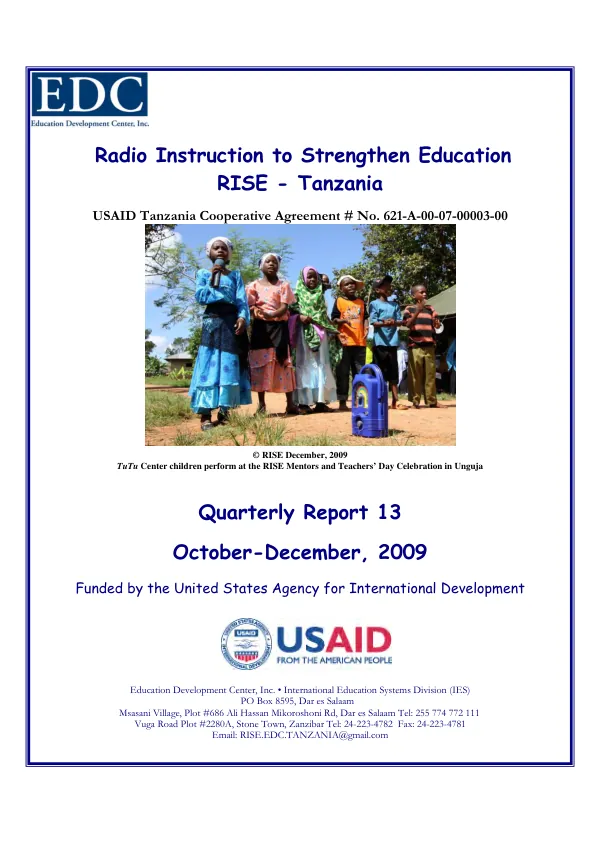
Quarterly Report 13: Radio Instruction to Strengthen Education in Tanzania
The RISE Project, Radio Instruction to Strengthen Education in Tanzania, is a USAID-funded initiative aimed at improving basic education activities for underserved children.
2009 · 54 pages
Sign in to readA free account is required to download.
Abstract
The project's core strategy is to strengthen instructional support from community and school levels to enable underserved children to achieve higher learning gains. Interactive Radio Instruction (IRI) is at the center of this strategy, guiding trained mentors and teachers who are supported by their local community and primary school. In Zanzibar, RISE will develop and/or adapt IRI programs with support materials for pre-primary and early primary, and assist communities to establish community-based Tucheze Tujifunze "Play-to-Learn" Clubs as well as pilot IRI in primary classrooms. In Mainland Tanzania, RISE will assist isolated communities, specifically pastoralist and coastal villages, to establish Mambo Elimu Community Learning Centers (MECLC) and work with the Ministry of Education and Vocational Training (MoEVT) to introduce IRI into government primary schools. The project is currently being carried out collaboratively with district education officials in remote and underserved areas of Mainland Tanzania (3 districts) and Zanzibar (3 districts), reaching disadvantaged children with the support required to enroll in school, stay in school, and complete their primary education. The project's objectives are to increase learning opportunities for pre-primary and primary-aged children, increase access to learning for underserved children, and provide selected strategic support for sector policy reforms. In Zanzibar, technical activities are being implemented through the TuTu Center, which provides production and activities for community sensitization, mobilization, and materials development. The center also offers training for mentors, teachers, and school management committees, as well as English language teaching programs through video. In addition, attendance and center development are being promoted through various initiatives. On the mainland, technical activities are being implemented through the Mambo Elimu program, which provides non-formal activities for underserved children. The program also offers training for mentors, teachers, and school management committees, as well as attendance and center development initiatives. The project is also working with the Ministry of Education and Vocational Training to introduce IRI into government primary schools. The project's monitoring and evaluation activities are being carried out through the Project Performance Monitoring Plan (PMP), which tracks progress towards the project's objectives. The project is also working with government partners to strengthen education systems and promote education for all.