CNFA, INC.
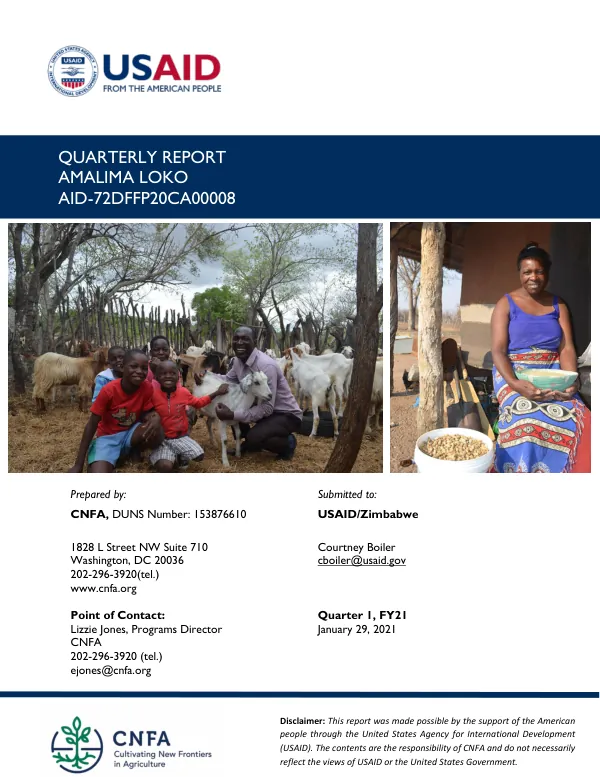
Quarterly Report: Amalima Loko Resilience Food Security Activity
The Amalima Loko program is a 5-year Resilience Food Security Activity implemented by CNFA as the prime implementer, in partnership with the Organization of Rural Associations for Progress (ORAP), Dabane, Mercy Corps, International Medical Corps (IMC), and The Manoff Group.
2021 · 11 pages
Sign in to readA free account is required to download.
Abstract
The program aims to improve food and nutrition security for over 67,000 vulnerable households in rural Zimbabwe through increased food access and sustainable watershed management. The program operates in 87 wards across Tsholotsho, Nkayi, Lupane, Binga, and Hwange districts of Matabeleland North province. The program began on October 1, 2020, and the first quarter of the program focused on operational start-up and the Refinement process. The Amalima Loko team made substantial progress in establishing a strong foundation for the project, including identifying information gaps, refining the theory of change (TOC), and conducting procurement. The team also established Covid-19 mitigation practices, introduced the project to district government stakeholders, and advanced sub-agreements with partners. The program's technical focus in the first quarter was on preparations for the upcoming Gender Youth and Social Dynamics and Inception Workshops in Q2. The headquarters and field teams worked closely with Program Cycle Support (PCS) and BHA to gain an understanding of the R&I process. The Amalima Loko team reviewed TOC training materials and conducted a detailed review and refinement process for the program's TOC based on recommendations from PCS and BHA. Dabane conducted GIS and Remote Sensing desk studies for the Nkayi Phase 1 Clusters, producing and analyzing maps depicting land use, vegetation, soil, erodibility, and household density to identify hazards and factors that influence soil erosion in the clusters. Dabane also conducted desk research on weather data for the Nkayi Phase 1 clusters to better understand cause-and-effect linkages between rainfall/runoff/evaporation. All program partners made substantial progress in the first quarter on recruitment, staff onboarding, and operational start-up, including office space, procurement, and finance. The COP and HQ management team reviewed the Amalima Loko cooperative agreement together with the CNFA Awards and Compliance Unit to ensure that all parties have a thorough understanding of the regulations and specific requirements. CNFA's standard operating manuals and templates were tailored based on the local context and award requirements and were reviewed by a local lawyer as appropriate. The Amalima Loko team recruited and engaged key management, operations, and technical staff, with all key personnel engaged by the end of Q1, with the exception of the CLA Lead. The CLA Lead candidate was submitted for key personnel approval in Q2. CNFA signed a short-term lease agreement for use of the former Amalima office, and a long-term lease agreement will be finalized in Q2. ORAP identified office spaces for the smaller satellite offices of Binga and Nkayi, and a warehouse in Binga. The program faced challenges due to the Covid-19 pandemic, which had significant short and long-term impacts in Zimbabwe and globally. The Amalima Loko team made progress during this period, while protecting the health and safety of staff, through a combination of remote working, limited traveling with safety protocols in place, and limiting capacity in the Bulawayo office. The team also faced challenges in finding facilities for the larger offices in Lupane and Hwange, despite several visits by the CNFA operations and commodities team and the COP. The program's progress in the first quarter laid the foundation for the upcoming Inception Workshop and advancing planning for pilot activities and scopes of work for Refinement studies. The team's efforts in refining the TOC, identifying information gaps, and conducting procurement will support the program's goals of improving food and nutrition security for vulnerable households in rural Zimbabwe.
Related documents