FHI 360
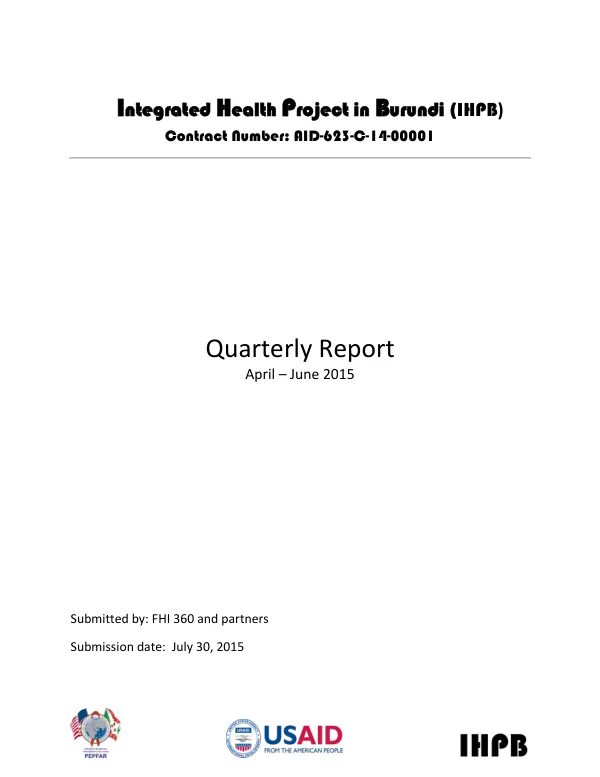
Quarterly Report: April – June 2015, Integrated Health Project in Burundi (IHPB)
The Integrated Health Project in Burundi (IHPB) is a USAID-funded initiative aimed at improving health outcomes in Burundi.
2015 · 45 pages
Sign in to readA free account is required to download.
Abstract
The project began in 2014 and is implemented by FHI 360 in partnership with local organizations. The project's primary objective is to increase access to quality integrated health and support services, particularly for vulnerable populations. The project is divided into three clinical lines (CLINs): CLIN 1 focuses on increasing positive behaviors at the individual, household, and community levels; CLIN 2 aims to increase the use of quality integrated health and support services; and CLIN 3 seeks to strengthen health systems and capacity. Within these clinical lines, several sub-clinical interventions are implemented to address specific health issues, such as maternal and newborn health, reproductive health, HIV/AIDS, malaria, and child health. One of the key strategies employed by the project is the Progressive Results-Based Financing (PBF) scheme, which provides incentives to health facilities for achieving specific health outcomes. The project also works with provincial and district health bureaus to strengthen district-level capacity and performance in managing the decentralized health system. Additionally, the project provides technical assistance to help strengthen the Burundi PBF scheme. The project places a strong emphasis on community-based initiatives, including the establishment of community-based organizations (CBOs) and the training of community health workers (CHWs). These initiatives aim to increase access to health services, particularly for marginalized populations, and to promote positive health behaviors. The project also focuses on strengthening health systems and capacity, including the development of data management systems and the provision of technical assistance to health facilities. The project's monitoring and evaluation (M&E) framework is designed to track progress towards project objectives and to identify areas for improvement. In terms of geographic focus, the project is implemented in all 18 provinces of Burundi, with a particular emphasis on the most vulnerable populations. The project's timeframes are aligned with the Burundian government's health sector plan, which aims to achieve significant improvements in health outcomes by 2025. The project's implementation is overseen by a project management unit, which is responsible for coordinating project activities, monitoring progress, and providing technical assistance to project staff. The project also engages with civil society organizations (CSOs) and international non-governmental organizations (INGOs) to leverage their expertise and resources in support of project objectives. Overall, the IHPB project represents a significant investment in Burundi's health sector, with a focus on improving access to quality integrated health and support services, particularly for vulnerable populations. The project's emphasis on community-based initiatives, health systems strengthening, and data-driven decision-making positions it well to achieve its objectives and contribute to improved health outcomes in Burundi.