FHI 360
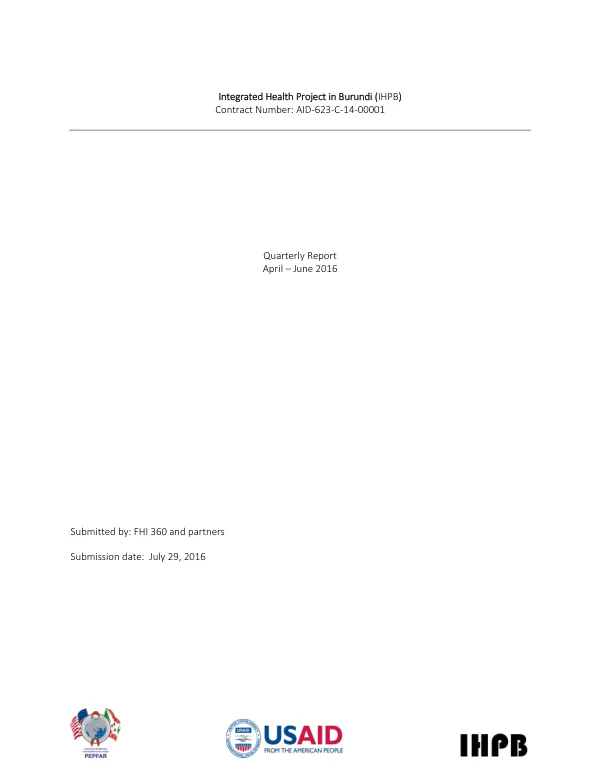
Quarterly Report: April – June 2016, Integrated Health Project in Burundi (IHPB)
The Integrated Health Project in Burundi (IHPB) is a USAID-funded initiative aimed at improving health outcomes in Burundi.
2016 · 73 pages
Sign in to readA free account is required to download.
Abstract
The project began in 2015 and is implemented by FHI 360 in partnership with local organizations. The project's primary objective is to increase access to quality health services, particularly for vulnerable populations, and to strengthen the country's health systems. The project focuses on three main clinical areas: CLIN 1, CLIN 2, and CLIN 3. CLIN 1 aims to increase positive behaviors at the individual, household, and community levels. This is achieved through improved key behavioral pre-determinants, increased accessibility and availability of health products, and strengthened support for positive gender norms and behavior. Sub-CLIN 1.1 involves improving key behavioral pre-determinants, such as increasing the use of modern family planning methods and improving maternal and child health practices. CLIN 2 focuses on increasing the use of quality integrated health and support services. This is achieved through increased access to health and support services within communities, increased percent of facilities that provide quality integrated health and support services, and increased capacity of providers and managers to provide quality integrated health services. Sub-CLIN 2.1 involves increasing access to health and support services within communities through community strengthening and health promotion activities. CLIN 3 aims to strengthen health systems and capacity. This is achieved through strengthened decentralized health care and systems in targeted geographic areas, strengthened M&E and data management systems at the facility and community levels, and increased civil society capacity to support positive behaviors and quality integrated services. Sub-CLIN 3.1 involves strengthening decentralized health care and systems in targeted geographic areas through the establishment of health management committees and the provision of technical assistance to health facilities. The project also focuses on priority health domain strategies, including maternal and newborn health, reproductive health, HIV/AIDS, malaria, and child health. The project's innovation study involves the pilot of integration of prevention of mother-to-child transmission (PMTCT) and early infant diagnosis (EID) of HIV into routine newborn and child health care. The project has also made significant progress in reducing malaria cases and improving maternal and child health outcomes. The project's success is attributed to the strong partnership between FHI 360 and local organizations, as well as the commitment of the Government of Burundi to improving health outcomes. The project's achievements are a testament to the effectiveness of integrated health projects in improving health outcomes and strengthening health systems in resource-constrained settings.