ADRA
Quarterly Performance Report: Second Quarter: January-March 2020
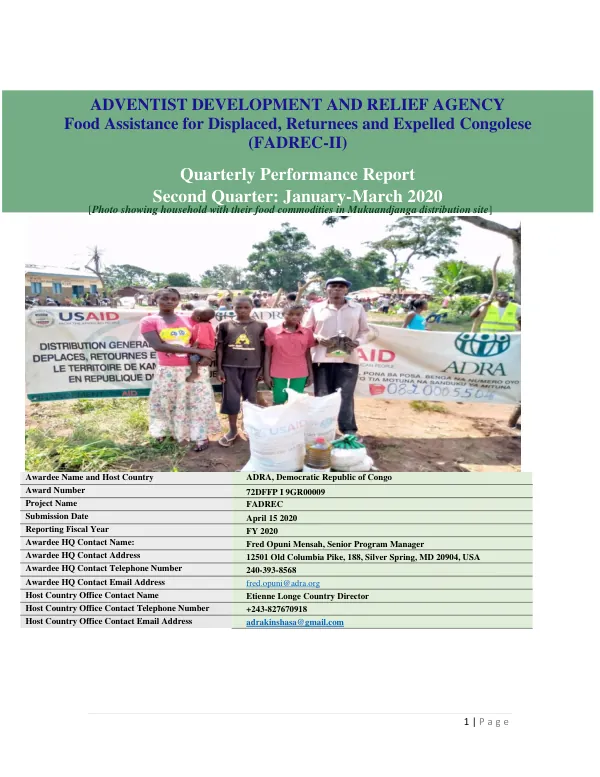
The Food Assistance for Displaced, Returnees and Expelled Congolese (FADREC) project is being implemented by ADRA in the western part of the Democratic Republic of Congo.
2020 · 20 pages
Sign in to readA free account is required to download.
Abstract
The intervention is taking place in Kamonia territory in Kasai Province, with the aim of alleviating people from hunger. The program targets Congolese who are returning from Angola, internally displaced persons, and the host community experiencing food insecurity. The number of new returnees and internally displaced persons is decreasing, but people are still struggling to access food due to inadequate agricultural practices. From January to May 2020, 495,548 people in Kamonia are projected to be at IPC phase 3 (crisis) and phase 4 (emergency) levels of food insecurity, representing 50% of the population. Many returnees have lost assets, leaving them without means for livelihoods or subsistence farming. Flooding in East-Central DRC has disrupted the latest agricultural cycle for maize and groundnuts, resulting in a below-average harvest. Looting and disease are also reducing livestock production. The FADREC-II project is continuing with the distribution of food commodities and agricultural seeds and tools in five health areas that have been majorly affected and are hosting a significant number of returnees from Angola. A total of 102,150 vulnerable beneficiaries are targeted to benefit from the intervention, including 63,000 old beneficiaries transitioning from FADREC-I to FADREC-II. This cohort of beneficiaries will receive half ration with the addition of agricultural seeds and tools. The project will identify 39,150 new beneficiaries who will receive the full ration and agricultural seeds and tools. During the second quarter of 2020, the project distributed 1,3076 MT of food commodities to 13,726 households, benefiting 93,504 individuals, including 44,367 males and 49,137 females. The project also distributed 77.11 MT of agricultural seeds to 13,726 beneficiaries and 7,136 hoes. Post-distribution monitoring for phase one distribution activities was completed. The FADREC-II project aims to curb food insecurity and save lives in the Kamonia Health Zone. Beneficiaries are being provided with maize flour, yellow beans, vegetable oil, and salt, as well as receiving agricultural seeds and tools, including maize seeds, bean seeds, amaranth, spinach, onion, and cabbage. A total of 17,052 vulnerable beneficiary households (102,150 individuals) have been targeted to receive three consecutive months of food rations for the family. The project's objective is to provide emergency food assistance to affected populations in the Kamonia territory. The distribution of food commodities and agricultural seeds and tools is ongoing, with a focus on vulnerable households. The project is working to alleviate food insecurity and support the recovery of affected communities.
Related documents