USAID DEC
Quarterly Report: Feed the Future Asia Innovative Farmers Project, Year 2 Quarter 3 (April 1 – June 30, 2017)
Sign inKASETSART UNIVERSITY
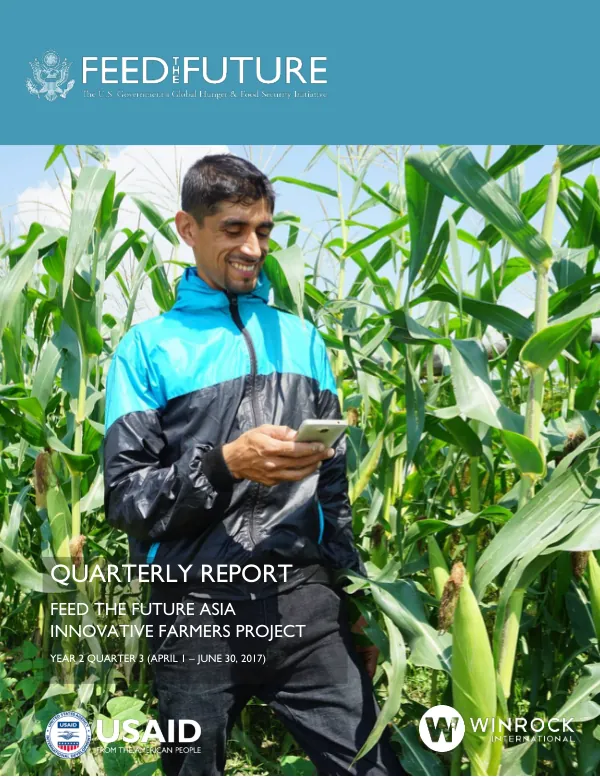
Quarterly Report: Feed the Future Asia Innovative Farmers Project, Year 2 Quarter 3 (April 1 – June 30, 2017)
Regional Agriculture Innovation Ecosystem Development is a key component of the Feed the Future Asia Innovative Farmers Activity (AIFA) project.
2017 · 31 pages
Sign in to readA free account is required to download.
Abstract
The project aims to build a diverse regional agricultural innovation community that can test, adapt, and share the latest practices and technologies with smallholder farmers in South and Southeast Asia. AIFA's goal is to empower the most promising innovators and leading early adopters, with an emphasis on youth and women. In the third quarter of 2017, the project partnered with Syngenta to support a youth-focused initiative, the Syngenta – USAID Ag Student Connections Program. The program brought together students from Nepal, Bangladesh, Cambodia, and Vietnam to Southern Vietnam for a two-week training program designed to support and mentor students on how to develop new agricultural solutions for smallholder farmers. The project also partnered with the Asia Pacific Seed Association (APSA) to support APSA's Third Experts Consultation Group meeting held in Bangkok. The meeting focused on key topic areas that will directly impact current policies and regulations regarding cross-border trade in seeds. Country participants from Bangladesh, Cambodia, Nepal, and Vietnam indicated a strong interest in participating in this effort. AIFA uses Facebook as a tool to share information and build communities. The Facebook pages of the project-supported national communities and the regional innovation Hub managed by Kasetsart University continue to attract large numbers of followers. The Tech4Farmers Asia Facebook page ballooned to 10,012 likes in this quarter, while the Shree Kisan Innovation Hub, managed by Shreenagar Farm, exceeded all initial expectations with over 30,000 likes. The project also began detailing and refining the nature of the support to the first Tech4Farmers Challenge winners. While continuing to facilitate adoption and scaling to regional markets, the project is also apparent that these companies must take full advantage of the opportunities and make the commitment to forge ahead on their own. EnerGaia is fully engaged in efforts to establish an office in Bangladesh and soon begin its first produce and buy-back contracts. Rhino Research will soon select a distributor in Cambodia for their beads and will begin a training program for staff next quarter. eFishery is currently fine-tuning their smart feeder based on KU testing results that may require a few design changes to meet local conditions. The Southeast Asia track of Fish 2.0 received an encouraging number of applications from Southeast Asia, with several new companies from the Lower Mekong region applying that had not attended the AIFA Summit. A total of 22 companies have entered the competition, with 18 moving to the next round; 9 from the Lower Mekong region and 9 from Indonesia. The project is working to strengthen Kasetsart University's capacity to become a regional innovation hub that is linked to a diverse number of local communities throughout the region. In this way, the regional community is driven by local interests and incentives (and in local languages), but is able to draw on regional diversity, experience, and expertise. The project held three activities to provide technical support to the national-level communities in addition to the grant funding. This assistance included organizational support to accelerate the communities' online presence and a visit to Kasetsart University's Research and Development (R&D) department. In Q3, the project provided social media training for HURREDO staff in Siem Reap, Cambodia. During the training, participants learned how to create a social media strategy to grow Cambodia's agricultural innovation community with an emphasis on reaching out to youth and women. Since this training, HURREDO has made impressive strides in its online community outreach strategy. This includes the following results as of writing: a video on how to germinate pepper seeds reached 23,092 people, with 9,725 video views and 567 reactions, comments, and shares; an infographic on Oriental Fruit Flies reached 12,537 people, with 384 reactions, comments, and shares; and an infographic on Paddy Rice Snail Control reached 2,096 people, with 219 reactions, comments, and shares. The team also held a similar training in Nepal and conducted a production tour to document the latest technologies transforming farmers' lives in direct collaboration with community partners. During the field visits, the team interviewed tech producers, NGO professionals, and farmers on their perceptions and experiences with using new technologies, such as pest exclusion nets and precision agriculture.