USAID DEC
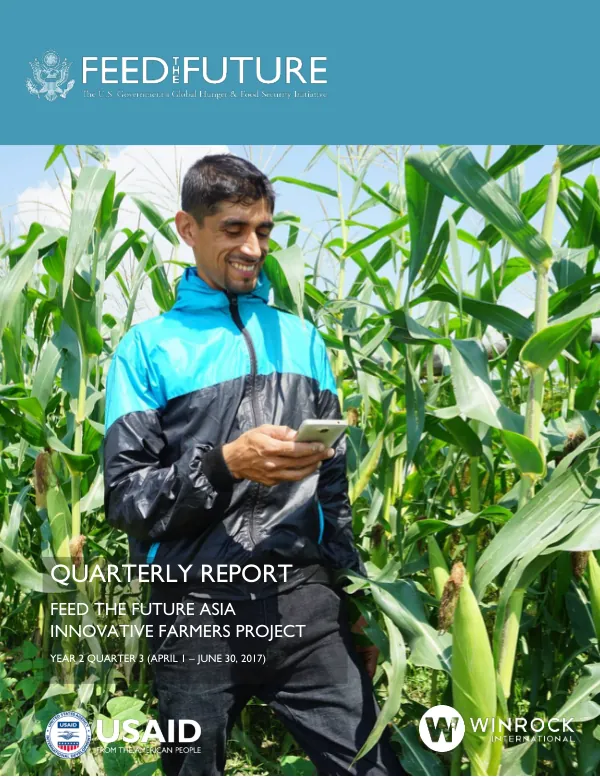
Quarterly Report: Feed the Future Asia Innovative Farmers Activity (AIFA) Year 1 Quarter 2 (January 1, 2016 – March 31, 2016)
Sign inBANGLADESH AGRICULTURAL UNIVERSITY
Quarterly Report: Feed the Future Asia Innovative Farmers Activity (AIFA) Year 1 Quarter 2 (January 1, 2016 – March 31, 2016)
The Feed the Future Asia Innovative Farmers Activity (AIFA) is a regional project aimed at facilitating the scaling of critical agricultural technologies through regional partnership and technology transfer.
2016 · 14 pages
Sign in to readA free account is required to download.
Abstract
Implemented between January 1, 2016, and March 31, 2016, AIFA's primary objective is to increase food security, reduce poverty, and improve environmental sustainability by facilitating agricultural innovation and technology diffusion in the Asia region. AIFA is comprised of four components: Horticulture-focused package of interventions, Aquaculture-focused package of interventions, Regional demand-driven packages of interventions to address food security, and Technology transfer to support USAID bilateral mission-oriented interventions. The project has made significant progress in revising its planned activities to better capitalize on its regional scope and align with USAID's division between bilateral and regional activities. The project has launched a regional challenge to solicit commercially-viable solutions for critical small holder agricultural constraints. AIFA has also revised its technology support approach, focusing on supportive research and testing of "Technology, Market and Model" to support evidence-based decision making among the private, government, and research sectors. The project has made practical progress toward objectives during this revision, including the design and organization of the Asia Regional Agricultural Innovation Summit, development of a 5-year regional exchange partnership with Syngenta and agricultural universities across the region, and MOUs developed with university partners in Feed the Future focal countries. AIFA has adopted an open innovation "challenge" approach to identify technology producers who are ready for and motivated to expand. This approach will better integrate and directly engage the regional stakeholder network, which the project is developing. The project has also significantly revised its technology support activities to ensure that regional funding is focused on the development and sharing of information that will enable evidence-based decision making. In Component 1: Horticulture-focused package of interventions, the project has made excellent progress in the implementation of activities for the "technology, market and model" research into pest exclusion nets. The project has developed MOUs with university partners in Bangladesh, Cambodia, and Nepal, and has determined crops and test locations for each country. Testing has already started in Bangladesh, and is scheduled to begin in August in Cambodia and Nepal. The project has also developed SOWs and procurement is underway.