USAID DEC
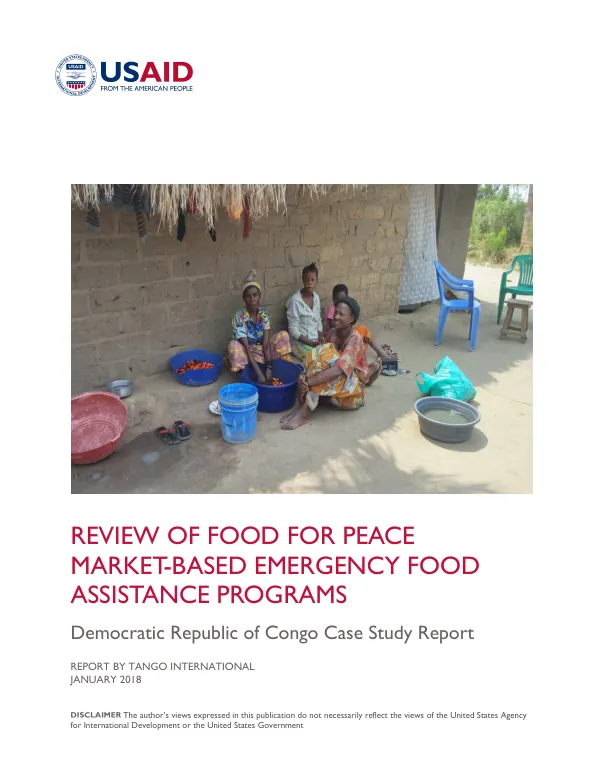
Review of Food for Peace Market-Based Emergency Food Assistance Programs: Democratic Republic of Congo Case Study Report
Sign inCATHOLIC RELIEF SERVICES ORGANIZATION
Review of Food for Peace Market-Based Emergency Food Assistance Programs: Democratic Republic of Congo Case Study Report
The Democratic Republic of Congo (DRC) continues to face high levels of conflict, political uncertainty, and poverty.
2018 · 35 pages
Sign in to readA free account is required to download.
Abstract
The country ranks very low (176 out of 188 countries) on the 2016 Human Development Index, and in 2012, 64 percent of the population was living in poverty. The continued postponement of the 2016 elections is expected to lead to escalating political crisis and livelihood interruptions. Ongoing military operations in multiple provinces along with ethnic fighting and the escape of thousands of prisoners contribute to general insecurity and violent conflict. Violence against humanitarian actors has limited non-governmental organization (NGO) access and involvement since 2008, though humanitarian funding reached a peak in DRC in 2013 at $741 million. People living in conflict-affected areas have limited access to markets and agricultural land, and agricultural production has been negatively affected over the years by challenges such as rainfall shortages, pests (e.g., fall armyworms) and disease (e.g., avian flu, cassava mosaic virus). The number of internally displaced people rose to 3.7 million in March 2017, and DRC hosts over 460,000 refugees from neighboring countries: the Central African Republic (CAR), Burundi, Rwanda, and South Sudan. Every year since at least 2009, USAID has classified DRC as a Complex Emergency and has reported regularly on the evolution of the situation through a series of factsheets, although regional armed conflict has been ongoing in eastern DRC since 1998. The DRC case study illustrates the complexity and diversity of contexts within which program design and implementation occurs. It highlights the need for provincial-scale assessments, local market monitoring, and flexibility to pivot to different modalities depending on changing contexts such as influxes of refugees from neighboring countries; sporadic inter-tribal conflict and subsequent internal displacements; seasonally poor road conditions; and insufficient mobile networks. All modalities were useful in at least some of the heterogeneous contexts, especially voucher fairs with in-kind aid (U.S.-sourced and locally and regionally purchased foods). This case also highlights collaborative programming between FFP and the United States Office of Foreign Disaster Assistance. The Food for Peace (FFP) market-based emergency programs (MBEP) in the DRC received Emergency Food Security Program (EFSP) or Title II 202(e)-enhanced funding between FY 2010 and 2016. The global review of FFP MBEP is based on FFP's guidance and award documents and partner reports; field visits to seven countries specified by FFP; and data, documentation, and information provided by FFP, implementing partners (IPs), key informants, and program beneficiaries. A consistent methodology was used across cases to allow for comparison and aggregation of findings for the Global Report. The review team conducted in-person interviews where possible; given security concerns and logistical constraints, the review team conducted some interviews remotely via Skype. Field work was conducted in the DRC from July 14–30, 2017. This case study concludes with recommendations about good practices to continue and approaches to consider modifying in the DRC. The case study provides context-specific information that relates to the global review's four main objectives: (1) establish a historical narrative about FFP market-based emergency food assistance programming between 2010 and 2016, (2) review program design and implementation processes, (3) analyze program cost-efficiency trends across a range of variables, and (4) identify developmental impacts of the projects on local economies and market actors. The DRC case study highlights the importance of flexibility in program design and implementation, particularly in contexts with changing security conditions and limited access to markets and agricultural land. The use of voucher fairs with in-kind aid was found to be effective in reaching beneficiaries in areas with limited access to markets. The case study also highlights the need for collaborative programming between FFP and other humanitarian actors, such as the United States Office of Foreign Disaster Assistance.