JHPIEGO
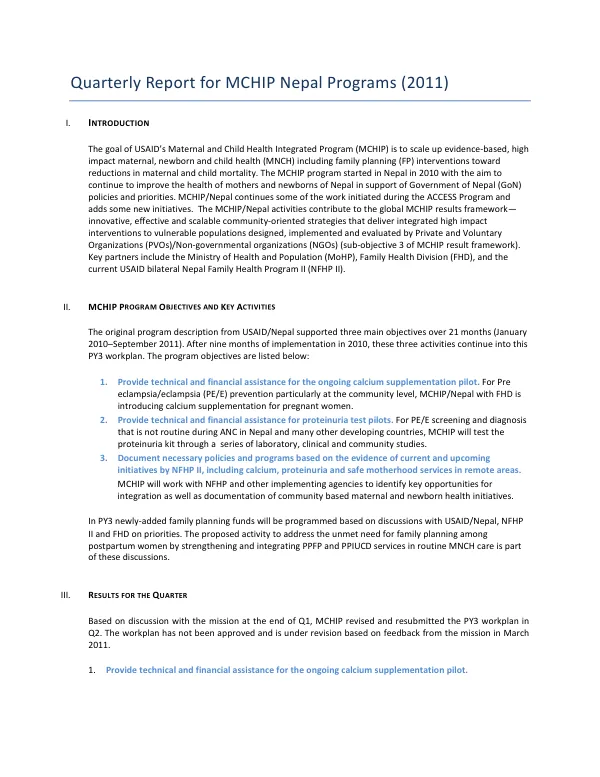
Quarterly Report for MCHIP Nepal Programs (2011)
The Maternal and Child Health Integrated Program (MCHIP) in Nepal aims to scale up evidence-based interventions to reduce maternal and child mortality.
2011 · 2 pages
Sign in to readA free account is required to download.
Abstract
The program, initiated in 2010, continues to improve the health of mothers and newborns in support of Government of Nepal policies and priorities. MCHIP/Nepal builds on the work of the ACCESS Program and introduces new initiatives, contributing to the global MCHIP results framework. Key partners include the Ministry of Health and Population, Family Health Division, and the USAID bilateral Nepal Family Health Program II. MCHIP's program objectives focus on providing technical and financial assistance for the ongoing calcium supplementation pilot, proteinuria test pilots, and documenting necessary policies and programs based on evidence. The calcium supplementation pilot aims to prevent pre-eclampsia/eclampsia through community-level interventions. MCHIP has formed a technical advisory group to advise and guide the pilot, and has pursued various options for calcium procurement, including UNICEF Nepal, Plan Nepal, and Marie Stopes International. The mission has requested identification of a calcium source by April 2011. The proteinuria test pilots aim to screen and diagnose pre-eclampsia/eclampsia through laboratory, clinical, and community studies. MCHIP has identified Koshi Zonal Hospital for the proteinuria test pilot and initiated site preparation. The mission has requested clarification on MCHIP/Nepal funding for this activity. Documentation of policies and programs on integration of community-based maternal and newborn health is also a key objective. MCHIP has participated in the formation of a MNCH Technical Advisory Group and has contributed to the development of an integration framework. MCHIP and NFHP II have worked to build consensus with FHD and NHTC on addressing unmet need among postpartum women, an effective strategy to increase family planning use. MCHIP has conceptualized an approach for introducing postpartum intrauterine contraceptive devices (PPIUCD) in existing platforms of postpartum family planning. In the coming quarter, MCHIP/Nepal will continue discussions with NFHP II, USAID/Nepal, and FHD to finalize the workplan activities and re-submit the workplan. Based on PY3 workplan approval, activities will be planned for Q3.
Related documents