GOVERNMENT OF INDONESIA
Repositioning Family Planning in Maternal and Child Health Services in India
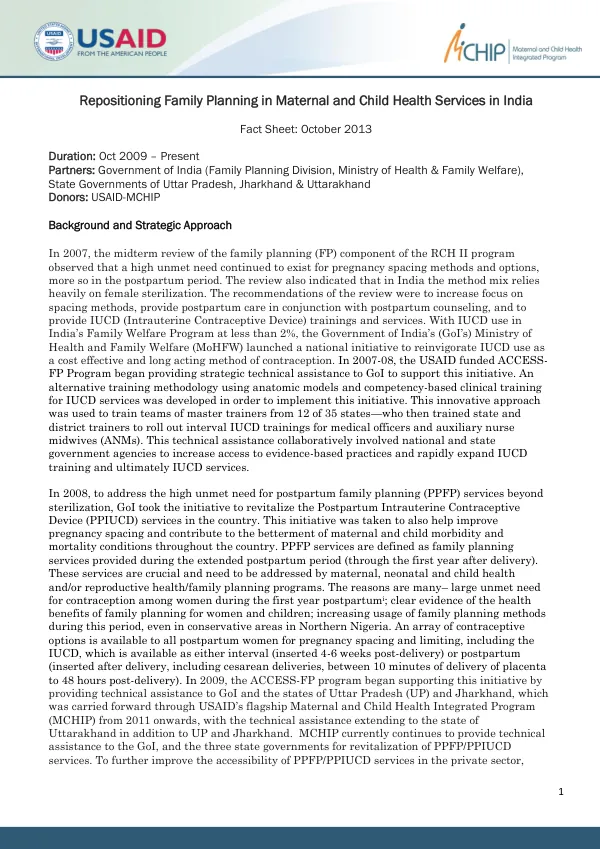
The Government of India's Family Planning Division, Ministry of Health & Family Welfare, launched a national initiative to reinvigorate Intrauterine Contraceptive Device (IUCD) use as a cost-effective and long-acting method of contraception in 2007.
2013 · 4 pages
Sign in to readA free account is required to download.
Abstract
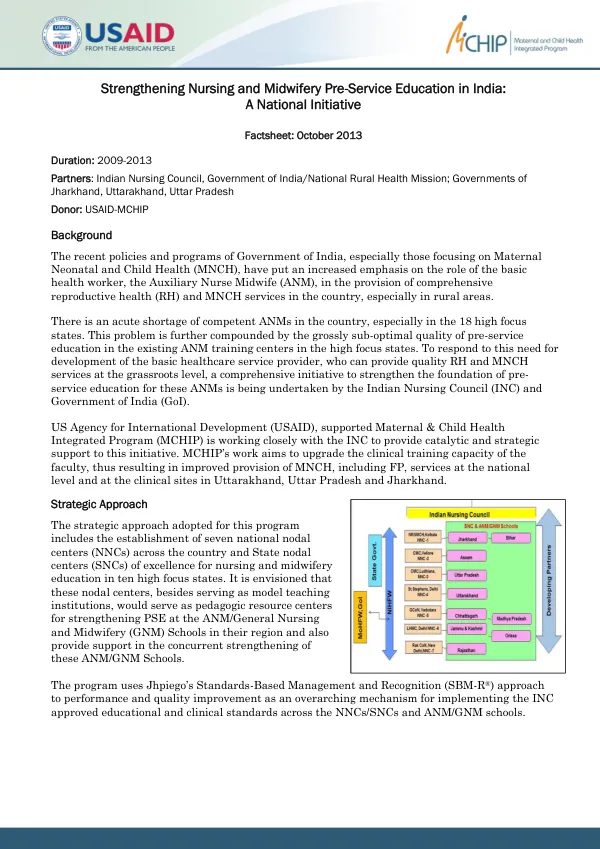
The initiative aimed to increase focus on spacing methods, provide postpartum care in conjunction with postpartum counseling, and provide IUCD trainings and services. The USAID-funded ACCESS-FP Program provided strategic technical assistance to the Government of India to support this initiative. An alternative training methodology using anatomic models and competency-based clinical training for IUCD services was developed to implement this initiative. This innovative approach was used to train teams of master trainers from 12 of 35 states, who then trained state and district trainers to roll out interval IUCD trainings for medical officers and auxiliary nurse midwives (ANMs). The technical assistance collaboratively involved national and state government agencies to increase access to evidence-based practices and rapidly expand IUCD training and ultimately IUCD services. In 2008, the Government of India took the initiative to revitalize the Postpartum Intrauterine Contraceptive Device (PPIUCD) services in the country. This initiative aimed to address the high unmet need for postpartum family planning (PPFP) services beyond sterilization, improve pregnancy spacing, and contribute to the betterment of maternal and child morbidity and mortality conditions throughout the country. PPFP services are defined as family planning services provided during the extended postpartum period (through the first year after delivery). The USAID-supported MCHIP program in India aimed to contribute to the achievement of MDGs 4 and 5 through scaling up evidence-based, high-impact maternal, newborn, child health (MNCH) including family planning (FP) interventions to improve the health of mothers and children and reduce maternal and child mortality. Recognizing the importance of the PPFP program, it is now envisioned as a critical component of the Government of India's recently launched RMNCH+A strategy—a comprehensive strategy focusing on a continuum of care approach with clear prioritization of action areas for improving reproductive, maternal, newborn, child, and adolescent health outcomes. MCHIP worked in collaboration with the Government of India to develop and finalize various materials for the PPFP/PPIUCD program, including the PPIUCD Learning Resource Package, PPIUCD BCC Material, and PPFP/PPIUCD Counseling Skills Learning Resource Package. These materials are being used to standardize the quality of PPFP/PPIUCD services and provide training to providers. MCHIP has been facilitating regular PPFP/PPIUCD clinical trainings for the staff of target facilities in Uttar Pradesh, Jharkhand, and Uttarakhand. The program has established sub-state level training sites at large delivery load facilities that have good PPFP/PPIUCD service delivery. So far, nine such sites have been established in Uttar Pradesh, four in Jharkhand, and two in Uttarakhand. After the completion of clinical trainings of these providers, MCHIP staff follows up with supportive supervision visits to provide the necessary post-training handholding and mentorship to initiate PPFP/PPIUCD services. The program has achieved significant results, with the number of women having accepted PPIUCD in the three states standing at 25,561 from March 2010 to August 2013. More than 500 providers (nurses and doctors) were trained in PPIUCD services across these states, and more than 100 facilities are providing PPFP/PPIUCD services. The average cumulative acceptance rate stands at 6.3% of the total deliveries conducted in these facilities in this period. A strong commitment to improve PPFP as a solution for improving healthy timing and spacing of pregnancy at both national and state levels, and strong advocacy and technical assistance by MCHIP has been critical to this successful implementation of PPFP/PPIUCD services.
Related documents