DEPARTMENT OF HEALTH
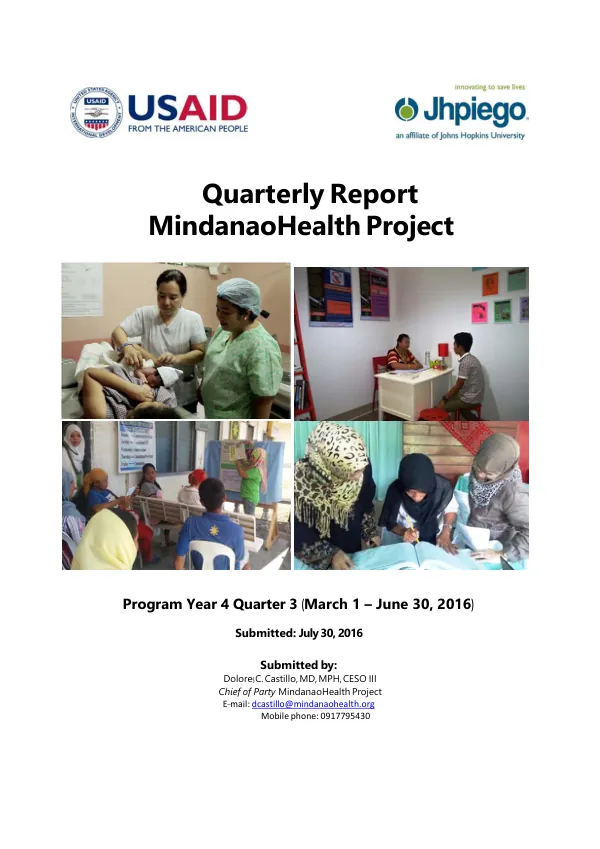
Quarterly Report: MindanaoHealth Project
The MindanaoHealth Project, a five-year initiative funded by the United States Agency for International Development (USAID), aims to improve family health in the southern Philippines by increasing the quality and uptake of integrated maternal, newborn, and child health and nutrition/family planning (MNCHN/FP) services.
2016 · 95 pages
Sign in to readA free account is required to download.
Abstract
The project is implemented by Jhpiego in partnership with RTI International and works closely with the Department of Health (DOH) to scale up high-impact services and client-centered information for Mindanao. The project focuses on improving child health and nutrition, reducing maternal and infant deaths, and decreasing unmet need for family planning services, particularly among the lowest wealth quintiles and in conflict-affected areas. To achieve this goal, the project collaborates with five DOH-regional health offices and the DOH for the Autonomous Region of Muslim Mindanao (ARMM), as well as local government units (LGUs) in 19 provinces, two cities, and 366 municipalities and component cities. During the quarter from April 1 to June 30, 2016, the project made significant progress in increasing couple years of protection (CYP) through the provision of postpartum intrauterine devices (PPIUD) and long-acting reversible contraception (LARC) services. The project also saw an increase in family planning current users, with the exception of a few provinces and cities in Zamboanga Peninsula, Davao Region, and ARMM. The project expanded its network of service delivery points (SDPs) providing family planning/reproductive health (RH) services, growing from 535 as of the end of Program Year 3 to 622, representing 96% of the Program Year 4 target. Additionally, the project achieved a slight increase in the number of women provided information on exclusive breastfeeding (EBF) and scaled up the implementation of data quality checks (DQCs) in 61 LGUs, bringing the total to 139 LGUs, equivalent to 52% of the Program Year 4 target. The project also expanded the number of SDPs providing adolescent and youth reproductive health (AYRH) services, with the number of hospitals and rural health units (RHUs) with established Center for Teens increasing from 1 as of the end of Program Year 3 to 25 as of the end of this reporting period. Furthermore, the project expanded the Adolescent Job Aids (AJA) program, which provides training and support to health workers in providing reproductive health services to adolescents and youth. The project's progress is a testament to its commitment to improving family health in Mindanao, particularly among the most vulnerable populations. The project's achievements in increasing CYP, family planning current users, and SDPs providing family planning/RH services demonstrate its effectiveness in addressing the unmet need for family planning services in the region.
Related documents