EUROPEAN UNION
Quarterly Report No. 13: October - December 2016: Promoting the Rule of Law Project
The Promoting the Rule of Law Project in Myanmar began its two-year option period in this quarter, with work focused on various justice sector actors and institutions.
2016 · 26 pages
Sign in to readA free account is required to download.
Abstract
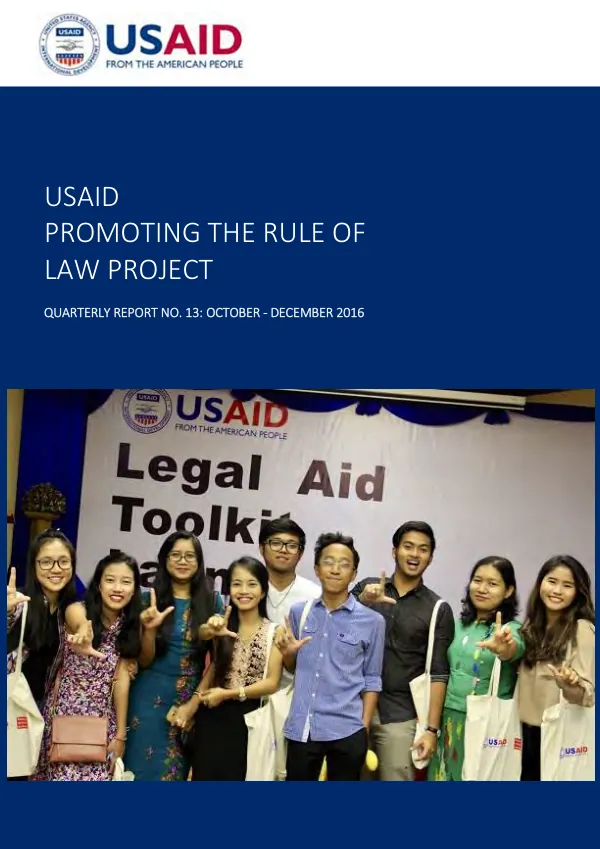
Two new areas of programming started, including activities to combat human trafficking and the design of a Union Attorney General's Office (UAGO) pilot law office program. The Project also launched a Legal Aid Toolkit, a dual-language self-education resource for Myanmar's legal aid providers. The Legal Aid Toolkit is designed to educate and assist legal aid providers in developing case analysis skills and organizational capacity. The toolkit includes skills-based topics such as case analysis, witness interviewing, trial preparation and presentation skills, and techniques on how to manage legal aid organizations. Development of a more comprehensive skills curriculum is underway and will be conducted in cooperation with other donors and projects. The Project engaged with various Myanmar counterparts to develop a comprehensive trafficking in persons (TIP) program. With the support of a former US Department of Justice prosecutor and TIP expert, the Project worked with Members of Parliament, the Office of the Supreme Court of the Union, and legal aid attorneys to introduce best justice sector practices when dealing with TIP cases. This included a roundtable with MPs on the current Myanmar TIP law, a workshop with OSCU officials on special judicial concerns in TIP cases, and training for legal aid providers working with TIP victims/survivors and defending those accused under the TIP law. The UAGO Pilot Law Office Program was approved by the Attorney General in November 2016. The Project worked with UAGO leadership to develop an implementation plan that would see USAID support continue through the life of this Project. The plan includes the creation of supervisory and program management committees, case surveys and business mappings in pilot sites, and legal framework analysis, followed by program design and a 12-month implementation period. Pilot law office sites were selected in Pyin Oo Lwin District, Chan Aye Tharzan Township, and Mawlamyaing Township. The Project continued to develop capacity among justice sector stakeholders, including the OSCU, UAGO, and civil society, to prepare each for a role in broader rule of law reform efforts. This support is highlighted here and described more thoroughly in other sections of this report. In addition to capacity building, the Project began work in a new technical area – activities to combat trafficking in persons. Myanmar was identified as a Tier 3 country in June 2016, indicating that it did not meet minimum standards defined under the US's Trafficking Victims' Protection Act. The Project supported the OSCU on data collection and analysis, with data collection and analysis continuing at the eight Project-supported pilot courts. These courts are spearheading efforts to collect and analyze data that will track court performance, identify trends in criminal and civil cases, and monitor perceptions of the justice sector. The Project continued to monitor performance of each pilot court in cooperation with the OSCU's Case Management Unit. The Project also continued to support the civil-society led Access to Justice Initiative (A2JI), which conducted its initial formal engagement with Hluttaw Ministers of Parliament and started a six-month organizational development scheme. The A2JI aims to increase legal literacy, access to justice, and the participation of marginalized populations in target regions/states. The Project's work in this quarter was focused on various objectives, including increasing the effectiveness, accountability, and accessibility of justice sector institutions. The Project continued to develop capacity among justice sector stakeholders, including the OSCU, UAGO, and civil society, to prepare each for a role in broader rule of law reform efforts. The Project also began work in a new technical area – activities to combat trafficking in persons. The Project's results framework was revised during the development of the Draft Activity Monitoring and Evaluation Plan. The revised framework includes all of the elements of the original scope of work and results framework but resolves issues of overlap and improved linkages between the scope of work and the results framework. This report is organized pursuant to the Results Framework below.