DIMAGI, INC.
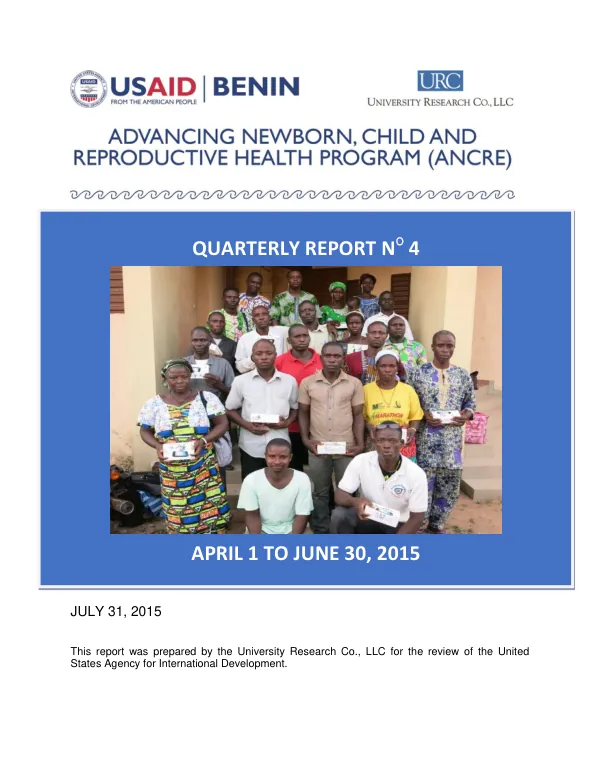
Quarterly Report No 4: April 1 – June 30, 2015
The Advancing Newborn, Child and Reproductive Health (ANCRE) program is a USAID-funded initiative implemented by University Research Co., LLC in Benin.
2015 · 57 pages
Sign in to readA free account is required to download.
Abstract
The program aims to improve public health sector performance in delivering integrated family health services. Key achievements during the April 1 to June 30, 2015, quarter include the completion of needs assessments for the Package of High-Impact Interventions (PIHI) utilization, quality, and management systems in all 10 health zones. This information will be used to develop comprehensive improvement plans for each health zone. All 10 health zones consistently reported morbidity and mortality indicators on a monthly basis, demonstrating improved planning and management of health systems and services. Health Zone Management Teams (HZMT) in all 10 zones actively engaged in scaling up and institutionalizing effective strategies, as evidenced by the reporting of quality improvement (QI) results. Analysis of collected data identified PIHI needs in the 10 priority health zones, and support was provided to the Ministry of Health to review and standardize PIHI implementation. The program also made progress in improving quality service delivery, especially for women and young children, at public health facilities. Essential commodities became more available at service product delivery points, and the program strengthened community-level contribution to health sector decisions and financing. The ANCRE program is implemented by University Research Co., LLC, with sub-recipients Dimagi, Inc. and Results for Development Institute (R4D). The program's intermediate results are aligned with the USAID/Benin's goals, focusing on improving public health sector performance, private health sector performance, and prevention and care-seeking behavior of an empowered population. The ANCRE program's achievements during the quarter demonstrate progress towards these goals, with a focus on improving health outcomes for women, children, and families in Benin. The program's implementation is supported by a range of partners, including the Ministry of Health, the National Directorate of Public Health, and the Health Zone Management Teams. The ANCRE program's quarterly report provides an update on progress towards the program's intermediate results and highlights areas for continued focus and improvement. The program's performance monitoring plan is designed to track progress towards the intermediate results, with a focus on key indicators such as morbidity and mortality rates, quality of care, and community engagement. The program's challenges and lessons learned are also documented, providing valuable insights for future program implementation. The ANCRE program's achievements during the quarter demonstrate the importance of a coordinated approach to improving health outcomes in Benin. By working with a range of partners and focusing on key intermediate results, the program is making progress towards its goals and contributing to improved health outcomes for women, children, and families in Benin. The program's geographic focus is on the 10 priority health zones in Benin, with a focus on improving health outcomes for women, children, and families in these areas. The program's timeframes are aligned with the USAID/Benin's goals, with a focus on achieving intermediate results by the end of the program. The ANCRE program's recommendations for future program implementation include continued support for the Ministry of Health to review and standardize PIHI implementation, as well as ongoing engagement with Health Zone Management Teams to scale up and institutionalize effective strategies. The program's quarterly report provides a valuable update on progress towards the program's intermediate results and highlights areas for continued focus and improvement.
Related documents