CATIE
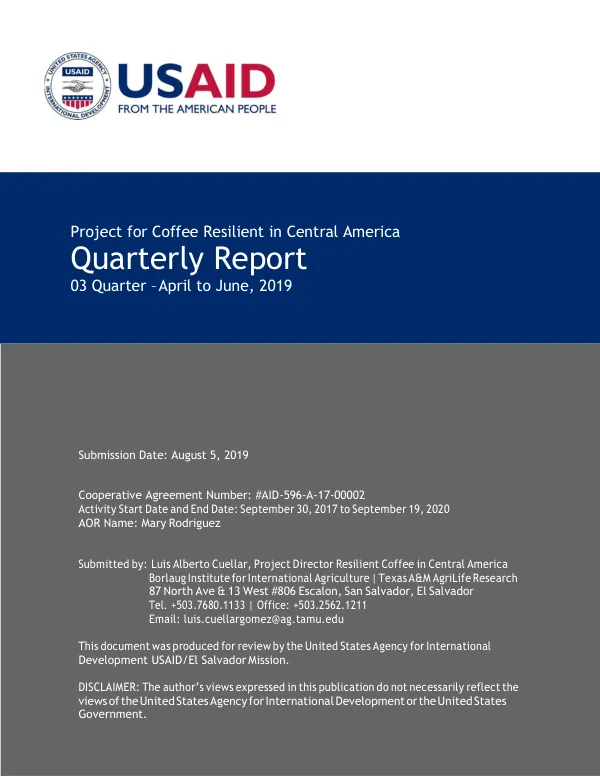
Quarterly Report: Project for Coffee Resilient in Central America
The Resilient Coffee in Central America Project is a cooperative agreement between the United States Agency for International Development (USAID) and the Norman Borlaug Institute for International Agriculture at Texas A&M AgriLife Research.
2019 · 24 pages
Sign in to readA free account is required to download.
Abstract
The project aims to improve the resilience of coffee production in Central America by promoting climate-smart coffee cultivation, disseminating resilient production and better environmental practices, and strengthening research capacities. Implementation activities for the third quarter of the fiscal year 2019, April to June 2019, focused on training producers and technicians on the protocol for implementing demonstration plots, distributing coffee plants in El Salvador and Guatemala, and establishing demonstration plots at the field level. Key results include the launch of the Coffee Cloud application in Honduras and El Salvador, with a total of 40 participants in Honduras and 112 participants in El Salvador. The application was presented to attendees, and a test of the use of the rust module application in the field was conducted. A total of 18 demonstration plots have been established in Guatemala for the fiscal year 2019, with the support of ANACAFE and producers selected by mutual agreement. In El Salvador, a total of 22 demonstration plots have been established for the fiscal year 2019, with the support of partners from organizations, individual producers, and UNEX El Salvador. An induction workshop on the use of the protocol for establishing demonstration plots was held in Honduras, involving 33 people, including technicians and producers who will implement the demonstration plots in the country. Partners have been identified for the establishment of 21 demonstration plots for the fiscal year 2019 in Honduras, along with the sites for their implementation. At the SCA Coffee Expo 2019, ten representative samples of rust-resistant coffee varieties and hybrids were presented at the cupping panel organized by the technical team. Approximately 20 people attended the cupping event, including buyers and tasters. Two participating buyers expressed interest in knowing the farms where the promoted coffee varieties came from. The project has prioritized its efforts on training producers and technicians, distributing coffee plants, and establishing demonstration plots. The launch of the Coffee Cloud application has been a significant achievement, with a total of 152 participants in Honduras and El Salvador. The project has also made progress in establishing demonstration plots in Guatemala and El Salvador, with a total of 40 plots established in Guatemala and 22 plots established in El Salvador. The project has received support from various partners, including ANACAFE, UNEX El Salvador, and the Regional Climate Change Program implemented by CATIE. The project has also received interest from buyers and tasters at the SCA Coffee Expo 2019, with two participating buyers expressing interest in knowing the farms where the promoted coffee varieties came from. The project's efforts to promote climate-smart coffee cultivation and disseminate resilient production and better environmental practices are expected to improve the resilience of coffee production in Central America.
Related documents