ROBERT NATHAN ASSOCIATES
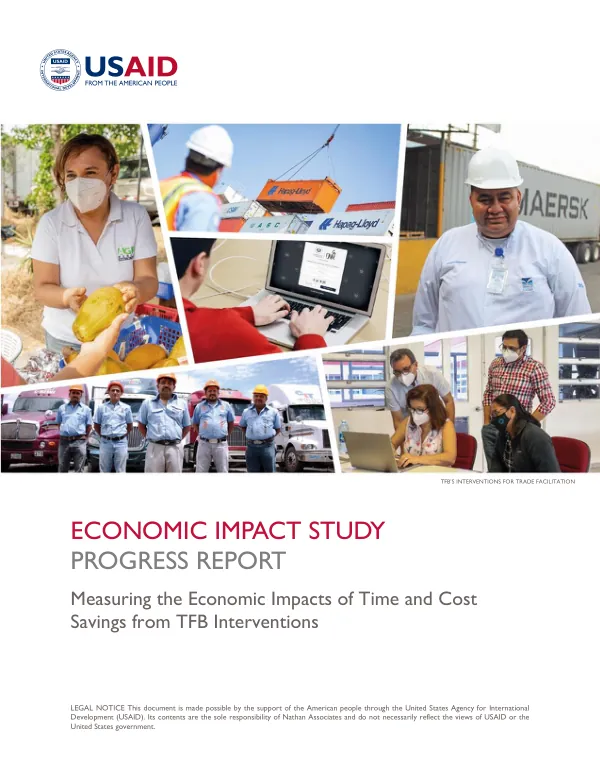
Economic Impact Study – Progress Report
The Regional Trade Facilitation and Border Management Project (TFB) aims to strengthen the trade capacity and competitiveness of Central American countries by implementing activities that improve border management and facilitate trade.
2021 · 35 pages
Sign in to readA free account is required to download.
Abstract
To achieve this goal, TFB works with key regional and national institutions, including Customs agencies, health registry authorities, Ministries of Economy, Health, and Agriculture, and representatives of the private sector in El Salvador, Guatemala, and Honduras. TFB focuses its activities on reducing the time and cost of trading across borders. To this end, the project works to implement measures with Customs authorities that optimize border processes and with other regulatory authorities to develop sanitary and phytosanitary electronic certifications. TFB also works with individual companies and trade associations to strengthen the private sector's application of border crossing practices. Additionally, the project seeks to reduce the time companies spend to obtain a sanitary registration of pharmaceutical products, food, and beverages, and increase the number of registered products by streamlining and automating sanitary registration procedures. The purpose of this study is threefold. First, it will identify the key TFB interventions whose impact on time and cost are to be measured based on their importance/priority, scale, and scope. In this progress report, priority has been given to selecting TFB interventions in El Salvador, with selected activities for Guatemala and Honduras to be included in the final study. As a second step, the impact of reductions in time and cost to trade resulting from these TFB activities on inter-regional and global trade for the three countries will be estimated. Finally, the economic activity (GDP, investment, employment) in El Salvador, Guatemala, and Honduras that can be attributed to increased international trade will be estimated. The study is organized in three stages: literature review, survey/interviews with various stakeholders, and identifying top sectors for import and export. Preliminary findings show the expected increase in trade volumes if TFB indicators are achieved. The TFB activities selected for this study are focused on streamlining the document compliance and border compliance processes in El Salvador, Guatemala, and Honduras. It is targeted that these activities will result in average time savings of 30% across import, export processes, and international transit by 2023. Given the estimated relationships between time savings and imports and exports in El Salvador, Guatemala, and Honduras, an average savings of 30% in import and export process time in 2023 would result in an increase in imports and exports of 0.58% and 4.20% in these three countries, respectively. Completion of this study will allow stakeholders to draw clear linkages between projected reductions in time and cost to trade through Program interventions and how this reduction in time and cost leads to increased trade and improved macroeconomic outcomes. The TFB project has undertaken several activities that are focused on streamlining the processes for sanitary and phyto-sanitary registrations, approvals, cross-border coordination, risk management, and data security that have the effect of reducing the time and cost of trading across borders. The focus of this analysis is to quantify the effect the time savings accruing to importers and exporters from the selected TFB activities have on economic growth in these countries. Within El Salvador, the following activities have been selected for inclusion in this study: reducing time and cost to trade for companies by streamlining the document compliance and border compliance processes; reducing the time companies spend to obtain a sanitary registration of pharmaceutical products, food, and beverages; and increasing the number of registered products by streamlining and automating sanitary registration procedures.