USAID DEC
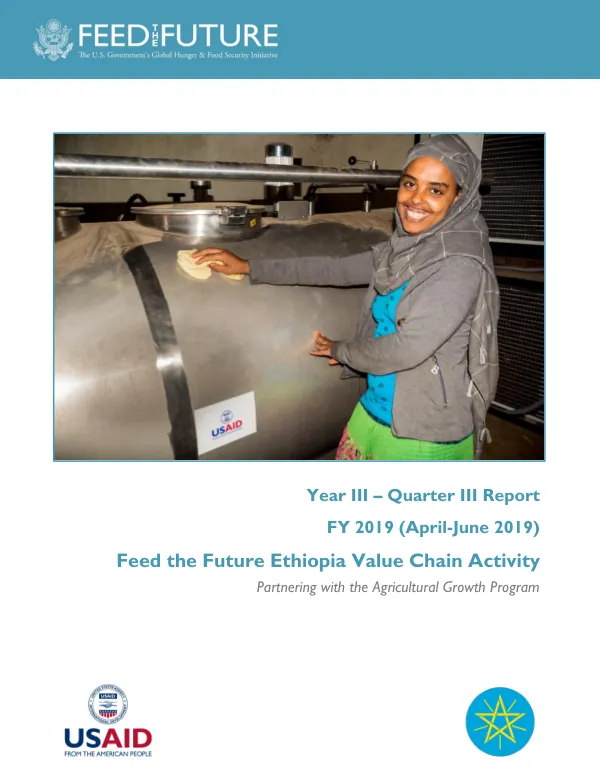
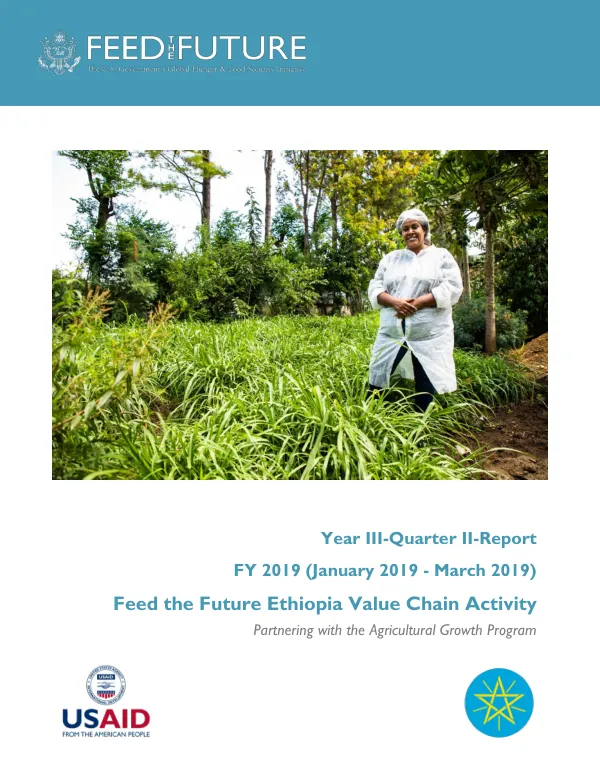
Year III-Quarter II-Report FY 2019 (January 2019 - March 2019) Feed the Future Ethiopia Value Chain Activity
Sign inUSAID
Year III-Quarter II-Report FY 2019 (January 2019 - March 2019) Feed the Future Ethiopia Value Chain Activity
The Feed the Future Ethiopia Value Chain Activity, partnering with the Agricultural Growth Program, aims to improve agricultural productivity and income for smallholder farmers in Ethiopia.
2019 · 40 pages
Sign in to readA free account is required to download.
Abstract
The activity focuses on six value chains: dairy, meat and live animals, maize, chickpea, coffee, and poultry. These value chains are critical to the Ethiopian economy, with dairy and coffee being major export commodities. In the dairy value chain, the activity is working to improve milk processing facilities and training milk suppliers on good agricultural practices. Marketing efforts are also underway to increase demand for dairy products. In the meat and live animals value chain, the activity is promoting commercial partnerships and technologies to improve productivity and efficiency. Marketing efforts are also being implemented to increase demand for meat and live animals. In the maize value chain, the activity is promoting postharvest technologies and low-cost technologies to reduce losses and improve productivity. Efforts are also being made to combat the fall armyworm, a major pest affecting maize yields. In the chickpea value chain, the activity is promoting commercialization and good agricultural practices to improve productivity and income for farmers. In the coffee value chain, the activity is promoting postharvest management and access to inputs to improve productivity and quality. Cross-cutting activities are also being implemented to address gender and nutrition issues. The activity is facilitating access to finance for women farmers and promoting gender awareness at trade fairs. The Transformative Household Methodology is being used to improve household income and nutrition. The activity is also working to improve capacity building, markets and commercialization, finance, and the enabling environment for smallholder farmers. Monitoring and evaluation are critical components of the activity, with tracking of direct beneficiary numbers, annual performance monitoring surveys, and semi-annual reviews by the regional AGP steering committee. Participating in the CIG assessment and learning and adaptation are also key components of the activity. Success stories from the activity are highlighted in Annex I, while Annex II provides a maize price outlook, and Annex III provides a pipeline of loan applications. Annex IV provides performance indicators, and Annex V provides a financial summary.