USAID
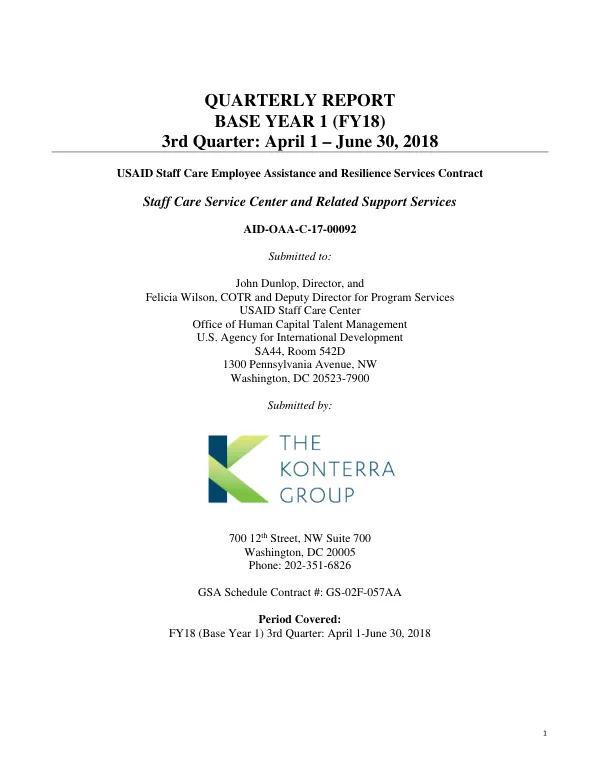
Quarterly Report: Staff Care Services Center FY18-Q3 April 1 – June 30, 2018
The USAID Staff Care Employee Assistance and Resilience Services Contract is a quarterly report for the third quarter of the base year 1 (FY18).
2018 · 18 pages
Sign in to readA free account is required to download.
Abstract
The report covers the period from April 1 to June 30, 2018. The Staff Care Services Center (SCSC) served USAID individuals 7,020 times, providing awareness raising and resources for 4,401 individuals through various channels. SCSC also provided capacity building and intervention services for 1,994 individuals to address stress, low moods, anxiety/panic, workplace conflict, and other issues. Implementation of the Staff Care services resulted in 889 work days saved, valued at $341,838. The services helped improve individual and team performance, stress, resilience, and wellbeing, job satisfaction, morale, and commitment to USAID. Utilization highlights include 3,000 Staff Care Scoop recipients in Washington and Missions each month, 1,369 staff and eligible family members (EFMs) increased their Staff Care awareness, and 935 participants in Wellness Challenges/Events and Work-Life Challenges. The top 5 concerns for counseling clients were personal stress, low/fluctuating mood, anxiety/panic, workplace stress, and difficulty concentrating. The primary reasons for emergency backup care were travel/TDY, regular care unavailable, and school closure. The program goal is to improve staff wellbeing, resilience, engagement, and productivity. The Organizational Health and Resilience Program aimed to increase capacity for resilience. Four hundred fifty-four staff participated in resilience education and training, including 274 staff in 7 Washington teams. Resilience workshops were also provided during mission engagements in USAID/Ethiopia, USAID/Malawi, and USAID/Nicaragua. One hundred eighty staff registered on DisasterReady.org, a customized set of online resources to enhance individual resilience, organizational resilience, and work-life balance. Participation in resilience workshops and DisasterReady.org resulted in improved well-being, effectiveness at work, and feeling that USAID appreciates and cares about its employees. Themes from the resilience workshops included stress and resilience in high-threat environments, remaining resilient during change/uncertainty, setting boundaries at work, and meditation, yoga, and mindfulness workshops. The Staff Care services also provided support to increase organizational and individual resilience, including 276 staff in three Missions and 8 staff in Washington. Staff Care provided Mission engagements, including organizational resilience and/or counseling support for 268 staff in three Missions. The services helped improve team cohesion and resilience, and participants reported improvements in team performance, morale, and commitment to USAID. The report highlights the effectiveness of the Staff Care services in improving staff wellbeing, resilience, engagement, and productivity. The services resulted in significant work days saved and improved individual and team performance. The Organizational Health and Resilience Program aimed to increase capacity for resilience, and participation in resilience workshops and DisasterReady.org resulted in improved well-being and effectiveness at work.