USAID DEC
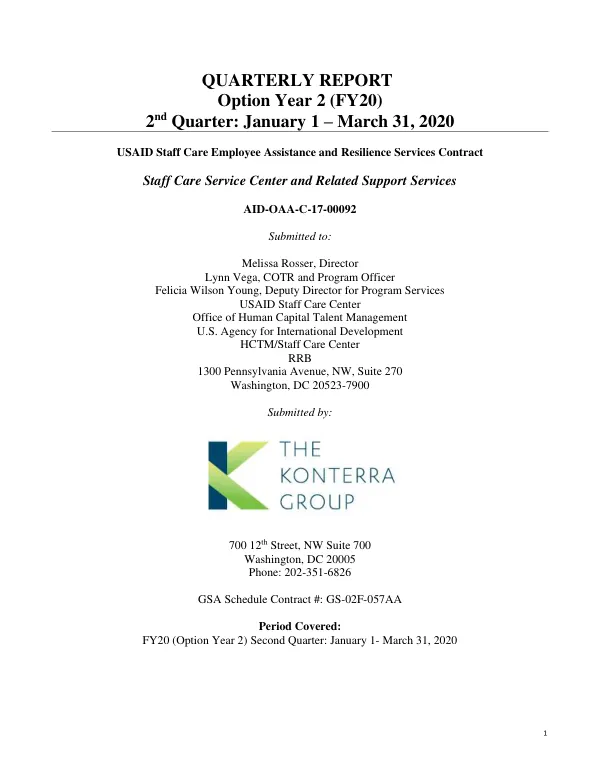
Quarterly Report FY20-Q2: Staff Care Employee Assistance and Resilience Services Contract
Sign inUSAID
Quarterly Report FY20-Q2: Staff Care Employee Assistance and Resilience Services Contract
The Staff Care Services Center (SCSC) served USAID individuals over 5,584 times during the second quarter of FY20, including a new seminar on Resilience During the Time of COVID-19 attended by 715 staff within one week.
2020 · 16 pages
Sign in to readA free account is required to download.
Abstract
SCSC promoted program awareness and education for 3,680 individuals through various channels, including the Staff Care Scoop, Staff Care overviews, and wellness and work-life promotions. Additionally, 1,174 logins to the Staff Care website were recorded for program information and resources. Implementation of SCSC services resulted in an estimated 319 work days saved, valued at $103,760. SCSC services helped improve individual and team performance, stress, resilience, wellbeing, job satisfaction, morale, and commitment to USAID. The SCSC Call Center and email were utilized by staff to access program information and resources, with 2,870 Staff Care Scoop recipients in Washington and Missions in October, November, and December. Staff Care continually adapts its services in response to staff needs and demand, including developing new offerings such as workshops and resources on stress management and resilience. Top concerns for counseling clients included emotional health, legal issues, family/relationship concerns, and workplace concerns. In contrast, top concerns for work-life clients included daily living, financial issues, and elder care. The SCSC provided support to USAID Missions in various regions, including Afghanistan and Pakistan, Albania, Burkina Faso, Haiti, Mexico, and Nicaragua. Services provided included pre-deployment resilience workshops, EAP/critical incident support, resilience VTCs, and organizational resilience TDYs. In Washington, the SCSC supported various teams, including BFS/Program Office TT, BHA/ISU, DCHA/DRG, DCHA/OAPA, E3, FEI Adaptive Leadership Program, GH/Office of Infectious Disease, and GH/PMH. Key outcomes of SCSC services included improved personal wellbeing and performance, morale, and commitment to USAID. Participants completed evaluation surveys, with 138 days from work-life services/referrals and 181 days from EAP counseling resulting in estimated savings. The results showed that 71% of survey respondents agreed or strongly agreed that they experienced improvement or expected to see improvements in personal wellbeing and performance, morale, and commitment to USAID due to SCSC services.
Related documents