FUTURES GROUP INTERNATIONAL, LLC
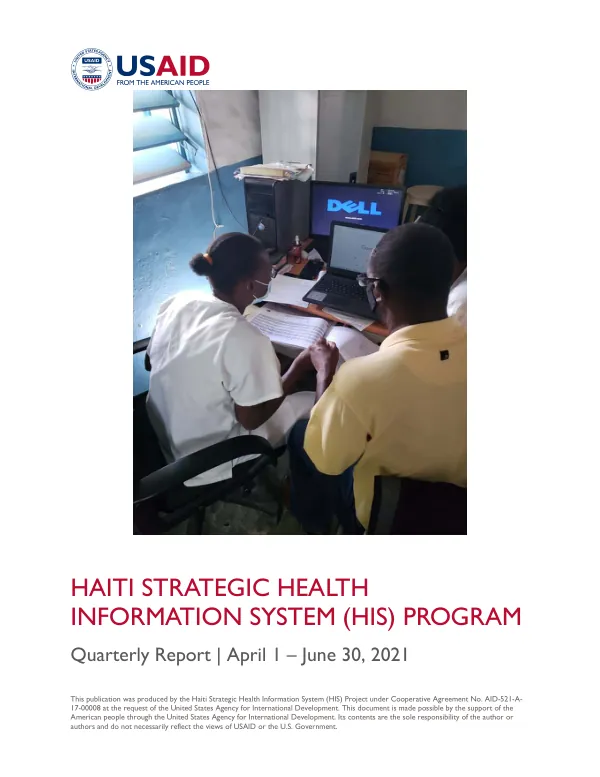
Quarterly Report: Support of Government of Haiti Strategic Information Systems
The Support of Government of Haiti Strategic Information Systems Project is a four-year cooperative agreement funded by the U.S.
2013 · 12 pages
Sign in to readA free account is required to download.
Abstract
Agency for International Development under Agreement No. AID-521-C-13-00005, beginning March 30, 2013. The project is implemented by Futures Group, in collaboration with Transversal and GSIS Haitian subcontractors, USAID, and CDC Partners. The project's primary objectives are to build strengthened and sustainable health information systems within Haiti, allowing the Haitian government to effectively manage and monitor program resources and patient outcomes. The project focuses on four key objectives: building the capacity of the Ministry of Health (MOH) in Strategic Information Systems, developing an expanded and comprehensive Carte Sanitaire platform for the Planning and Evaluation Unit (UPE), supporting the implementation of a comprehensive Health Information System (HIS), and improving data quality and applied data use within the Haitian government's data reporting chains. During the reporting period of March to June 2013, the project made significant progress in achieving its objectives. The project team held meetings with USAID, the MOH, and other stakeholders to introduce the project scope and objectives. The team also established weekly meetings with the statistics unit in the MOH and hired five staff members, including a Chief of Party, Capacity Building Manager, Operating Officer, Programmer and Analyst, and a HIS consultant. The project team conducted assessments of the existing Health Information System (HSIS) and the Carte Sanitaire platform, identifying areas for improvement and recommending changes. The team also began collaboration with the UPE in their departmental supervision activities to better understand the strengths and weaknesses of organizational reporting at all levels. Joint visits provided inputs in the information collection analysis process, serving to establish diagnostics in developing a new managerial approach for greater efficiency in data collection and data quality. The project team also made progress in developing an expanded and comprehensive Carte Sanitaire platform for the UPE, conducting an assessment of the design of the Carte Sanitaire, the system architecture, and its potential development needed to meet the challenges expressed by the Minister of Health. Work was started on a platform that will offer the opportunity to adapt the application for multiple perspectives, with a user interface prototype design begun and a presentation expected to the Minister in September. In addition, the project team supported the implementation of a comprehensive HIS, consulting previous documentation received that was produced at the MOH since 2008 and holding meetings for a better understanding of the expected HIS. The team also worked with the UPE to understand and design the diagram flow of collection tools process and recommended the building of a management unit to deal with this major logistical task. CDC and other partners are collaborating in the application of the solution to resolve these problems as they seriously impact the data quality and reporting process. The project team also established procedures for the standardization of the tools amongst service providers and developed a policy on tools management. During the next quarter, a policies and procedures manual will be drafted for data collection tools management. The team also began preparations to establishing the health indicators that will be the baseline of the data collection process, under the leadership of the UPE. The workshop will be for the MOH, the ten departments, and agency partners to establish a common definition of HIS and align the project work plan with the MOH vision of its HIS. Overall, the project made significant progress in achieving its objectives during the reporting period of March to June 2013. The project team's efforts have laid the groundwork for the development of a comprehensive HIS and the improvement of data quality and applied data use within the Haitian government's data reporting chains.