USAID. MISSION TO PHILIPPINES
Rainfed resources development project (RRDP)
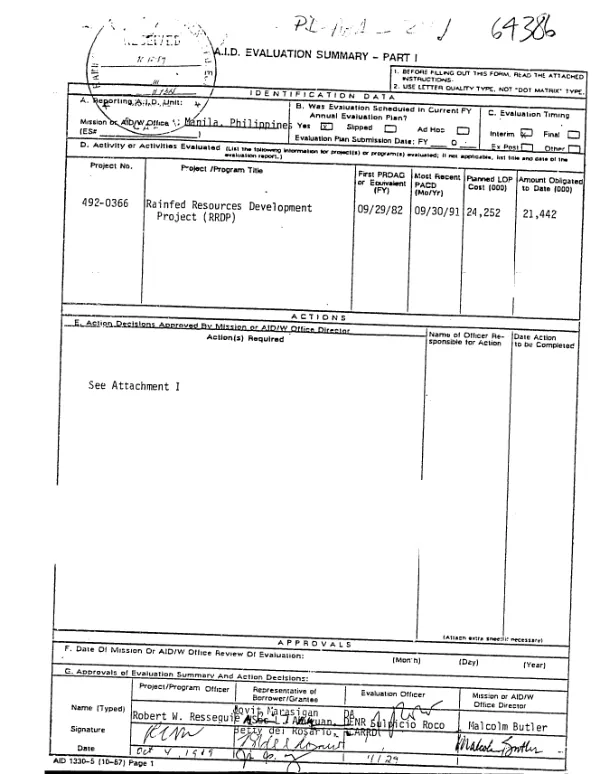
Summarizes mid-term evaluation (XD-ABA-297-A) of a project to develop the institutional capacity of the Government of the Philippines (GOP) to support land and water resource management activities in the settled upland forest, rainfed agricultural areas, and coastal zones.
1989
Sign in to readA free account is required to download.
Abstract
The evaluation covered the period 9/82-5/89. Project activities are headed in the right direction and yielding successful results, but progress has been too slow to achieve objectives by the PACD. There have been two major reasons for the implementation delays: virtually inoperable funding mechanisms and micro-management by USAID/P and the GOP. Creative measures to address the problem with funding flows are urgently needed. Moreover, the project is not improving farm incomes or the macro environment as planned, mainly because not enough funds have been committed by USAID/P to activities in the rainfed areas. The Mission is faced with the choice of (a) committing blocks of money large enough to affect the problems in rainfed areas, or (b) limiting efforts to institution building, pilot activities, and research. It is recommended that the GOP and USAID/P prepare immediately for a new initiative in denuded hillsides. The community-based approach has proved effective and is being supported by the ongoing decentralization of authority to the regions and provinces. However, the project technology - although it seems adequate - is not being adopted by farmers, and the National Research and Development Network has failed to determine why this is so. Contracting procedures are inadequate and should be improved. Two major lessons were learned. (1) The community-based approach to development planning and implementation works well for field-oriented programs. (2) There is a heavy responsibility at the initial program design stage to use the simplest procedures available in order to facilitate funds flow and preclude micromanagement.
Related documents
Documents in this collection
 1989
1989USAID DEC
RRDP : an evaluation for the Government of the Republic of the Philippines and the United States Agency for International Development/Manila
Open record 1989
1989USAID DEC