USAID DEC
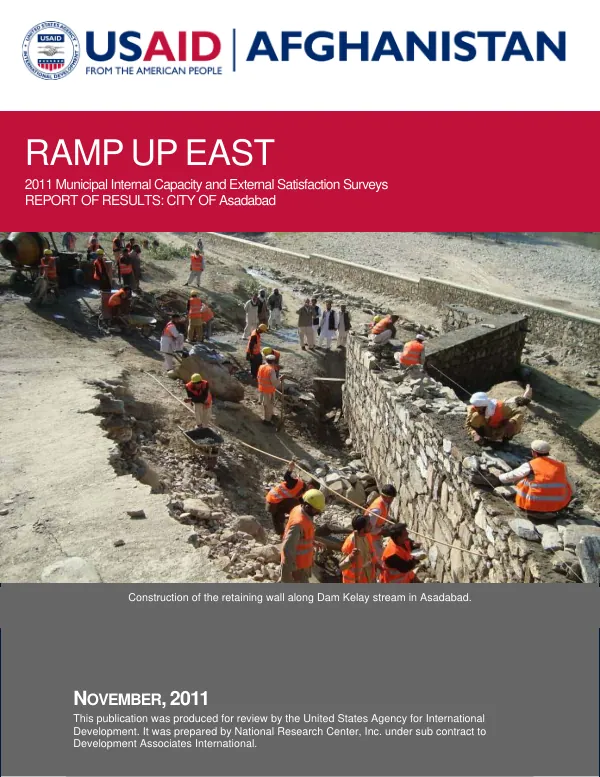
RAMP UP East 2011 Municipal Internal Capacity and External Satisfaction Surveys: REPORT OF RESULTS: CITY OF Asadabad
Sign inDAI
RAMP UP East 2011 Municipal Internal Capacity and External Satisfaction Surveys: REPORT OF RESULTS: CITY OF Asadabad
The City of Asadabad, located in the Regional Afghan Municipalities Program for Urban Populations – Regional Command East, underwent a municipal internal capacity and external satisfaction survey in 2011.
2011 · 107 pages
Sign in to readA free account is required to download.
Abstract
The survey aimed to assess the city's internal capacity and external satisfaction, with a focus on municipal governance, public works, financial management, and revenue enhancement. The city's demographics are characterized by a population of approximately 20,000 residents, with a high percentage of youth and a relatively low percentage of elderly individuals. The city's economy is primarily driven by agriculture, with a significant portion of the population engaged in farming and livestock production. The city's infrastructure is relatively underdeveloped, with limited access to basic services such as water, sanitation, and healthcare. The survey revealed that the city's municipal government has a relatively weak capacity, with limited resources and inadequate infrastructure. The municipal council meets regularly, but the frequency of meetings is not consistent. The municipality has a limited number of employees, with a high turnover rate, which affects the delivery of services. The public works department is responsible for maintaining the city's infrastructure, including roads, public parks, and latrines. However, the department faces significant challenges, including limited resources and inadequate equipment. The financial management capacity of the municipality is also a concern, with limited resources and inadequate accounting and budgeting systems. The municipality relies heavily on external funding, including grants and donations, to support its operations. The revenue enhancement capacity of the municipality is also limited, with a reliance on traditional sources of revenue, such as taxes and fees. However, the municipality has made efforts to improve its revenue collection, including the implementation of a systematic filing system and the use of computerized accounting and budgeting systems. The resident survey revealed that the quality of life in Asadabad is relatively low, with limited access to basic services such as water, sanitation, and healthcare. The survey also revealed that the city's residents are satisfied with the services provided by the municipality, but express concerns about the lack of transparency and accountability in the municipality's operations. The survey also highlighted the importance of improving the municipality's capacity to deliver services, including the provision of basic services such as water, sanitation, and healthcare. The survey results provide valuable insights into the challenges facing the City of Asadabad and highlight the need for improved municipal governance, public works, financial management, and revenue enhancement capacity. The results also emphasize the importance of improving the quality of life for the city's residents, including the provision of basic services such as water, sanitation, and healthcare.
Related documents